|
home | what's new | other sites | contact | about |
||||||||||||||||||||||||||||||||||||
|
Word Gems self-knowledge, authentic living, full humanity, continual awakening
Editor's Essay -- The Great Books, the Great Ideas, the Great Conversation
* Below, click on the opening words of each brief book synopsis:
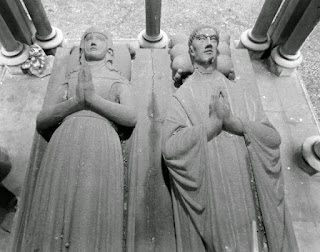
Paris tomb of Heloise and Peter Abelard, Peter (1079-1142) Sic et Non (Yes and No) -- What happens when truth is treated as something that emerges through tension of different authorities? This forces the reader into active judgment rather than passive reception of authority. (Abelard,) Heloise (c.1100-1164) Love letters collection -- The letters contain what might be the most explosive statements in all medieval love literature. Heloise refuses the shame logic imposed by society. She is effectively saying: truth of love outweighs honor, rank, and moral labeling. This collapses the entire medieval hierarchy of virtue, reputation, and legitimacy. Problemata Heloissae -- Heloise cannot simply “accept” but interrogates everything. Even after catastrophe, she does not surrender intellect. Her writings reveal a consciousness refusing a reduction into retreat, obedience, or silence. Adams, Abigail (1744-1818) -- America’s Founding Mother Selected letters -- "I am more and more convinced that Man is a dangerous creature, and that power whether vested in many or a few is ever grasping... You tell me of degrees of perfection to which Humane Nature is capable of arriving, and I believe it, but at the same time lament that our admiration should arise from the scarcity of the instances." Adams, John (1735-1826) Selected books, letters, speeches -- “Design government for human beings as they are, not as you wish they were." “Power always thinks it has a great soul." Power rarely sees itself as selfish but always justifies itself as noble, necessary, and righteous. Adams saw the central political problem as not tyranny alone but human nature itself. People seek power, status, recognition, and advantage. His writings repeatedly return to a single concern: how can liberty endure when every individual and faction – even Freedom’s advocates -- possesses motives that may eventually threaten it? Adams, John Quincy (1767-1848) Selected books, letters, speeches -- "Duty is ours; results are God's." One acts rightly because it is right, not because victory is assured. Quincy Adams spent his life confronting a paradox: America was founded on liberty, yet liberty continually generated new temptations toward empire, faction, and slavery. His writings document a mind wrestling with whether republican virtue can survive success. How can a free republic remain morally free after it becomes powerful? The stronger a nation becomes, the greater the temptation to abuse power. Character matters more than institutions which cannot permanently compensate for moral decay. Addison, Joseph (1672-1719) The Spectator -- A collection of 555 periodical essays. Mr. Spectator moves anonymously through London observing the behavior of people. Addison connects seemingly trivial subjects with larger questions of moral character, arguing that civilization is sustained through small habits rather than occasional heroic acts. Aeschylus (c.525-456 BC) The Oresteia -- Can violence ever end? Can we escape blood feud? move from primitive retaliation to institutional justice? The Persians -- When pride meets catastropic reality. The cost of hubris. Can human greatness emerge from total loss? Prometheus Bound -- Human ascent comes by willingness to suffer for the future. Civilization advances by principled disobedience, defiance against monopolies of power. Who yields first: tyranny or moral intelligence? Albee, Edward (1928-2016) Who's Afraid of Virginia Woolf? -- A married couple create illusions to survive emotional emptiness, failure, and aging. Alighieri, Dante (1265-1321) The Comedy -- The title suggests that human existence is a comedy not a tragedy: the soul's journey can end in reunion with the divine. Few works before Dante had attempted to make the entire cosmos intelligible through a single poetic journey. Anselm of Canterbury (1033-1109) Proslogion -- Can reason alone compel us to recognize ultimate reality? Anselm's famous, but unconvincing, proof of the existence of God. Aquinas, Thomas (1225-1274) On Evil -- Is the universe morally coherent? Could a perfectly good God create evil? No - therefore, evil is not created, is not a thing, but merely a privation of the good. What we call evil is a temporary classroom for beings with free will to effect something else. God’s Power -- Can an omnipotent God create logical impossibilities? - the “square circle”? No, because reality itself is rationally ordered. If omnipotence were to include contradiction, then rational thought would collapse, and the natural order would issue as chaos. God’s power is not chaotic force but the power to actualize things that have being. Logically impossible things have no ‘in potentia’ being to be actualized. Summa Theologiae -- A systematic explanation of God suggests that humans can ascend toward ultimate truth. Aquinas attempts to show that reality is intelligible, ordered, and rooted in divine rationality. The Soul -- His account of the soul is an attempt to explain what a human being is in the deepest metaphysical sense. Truth -- Aquinas taught that “truth” is a correspondence between one’s thoughts and reality (God) 'out there'. Virtues -- How do humans—pulled between desire and weakness—become ordered and capable of moral excellence, to reliably choose the good? Virtue is a deep structural alignment toward reason and ultimately toward godliness.
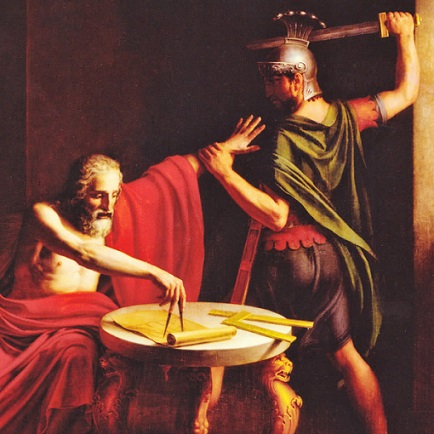
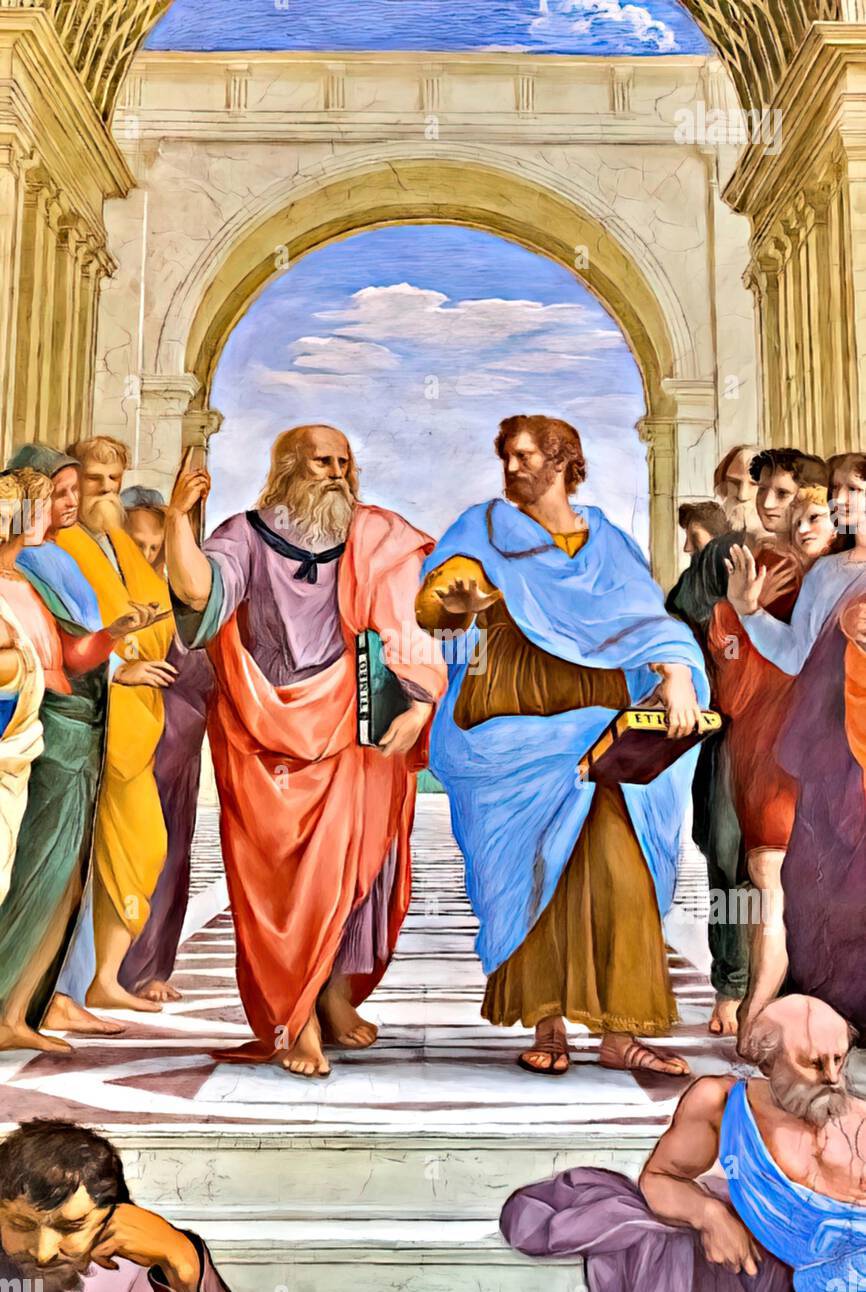
Archimedes (c.287-212 BC) Survey of major works and accomplishments -- A mind that reached modern-level ideas inside an ancient toolkit. Aristophanes (c.446-386 BC) The Birds -- This comedic play imagines a society where humans and birds collaborate to seize control of the sky, and reality itself, to challenge the power of the gods. The Clouds -- What societies do to one who undermines status quo with new ideas. They laugh at him, fear and misrepresent him. And, if they can, they destroy him. The Frogs -- Can great art rescue a civilization in decline? Can a morally and culturally exhausted society be saved by renewed emphasis on heroic art? Lysistrata (She Who Ends War) -- Women refuse sexual relations until men agree to end war. The addiction to cycles of destruction, the inertia of bellicose systems. Aristotle (384-322 BC) Categories – To know anything, first classify what it is. Reality becomes understandable when we group things, notice their features, and see how they fit together. Constitution of the Athenians – Aristotle shows how the Athenian state runs, what makes it function, and what structures best support a flourishing society. De Anima (On the Soul) – The soul makes a body do all normal functions - not a ghost in a machine, he says, but the full set of capacities that let a being grow, sense, move, and act as itself. Eudemian Ethics – Flourishing comes from practicing excellence, guided by reason, in thought and action, moment by moment, over a lifetime. Generation and Corruption – Change is about how things come into being and pass away. Things transform while underlying reality persists, revealing nature’s patterns and rhythms. Metaphysics – To truly understand a thing, see what it is, what it does, and what it's unfolding toward. Nicomachean Ethics – What is the best life possible? Can we make it an adventure and fulfilling? Happiness and human flourishing come from acting with virtue, exercising reason, and embracing life fully in every choice and moment. On Interpretation – Nature is innocent, beyond labels, but what we call 'truth' or 'falsehood' energes only when we use language. This frames reality in words, allowing us to judge, reason, and communicate. Physics – We understand nature when we see things move and change, along with their causes and effects. While our intuition experiences life directly, reason lets us trace patterns, connections, and the principles behind what happens. Poetics – Just as science uses models, art creates models of life. Through tragedy, comedy, and story, we explore happiness and suffering, meaning and purpose, gaining insight into the rhythms of human experience. Politics – Man by nature is drawn to community and fellowship. Human fulfillment grows when we live with friends, neighbors, and fellow citizens on the polis. Posterior Analytics – This is reasoning 'after' we have the blueprint for analzing, offered in "Prior Analytics". Prior Analytics – This is reasoning 'before' we look at the world, a blueprint for analysis. Rhetoric – One's discovered truth ought to be skillfully shared with others. Even so, what truly matters is not what is said but the state of soul in which it is heard.
Athanasius of Alexandria (c.296-373 AD) On the Incarnation -- Sees humanity as flawed, defective, needing repair. The Incarnation is metaphysical rescue. Augustine of Hippo (354-430 AD) Confessions -- Why is the human heart restless, and what can finally satisfy it? “The mind commands the body and is instantly obeyed; the mind commands itself and is resisted.” On Continence -- If the self is divided against itself, unable to consistently choose what's right, if I cannot fully command myself, who—or what—can make me whole? The City of God -- The book begins after the sack of Rome (410) which shattered Rome’s aura of power. Augustine answers: The true city is not Rome but God’s “city”. Aurelius, Marcus (121-180 AD) Meditations -- "You have power over your mind, not outside events. Realize this, and you will find strength." These are private notes, not intended to become a book. “At dawn, when you have trouble getting out of bed, tell yourself: I have to go to work - as a human being”. Marcus is constantly talking to himself: "Remember that death is natural." "Do not be distracted by fame." "Focus on what is under your control." "Treat others justly." Other works explained Stoicism, but this is Stoicism practiced, in real time.
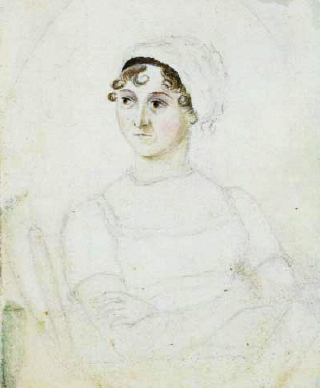
Austen, Jane (1775-1817) Emma -- Emma Woodhouse is a literary proxy for the overbearing friend or relative who attempts to run one’s life because they “know what’s best for you.” She constructs narratives about others' inner lives while failing to perceive actual motives, sufferings, or desires. Mansfield Park -- Fanny Price is physically inside Mansfield Park but socially marginal; belonging but not truly belonging. Around her, charm, performance, and social ease often substitute for integrity. A hierarchical world that rewards performance over principle. Northanger Abbey -- Northanger Abbey is less about a haunted place than about a haunted way of seeing. The “horror” is generated by Catherine Morland’s overactive imagination, shaped by her reading of sensational fiction, which distorts perceptions of reality. Persuasion -- In contrast to Emma, Persuasion completes the arc: those who believe they have the authority to persuade, versus those who unwisely allow themselves to be persuaded. This maps a more complete spectrum of epistemic failure. Both are distortions of judgment, but in opposite directions: one expands the self too far outward; the other contracts it too far inward. Pride and Prejudice -- Love's obstacle is not fate, society, or circumstance but the ego’s inability to see clearly. Human connection requires the painful collapse of ego illusions. The novel follows the course of two people who misread one another as each is trapped within a flattering interpretation of self. Sense And Sensibility -- Two sisters embody opposing responses to emotional life: disciplined restraint and passionate openness. Marianne “feels” intensely yet often misreads reality. She treats emotional spontaneity as proof of authenticity; romantic intensity is mistaken for deeper identity and true selfhood. Bacon, Francis (1561-1626) New Atlantis -- Humanity has immense potential yet remains trapped in ignorance. Bacon imagines an island utopia whose greatness arises not from conquest, wealth, traditional answers, or hereditary privilege, but from an organized pursuit of knowledge. Novum Organum -- The title is, "New Tool" for the mind, Bacon's replacement for Aristotle's logic as the primary method of discovering knowledge. Can humans ever see reality clearly, or are we forever trapped inside the distortions created by our biology, personality, language, and culture? Before we can discover truth, we must understand the ways our own thinking distorts reality. The Advancement of Learning -- If Novum Organum is "How knowledge grows," and New Atlantis is "What a society of discovery looks like," then The Advancement of Learning is "Why humanity must stop deferring to ancient authorities and start questing for new knowledge." Humanity's story is unfinished. Future gain can be greater. Progress is not accidental but achievable through method. Bacon, Roger (c.1219-1292) Opus Majus -- Bacon begins from a diagnosis of intellectual disorder: universities are saturated with commentary on Aristotle, yet lack reliable methods for verifying claims about nature. He argues that authority has become a substitute for understanding, producing confusion rather than clarity. Barth, Karl (1886-1968) The Epistle to the Romans (1919/1922) -- Barth taught that we do not climb up to God, but he speaks through us. Moreover, God reveals himself to humanity, a virtual “intrusion of another reality into the human situation.” Dogmatics in Outline (1946) -- Barth is not presenting his complete theology but its essential structure, almost skeletal form. Dogmatics = the systematic study and formulation of Christian doctrine. Church Dogmatics (1932-1967) -- Church Dogmatics is Barth's fullest expression of his mature theology. Unfinished at his death, it runs to 13 volumes, from 1932 to 1967, 9,000+ pages. Beauvoir, Simone de (1908-1986) The Second Sex (Le Deuxième Sexe) (1949) -- Beauvoir’s central argument = women have been treated as secondary human beings – “the Other” -- defined in relation to men rather than recognized as autonomous persons in their own right. Man is treated as the universal human (“the Subject”), and Woman is treated as the Other. Beauvoir’s famous statement: “One is not born, but rather becomes, a woman”: the human person becomes free by creating oneself against the limitations imposed by society and inherited roles. Becket, Thomas (c.1119-1170) Letters -- Can one remain faithful to conscience when obedience demands surrendering what is believed to be sacred? The correspondence steadily narrows toward a confrontation between two incompatible understandings of authority. Beckett, Samuel (1906-1989) Waiting for Godot -- Two men wait for someone named Godot, who never arrives. How should human beings live when they cannot know whether ultimate meaning, justice, or redemption will ever arrive? Is uncertainty a permanent feature of existence? Bentham, Jeremy (1748-1832) An Introduction to the Principles of Morals and Legislation (1789) -- Bentham's ambition: to construct a single standard – a pleasure-pain principle -- capable of judging both what an individual ought to do and what a government ought to enact. His fundamental error: he believed human conduct and aspiration could be reduced to a mathematical formula. Bergson, Henri (1859-1941) Nobel Prize in Literature (1927) Time and Free Will (1889) -- Bergson argues that the debate over free will has been misdirected because philosophers confuse two different kinds of time. "Clock time" treats time as a sequence of units, while consciousness experiences an indivisible flow in which past and present interpenetrate. Once this is recognized, freedom no longer = exception to causality but expression of a living personality. Matter and Memory (1896) -- Can consciousness and memory be reduced to brain activity, or does human experience reveal a deeper dimension of reality? Bergson argues that the material world is real, but it cannot explain the richness of consciousness. Laughter: An Essay on the Meaning of the Comic (1900) -- Why do we laugh, and what does laughter reveal about the nature of life? An Introduction to Metaphysics (1903) -- The best way to learn about honey is to taste it. Scientific analysis is an indispensable tool but takes us only so far. True metaphysical knowledge requires intuition—an immediate participation in the continuous flow of existence. Creative Evolution (1907) -- Bergson introduces the concept of the élan vital ("vital impulse"), describing life as an original creative movement that continually branches into diverse forms. The Two Sources of Morality and Religion (1932) -- Bergson argues that morality and religion arise from two different sources. One preserves society through habit, duty, and social pressure; the other transforms humanity through creative love and genuine spiritual experience. Civilizations require both, but history's greatest moral advances originate in extraordinary individuals who awaken new possibilities of compassion. The Creative Mind (1934) -- This book represents Bergson's mature reflection upon the journey begun decades earlier. The central claim is that intellect might analyze what is already fixed, but intuition alone can enter the flowing movement of reality itself. Berkeley, George (1685-1753) An Essay Towards a New Theory of Vision (1709) -- Berkeley argues that the eye alone never perceives distance, depth, or spatial extension directly. Instead, the mind gradually learns to interpret visual signs through associations with touch, movement, and lived experience. This is the first major step toward Berkeley's later immaterialist philosophy by showing that perception is an active construction rather than a passive reception. A Treatise Concerning the Principles of Human Knowledge (1710) -- Prompted by advancements in science, nature and the universe increasingly came to be understood as a vast machine composed of material particles. But if all we ever experience are perceptions – not objects, as such, but particles, which we cannot see -- how can we know that an independent material world exists at all? His response was radical: eliminate matter as the foundation of the universe rather than our knowledge, our perception of it. Three Dialogues Between Hylas and Philonous (1713) -- Berkeley carefully distinguishes between denying matter and denying reality. Trees, rivers, mountains, and people remain entirely real. He stages a debate between The Materialist and The Lover Of Mind. Can matter explain reality, or is mind the deeper foundation? Bernard of Clairvaux (1090-1153) Sermons on the Song of Songs -- He uses the biblical Song of Songs as allegory of erotic longing, reinterpreted as mystical union.
Boethius (c.477-524 AD) The Consolation of Philosophy -- A man awaiting execution discerns the essence of inward stability: One of the great treatises of history on the meaning of suffering: true freedom lies in aligning the mind with what cannot be taken away. Boileau-Despréaux, Nicolas (1636-1711) L'Art poétique (The Art of Poetry) -- The title = poetry is not merely spontaneous inspiration but a disciplined craft governed by principles, judgment, and technique. Civilization’s highest creativity does not come from uncontrolled spirit but genius disciplined by reason, and an understanding of the mind. The work takes poetry from haphazard impulse into a disciplined search for universals. Boileau challenges writers who value novelty over truth. Bonaventure (1221-1274) The Journey of the Mind into God -- The soul’s drive to move beyond sensory knowledge into unity with God. Boyle, Robert (1627-1691) The Sceptical Chymist -- Boyle challenges popular chemistry: Aristotle’s 4-elements (earth, water, air, fire), alchemical principles like sulfur and mercury, and reliance on tradition rather than experiment. He introduces the corpuscular hypothesis: matter is composed of tiny particles which produce observable properties. New Experiments Physico-Mechanical, Touching the Spring of the Air and Its Effects -- Boyle realizes that air—treated as invisible “nothing”—is a structured physical medium. Air behaves elastically and obeys pressure relations. What emerges is not just a discovery about air, but a transformation in how knowledge itself is produced: the collapse of assumptions under experiment. The Christian Virtuoso -- He argues that the study of nature—its order, complexity, and intelligibility—leads the mind toward recognition of a creator. Far from undermining faith, investigation reveals deeper layers of design and structure in the natural world. Brahe, Tycho (1546-1601) De Nova Stella (On the New Star) -- What happens when the sky contradicts civilization’s picture of reality? In 1572, Brahe observed a brilliant new star in Cassiopeia, shining where no star had been known before. In De Nova Stella he records its appearance, which challenged the Aristotelian belief that the heavens were immutable. But empirical observation forced metaphysics to retreat. De Mundi Aetherei Recentioribus Phaenomenis (On Recent Phenomena in the Celestial World) -- What if the heavens are not perfection but where new things happen? This book is Brahe’s attempt to interpret the comet of 1577. The central problem is not whether a comet appeared, but where it appeared: if it lies beyond the Moon, then the old Aristotelian claim that the celestial realm is unchanging begins to collapse. Astronomiae Instauratae Mechanica (The Instruments of Restored Astronomy) -- Can knowledge of the heavens be rebuilt on measurement instead of speculation? The book is a manifesto of epistemic repair: if the world appears unstable or contradictory, the fault may lie in the means of seeing, not in reality itself. Astronomy must no longer be a speculative branch of philosophy but a structured empirical science grounded in engineered precision. Astronomiae Instauratae Progymnasmata (Introductory Studies in Restored Astronomy) -- Can astronomy become a trainable discipline of perception, rather than a reliance on inherited models or isolated genius? The book frames astronomical knowledge as actively cultivated through repeated, disciplined practice using improved instruments. It is not enough to possess better tools - observers themselves must be reshaped into reliable instruments of perception.
Browning, Elizabeth Barrett (1806-1861) Aurora Leigh -- Woman seeks truth through art and love. What is she permitted to become in marriage? Fully herself without surrendering intellect or heart? The Cry Of The Children -- What kind of civilization refuses to hear the cries of abused children? A moral indictment of a society that has normalized the destruction of childhood. Sonnets From The Portuguese -- "How do I love thee? ... I love thee to the depth and breadth and height my soul can reach… I love thee with the breath, smiles, tears, of all my life; and, if God choose, I shall but love thee better after death." Browning, Robert (1812–1889) Andrea del Sarto -- A man desires, far more than eros, his mate participate in his life's work, his ideals and very soul. This is the meaning behind the famous words, “a man’s reach should exceed his grasp, or what’s a heaven for?” The Bishop Orders His Tomb at Saint Praxed’s Church -- A dying bishop obsesses over his self-glorifying tomb. The poem exposes how ego survives on a death-bed. Caliban upon Setebos -- A concept of divinity built from perceived cruelty in nature. Is religion a projection of fears about reality and the human condition? Dramatis Personae -- Is there truth when words come from self-interest? Truth emerges through speech under pressure: contradiction, omission, and tonal instability. Fra Lippo Lippi -- A monk-painter pushes back against art as pious propaganda. He wants to paint reality and life as it is: no more sanitized sickly-looking saints. Men and Women -- How can we truly know another human being—or even ourselves—when speech itself distorts truth? What we say is never quite what we are. My Last Duchess -- Aristocrat reveals lethal control while arranging remarriage. Her exposes an inability to tolerate another person’s independent joy. Porphyria’s Lover -- A lover kills to preserve a perfect moment forever. A terrifying logic of possession disguised as love. Prospice -- “O thou soul of my soul! I shall clasp thee again.” The desire for reunion with a beloved after death. Rabbi Ben Ezra -- Life can be properly judged only at its end, when all experiences are integrated into a single whole. What seems like loss is actually development in disguise. The Ring and the Book -- The murder of a young woman by her abusive husband. Different voices reshape the narrative according to moral position or personal agenda. Soliloquy of the Spanish Cloister -- The internal voice of a monk who obsessively criticizes another monk. How one can become morally inverted inside a system meant to produce holiness.
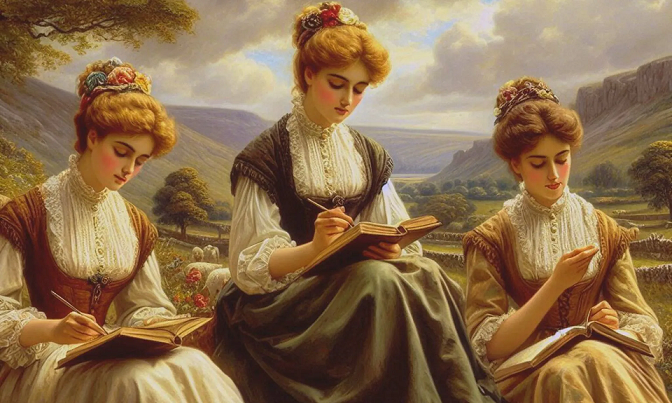
Brontë, Anne (1820-1849) Agnes Grey -- A governess is held responsible for children’s conduct though given no authority over them. What does it mean to be human when seen as function, not as person? The Tenant of Wildfell Hall -- “The fatal confidence that love can reform character”. Can the Byronic male -- charismatic but morally impaired – be remedied by a loving woman? Selected letters and short works -- What kind of God governs human destiny? Could he coexist with endless damnation? Can one rejoice in heaven if multitudes are eternally excluded? - “Even the wicked shall at last be fitted for the skies.” Brontë, Charlotte (1816-1855) Jane Eyre -- The formation of a self that refuses to be owned. She is repeatedly placed in systems that try to define her. Can one remain inwardly autonomous while still needing love? The Professor -- Can life be organized like a profession: through discipline, labor, and rational control? Such attempt may discover that love will disrupt best plans. Shirley -- What happens when a woman occupies a role society reserves for men? What is human life worth if it lacks agency? Villette -- What does it mean to exist when one is unseen and unloved? What is the self when no one reflects it back to you? How can a person sustain identity and meaning in isolation? Brontë, Emily (1818-1848) Wuthering Heights -- The novel presents dysfunctional love as merged identity, not relationship. Two mature lovers ever retain selfhood, yet move toward, what mystics call, the One Person. No Coward Soul Is Mine -- Emily's confidence in eternal life is not grounded in external doctrine but an inner perception of immediate divine presence. Bruno, Giordano (1548-1600) Cause, Principle, and Unity -- Bruno's great insight: Reality is fundamentally One. Humans see themselves as isolated while belonging to something larger. Nature is not a collection of disconnected entities. All these arise from a common source. On the Infinite Universe and Worlds -- If Earth is not the center of the cosmos, why should the Sun occupy a privileged position? Why boundaries at all? An infinite Creator would generate an infinite creation, not with limits. Copernicus moved Earth from the center, but Bruno removed the center altogether. Why should reality contain a center, and why should humans inhabit it? This is the collapse of medieval certainty. The Ash Wednesday Supper -- At an evening meal on Ash Wednesday, Bruno suggests that resistance to Copernicus’ idea = attachment to authority and mental habit. Can the mind follow truth wherever it leads, even when it overturns old certainties? Reality does not arrange itself around the hubris of imagined human importance. The Heroic Frenzies -- Where The Ash Wednesday Supper asks whether humanity can accept a larger universe, The Heroic Frenzies asks, what kind of person can live faithfully within such a universe? Bruno's answer is the heroic seeker of truth: one whose longing for truth becomes source of transformation. The seeker is not merely a logician but an explorer, driven by an inner fire. Materialism reduces life to bodily satisfaction, but Bruno argues that the highest human vocation is an endless pursuit of truth, beauty, and wisdom. Bunyan, John (1628-1688) The Pilgrim’s Progress -- Can a burdened human being persevere through suffering, temptation, and doubt to reach eternal life? A pilgrim is a traveler on a sacred journey toward a holy destination. In Bunyan's allegory, the pilgrim is not merely a traveler but represents every person who seeks God and salvation. Burke, Edmund (1729-1797) Reflections on the Revolution in France (1790) -- Can human society be rebuilt by reason alone, or does civilization depend upon inherited wisdom? Burke presents an argument about the fragile nature of civilization. He asks whether a society can discard centuries of tradition, religion, customs, and institutions in pursuit of abstract ideals like equality and liberty. He argues that social order contains invisible knowledge accumulated over generations. The book confronts a human temptation: the desire to destroy what is imperfect before understanding what makes it possible. Byron, Lord George Gordon (1788-1824) Selected poems -- “She walks in beauty as the night”. Byron’s self is never “at home” but moves through places, moods, relationships, without settling into final form. The world cannot be redeemed, only perceived. Reality resists final harmonization, is irreducibly unstable. The best consciousness can do is witness its own movement lucidly. Caesar, Gaius Julius (100--44 BC) Commentaries on the Gallic War -- Caesar is conquering Gaul and turning it into his power base, while framing the conquest as defensive and necessary to protect Rome. He builds his resources to overthrow the government. Commentaries on the Civil War -- Caesar grasps ultimate power in the name of “national security” and a claim to restore order. Campanella, Tommaso (1568–1639) The City of the Sun -- He imagines a utopian city governed by highest principles. A flourishing civilization is illuminated by truth, ordered by nature, governed by wisdom, reflecting divine order. Carlyle, Thomas (1795-1881) French Revolution: A History -- The focus is not France but the fragility of civilization. Perceived legitimacy can vanish suddenly. "Committee of Public Safety" is an Orwellian euphemism – a state agency to organize mass executions. Letters and Speeches of Oliver Cromwell -- Carlyle attempts to save Cromwell from hostile interpretation. Cromwell learns that destroying corrupt authority does not automatically create societal order. Carlyle posits that history is shaped by forceful individuals rather than systems – his “Great Man” theory. Materialists attack this claiming that there is no real courage, no free will, no underlying moral order, consciousness itself is but emergent property, with actors in history merely riding waves of events. On Heroes -- The “Great Man” theory extended: The history of the world is the biography of great persons. One who sees reality more clearly, acts more decisively, embodies truth more fully, possesses sincerity and inward conviction to effect a vision. Past and Present -- Carlyle is trying to solve the problem of spiritual disintegration within modern industrial civilization. He attacks what he sees as the dominant illusion of the age — the belief that economics alone can organize society. How can a civilization endure material prosperity while spiritually disintegrating? Sartor Resartus -- This work is about how a modern, fragmented mind can reconstruct meaning in a world where traditional religious and metaphysical structures have collapsed. Cato (the Younger) (95–46 BC) Secondary source review -- Cato is a figure of austere discipline. He enters public life not as charismatic reformer but as rigid enforcer of traditional Roman virtue. He refuses compromise, treating political negotiation as moral contamination. He does not adjust his principles to circumstance. Cato is a moral limit case. Cervantes (1547-1616) Don Quixote -- A man becomes obsessed with chivalric romances and renames himself Don Quixote, deciding to restore a lost age of knightly virtue. He attempts to impose heroic meaning onto a world that does not recognize it. The novel asks whether idealism is a form of madness or a higher kind of truth; a tension between what the world is and what it could be.
Charlemagne (c.742-814) Capitulare de Litteris Colendis (directive on the study of letters) -- One of the earliest (787 AD) large-scale attempts in Western Europe to extend general education across social ranks, making "no difference between the sons of serfs and freemen”. Chaucer, Geoffrey (1343-1400) The Canterbury Tales -- How do ordinary people reveal who they truly are when they are free to tell their own stories? Chaucer suggests that to understand a civilization, one should listen carefully to the stories its people choose to tell. Cicero, Marcus Tullius (106–43 BC) Letters to Atticus -- "I am tossed on a sea of troubles." "What is to become of us?" Cicero’s 426 personal letters to a close friend over 25 years. These create something close to the first great surviving record of a civilization watching its own collapse in real time. The age of Julius Caesar and the fall of the Republic. On Duties -- For Cicero, “duty” = action that flows from one's nature as a rational and social being. From this arises obligations toward truth and the common good. "We are not born for ourselves alone." Given who you are and the situation you face, what is the right thing to do? Cicero's central thesis: Nothing that is morally wrong can be advantageous, even though it may seem to offer short-term gain. Deception undermines character. To corrupt oneself is no benefit. On the Ends of Good and Evil -- The title can be understood as: "On the Highest Goal of Human Life." or “What Makes Life Worth Living?” or “What am I ultimately living for?” On the Laws -- Cicero writes during the collapse of the Republic: laws are now instruments of power rather than expressions of justice. He defines law not as written statute but as right reason in agreement with nature itself. True law is universal and eternal, not dependent on political authority. Human legislation is valid only insofar as it reflects this higher rational order. On the Nature of the Gods -- The title = “An inquiry into what the gods are, whether they exist, and what their true nature would be.” Cicero is staging a debate about whether belief in gods can survive critical philosophical scrutiny. On the Orator -- Cicero is well aware that political rhetoric can easily become a tool of power struggles. The ideal orator is an integration of virtue, wisdom and eloquence, the fusion of life-long education, thinking, and speaking in a single civic force. Copernicus, Nicolaus (1473-1543) – “The Earth moves.” On the Revolutions of the Heavenly Spheres -- Copernicus’ primary idea is not just that the “sun is at the center” -- for some of the Greeks knew this -- but the true conceptual leap is that “the Earth moves”, is not fixed. This is why the title is not “a heliocentric heaven” but focuses on the “revolutions” or orbits of cosmic bodies, of which the Earth is now viewed as one more. The question becomes, why can’t we feel the Earth move, as it does seem fixed. The short answer is: We, and everything else on the Earth, share in, are caught up in, the orbital movement – everything is moving together as a unit. Crispus, Gaius Sallustius ('Sallust') (86–35 BC) The Conspiracy of Catiline -- A republic does not die because enemies attack but when citizens no longer value the nation and are consumed by personal ambition. Romans increasingly identified with hostile political camps rather than as cooperative citizens of the common good. How can a society survive if its people are taken over by greed, pleasure, revenge, hatred, and factional aims? The Jugurthine War -- "A city for sale, and doomed to speedy destruction if it finds a purchaser." A foreign military ruler bribes corrupt Roman officials to win on the battlefield. Defoe, Daniel (1660-1731) Robinson Crusoe -- What remains of a human being when left alone with nature, fear, time, and God? A study of the solitary self. Crusoe undergoes spiritual transformation as illness and solitude force him into self-examination, repentance, and renewed religious faith.
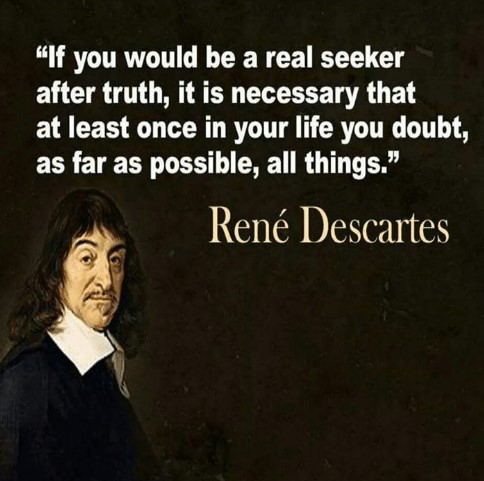
Descartes, René (1596-1650) Discourse on the Method -- What if most of what we believe is inherited confusion—and the only way to reach truth is to tear down our opinions and rebuild from the one thing that cannot be doubted? Meditations on First Philosophy -- Descartes wants readers to walk through the same intellectual journey he himself undertook. Each of six meditations reconstructs knowledge from the ground up.
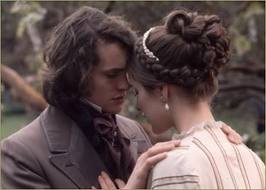
Agnes: 'My heart is so overcharged, but there is one thing I must say.' - 'Dearest, what?' - 'Do you know, yet, what it is?' - 'I am afraid to speculate, my dear.' - 'I have loved you all my life!' Dickens, Charles (1812-1870) -- the most influential novelist of Victorian England; combined social criticism with unforgettable storytelling A Tale of Two Cities -- How can societies respond to injustice without becoming what they hate? The novel explores a world where oppression produces rage, and rage produces violence that mirrors the original injustice. How normal people become capable of sustained atrocity. Bleak House -- The real "bleak house" is the entire nation. Victorian Britain was experiencing enormous economic growth while generating new forms of poverty and bureaucracy; institutions becoming increasingly powerful and increasingly impersonal. The lawsuit at the center of the novel ultimately collapses in absurdity when legal costs consume an entire estate. How can ordinary human goodness survive within systems so vast and dysfunctional that they destroy the very people they are supposed to serve? David Copperfield -- David questions, “whether I shall turn out to be the hero of my own life.” The case of how a vulnerable child, exposed to instability and abandonment, gradually constructs a stable identity. Great Expectations -- When unexpected wealth arrives, Pip believes money and refinement will transform him into a worthy person. Instead, success magnifies his confusion, separating him from those who genuinely love him. Hard Times -- Dickens explores the consequences of treating people as units of production rather than complete human beings. He examines an industrial civilization increasingly dominated by efficiency, calculation, and utility. He argues that imagination, appreciation of beauty, and affection are not useless luxuries but necessities. Can prosperity and hard work compensate for the loss of humanity? Oliver Twist -- "Please, sir, I want some more." Oliver's request is a deviation from expected behavior - a small twist" against the system. This simple act sets much of the plot in motion. Oliver is continually bent, pressured, threatened by society and crime. Yet he never becomes morally twisted himself. His triumph is that he remains morally straight while moving through a crooked world. The contrast between the innocent boy and twisted institutions is central to the novel. Readers experience injustice through a single human life.
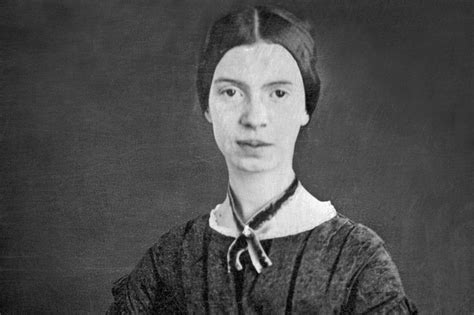
Dickinson, Emily (1830-1886) Several poems analyzed - 'I felt a funeral in my brain' - 'There is a pain so utter' - 'This consciousness that is aware' - 'To die takes just a little while' - 'I was the slightest in the house, I took the smallest room' Diderot, Denis (1713-1784) Encyclopédie (1751-1772) -- The Encyclopédie asks whether humanity can improve by categorizing knowledge. What happens when we construct a comprehensive map of what we know? Like the impact of today's internet, Diderot attempted to break the monopoly of information control by despotic authorities. Rameau's Nephew (c.1760s-1770s) -- What would happen if one spent his entire life adapting himself to whatever other people wanted? The Nephew is a person who understands what society actually rewards rather than what it claims to admire. D'Alembert's Dream (1769) -- The book asks whether we need to posit an immaterial soul to explain life or can consciousness emerge from increasingly complex arrangements of matter. Letter on the Blind for the Use of Those Who Can See (1749) -- Diderot is saying: “You think you can see, but you don't understand what you're seeing – you’re blind.” Dio, Cassius (c.155-235 AD) - one of the three great Roman historians Roman History -- At its core, this book a meditation on power: how it is seized and rationalized after the fact. Dio frames Augustus as restorer and transformer: he preserves republican structure while reconfiguring power into monarchy disguised as principate. Dio says this principate-arrangement was not immediately recognized as tyranny because it allowed familiar forms. The language of freedom is used while centralizing power in practice. Eliot, George (Mary Ann Evans) (1819-1880) Daniel Deronda -- One’s innate being points toward a purpose; heritage helps locate that purpose within a larger human story. The novel is not ultimately about bloodline but the search for a belonging large enough to give a gifted person a reason to devote his life to something beyond himself. However, many contemporary readers are uneasy with any notion at all that ancestry can determine vocation. Silas Marner -- Eliot addresses whether humans recover meaning after betrayal destroys trust in both society and transcendent order. A morally wounded man is betrayed and retreats into isolation and material obsession. When a child unexpectedly enters his life, he is forced to confront whether trust and love can be rebuilt.
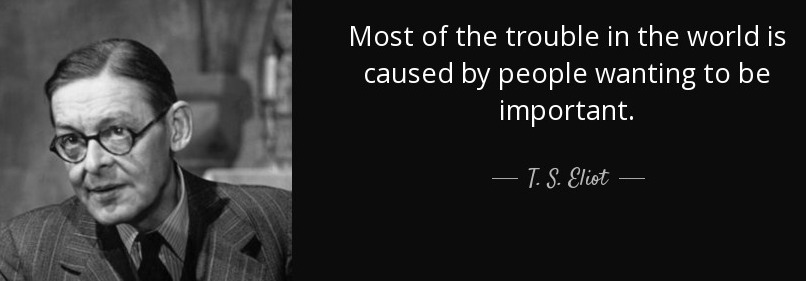
Eliot, T.S. (1888-1965) Ash-Wednesday -- A fractured soul attempts to recover himself; a tension between intellectual doubt and spiritual longing. Four Quartets -- How can mortality sanely confront eternity? There is a still point, a quiet center, unharmed by decay and ruin: “The end of all our exploring will be to arrive where we started and know the place for the first time.” Gerontion -- An old man meditates on cultural and spiritual collapse after WWI. How to live at the end of meaning -- when history, religion, and belief no longer cohere into a stable world? Journey of the Magi -- What does true spiritual transformation cost? A Magus recounts the journey to witness Christ’s birth -- but it's also a death, of the old beliefs, and the old self. Old Possum’s Book of Practical Cats -- Eliot presents a miniature society of cats in which each becomes an archetype of human character. What actually is “the self”? All culturally-conditioned or some irreducible core? The Love Song of J. Alfred Prufrock -- A life can be consumed not by catastrophe but incremental risk-avoidance. Tragedy is not one big failure but many small refusals to engage life. The Hollow Men -- Civilizations end not just in violence but in exhaustion. There are numbed states of consciousness, a living death, wherein transcendence becomes unreachable. The Sacred Wood -- Literature is a living, interconnected tradition. Eliot argues that every new work enters into a structured relationship with all past works. The Waste Land -- A view of the spiritual condition of modern civilization after cultural and moral collapse. Can anything restore meaning in a world that feels spiritually dead? Tradition and the Individual Talent -- What is poetry if not the expression of individual feeling or personality? Is human meaning created individually, or inherited collectively? Emerson, Ralph Waldo (1803-1882) Several of his major essays analyzed – Man, linked to the divine, in his own star, his own source of truth and light. Empiricus, Sextus (c.160 - c.210 BC) Overview of his works defending Pyrrhonism -- Can we ever reach certainty about reality, or whether “for every argument, an equal argument can be set against it.” Engels, Friedrich (1820-1895) Anti-Dühring -- One of the clearest introductions to dialectical materialism, Marxist economics and Marxist theory, socialist theory, and a grand exposition of the Marxist worldview. The Origin of the Family, Private Property and the State -- Engels argues that the family, private property, and the state did not exist eternally but emerged through economic changes in society. Systems of power had a beginning and may also have an end. Prehistoric communities were communal. With the rise of agriculture and surplus production, man began accumulating wealth. Disparities intensified. Out of this instability emerged the state, claiming neutrality while preserving the interests of property-owning classes. Epictetus (c.50-135 AD) Discourses -- The highest form of freedom is internal. People seek security in the external. Epictetus points toward our true possession: the inner domain, which cannot be enslaved unless we surrender it. He promotes a vision of human excellence grounded in self-command, rationality, courage, and acceptance of divine providence. Enchiridion -- The Enchiridion is a condensed survival guide for the human condition. What remains free when fate controls almost everything? Rather than attempting to eliminate suffering, he teaches readers how to meet it without surrendering their inner freedom. Epicurus (341-270 BC) Letter to Menoeceus -- The idea that Epicureanism = “eat, drink, and be merry” is a long-running misunderstanding that comes from later simplification + moral criticism, not from Epicurus himself. He defines the highest good as pleasure, but immediately narrows it: pleasure = absence of pain and disturbance, not constant stimulation or luxury. This essential pleasure is often achieved through simplicity: bread, water, friendship, reflection. Erasmus, Desiderius (1466-1536) In Praise of Folly -- A satire of “Folly” arguing that most human achievement—religion, politics, learning, love—is sustained not by pure reason but by comforting illusion and self-deception. Erasmus’ central question: whether wisdom can exist without folly. Handbook of the Christian Soldier -- A Christian learns that the real battlefield is the interior struggle between habit, illusion, and spiritual clarity. The central demand is continuous self-examination guided by Christ’s teaching rather than ecclesiastical formalism. Greek New Testament -- The book is about whether authority rests in tradition or in original sources. Erasmus’ translation challenged the the Latin Vulgate by re-centering Scripture on earlier forms. Euclid (c.300 BC) The Elements -- Can truth itself can be constructed from minimal assumptions? Can the mind build certainty from nothing more than self-evident beginnings? Does the universe present truth that is not guessed but forced by logic itself? Euripides (c.480-406 BC) The Bacchae -- Why are we fascinated by evil? The outwardly buttoned-down, repressed person, secretly conflicted, desires to participate in libertinism. What we fail to integrate lies unprocessed to eventually usurp. Hippolytus -- Forbidden desire cannot be negated by prescriptive decree ("thou shalt not") – which makes the forbidden apple a trophy -- but is finally neutralized only by clear-eyed integration and acknowledgment. Medea -- Any unenlightened individual, if sufficiently threatened, is potentially capable of any atrocity. Each person harbors “seeds of evil”, which, if unintegrated and unacknowledged, wait for a triggering event. Moral identity is not solid essence but maintained equilibrium. The Trojan Women -- What happens after war's victory? - women waiting to be enslaved, children killed, homes and families erased. What does “victory” mean in this dehumanization? Can civilization itself endure? Feuerbach, Ludwig (1804-1872) The Essence of Christianity -- Humans place their highest qualities outside themselves and call them “God”. Feuerbach argues that religion is not a revelation from heaven downward, but a revelation from humanity outward. Humanity gives away its own greatness and then kneels before it. Theology is disguised anthropology. Fichte, Johann Gottlieb (1762-1814) Addresses to the German Nation -- “Germany” in 1808 was not a nation but a collection of states under Napoleonic France. Fichte says, a nation is not primarily a political entity but a living organism through shared language and moral will. Without renewal, Germany risks permanent subordination and cultural dissolution by French rule. Foundations of the Entire Science of Knowledge -- The attempt to discover the absolute ground of all knowledge, not in external objects but the inward activity that makes any experience of “object” possible at all. The self is not a passive thing but an active self-generating process that “posits” both itself and the world of experience. The Vocation of Man -- Humanity’s deepest purpose is to discover meaning, realize freedom, through self-conscious moral activity, not by obeying external authorities. Consciousness is an active force that shapes reality; the very activity of the “I” structures experience. Fielding, Henry (1707-1754) The History of Tom Jones, a Foundling -- The protagonist's name is deliberately ordinary, signaling that Tom could represent ordinary humanity rather than an exceptional hero. Can a person of uncertain birth prove genuinely noble through character and conduct? Fontaine, Jean de La (1621-1695) Fables -- La Fontaine uses animal stories as mirrors of human behavior, allowing readers to see pride, ambition, foolishness, generosity, and cruelty without illusion. Beneath the simplicity of each tale lies a serious examination of the human condition: how the weak survive, how the powerful justify themselves, and how wisdom emerges from recognizing reality as it is.
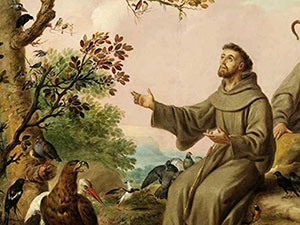
Francis of Assisi (1181-1226) Canticle of the Sun -- A view of reality itself as spiritual family: "Brother Sun" and "Mother Earth". Everything exists in reference to God, and so -- even suffering and death -- are integrated into a unified vision of meaning. The Testament -- A dying founder demands fidelity to his vision of austerity. Can a spiritual movement survive its own success? Francis insists that his directive must not be reinterpreted or diluted by intellect or institution. The Rule -- The “rule” measures how closely one’s life imitates Christ. The brothers are to live without property or status and in chastity -- outside normal life-anchors of security and identity. Admonitions and Letters -- Francis is pressing for total interior transformation expressed through radical humility, poverty, and self-denial. Can a human being truly live without deception, and what would it cost? Friedan, Betty (1921–2006) The Feminine Mystique (1963) – Friedan challenged the post–World War II idea that a woman’s fulfillment ought to come primarily through being a wife and homemaker. She called the widespread dissatisfaction among many educated suburban women “the problem that has no name.” This hidden emptiness behind the “perfect” domestic life – which denies unique self-actualization -- became a catalyst for women’s liberation from prescribed singular identities. Friedan was not arguing against motherhood, marriage, or family but opposing that these should solely define a woman’s existence. Galen of Pergamon (c.129--c.216) On the Usefulness of the Parts of the Body (De Usu Partium) -- Explains the purpose and design of every organ in the body. Presents a teleological view of nature, arguing that every bodily structure serves a wise and purposeful function. One of the foundational texts of anatomy and natural theology. Summary of major works -- The entire Galenic corpus forms a single ambitious project: to explain the human body as a rational, purposive, and intelligible system. Galilei, Galileo (1564-1642) Dialogue on Two Chief World Systems -- The dialogue unfolds among three interlocutors, defenders of heliocentrism, geocentrism, or a neutral position. It is a confrontation between certainty inherited from authority and certainty earned through reason and evidence. The work offers the emotional shock of losing humanity’s position in the cosmos. Does truth comes from tradition or from nature itself? Sidereus Nuncius (Starry Messenger) -- Title = “announcement” or “message from the stars”. The telescope allowed the sky to speak. The Moon is rough and mountainous, not perfect and smooth, as Aristotle said. Milky Way is filled with stars. But the most jarring “message” is about the four moons of Jupiter, demonstrating that not everything revolves around Earth, the universe is not Earth-centered. Two New Sciences -- One of the most important books on science ever written, offering foundations of modern physics and engineering. Galileo’s inclined-plane experiment converts something too fast and violent to apprehend (free fall) into something slow enough for the mind to track – effectively slowing down reality so that underlying structure becomes discernible. Gaskell, Elizabeth (1810-1865) North and South -- The title refers to the division between the industrial North and the rural aristocratic South of England during the mid-1800s. Margaret Hale moves from a southern village to a northern manufacturing town. The book is about the collision of two different worlds: Gibbon, Edward (1737-1794) The History of the Decline and Fall of the Roman Empire -- How can a civilization that once seemed unshakable be brought down? Rome’s strength decayed long before its final dissolution. The empire was weakened internally before external forces became decisive. Civilization becomes something that can quietly erode rather than dramatically fall; Rome ended without a single decisive conquest. External forces merely completed a collapse already in motion. Gibran, Kahlil (1883-1931) A Tear and a Smile -- “The deeper that sorrow carves into your being, the more joy you can contain… Love knows not its own depth until the hour of separation.” Broken Wings -- A broken wing is tragic because it belongs to something meant to fly. A bird with broken wings still remembers the air. “Love is a celestial light that shines from God upon the soul.” The Forerunner -- Beneath the surface self lies a deeper consciousness, a greater self, connected to universal being: “Would that you could behold your self as an ocean,” deep and transcendent. It is the part of you, enduring and immense, connected to God. The Garden of the Prophet -- The title implies enlightenment is not conquest but cultivation. Truth is not manufactured intellectually but cultivated inwardly through silence, suffering, intuition, love, and harmony with existence itself. “Your soul is oftentimes a battlefield.” The Madman -- Truth-tellers are seen as “mad” by society because they no longer seek for approval and obey its expectations. Such figures appear irrational because they reject society’s values of wealth, status, rigid religion, and shallow logic: “I found both freedom and safety in my madness.” Nymphs of the Valley -- Gibran confronts a civilization severed from beauty, tenderness, and inward truth. Human beings live socially yet remain emotionally starved and existentially isolated. The Procession -- A symbolic march of humanity itself. All are part of one vast spiritual journey. No one stands still forever. Earthly life is a passage: the soul’s movement toward higher consciousness. The Prophet -- The prophet answers questions by dissolving rigid oppositions. The people want certainty, but Almustafa offers something more difficult: acceptance of life’s irreducible mystery. Sand and Foam -- How can fragile, transient human beings glimpse eternal meaning? Gibran presents humanity as suspended between dust and infinity: materially finite yet inwardly capable of perceiving something eternal. Spirits Rebellious -- Gibran portrays souls who awaken to love, justice, truth, or freedom - and therefore become intolerable to authority structures, dangerous to corrupt systems, around them. Societies punish those most spiritually alive. Gilbert, William (1544-1603) A New Philosophy of Our Sublunary World -- A cosmic leveling: collapse of “perfect heaven vs corrupt Earth” distinction. The Earth stops being a lower realm and becomes part of a single explanatory framework. A step toward Newtonian universality of physical law. On the Magnet, Magnetic Bodies, and the Great Magnet the Earth -- How can natural phenomena like compass behavior be explained without appealing to mystical forces, religious doctrine, celestial influence, or Aristotelian forms? Gilbert presents a new model of enquiry: knowledge emerges from controlled observation, not inherited doctrine. The Earth itself is a giant magnet.
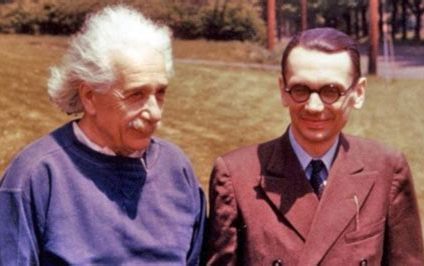
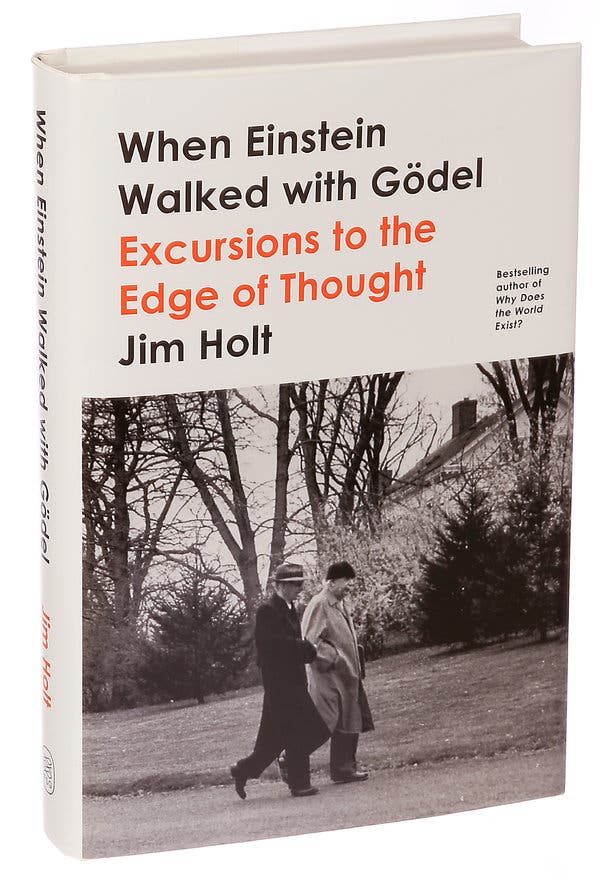
Gödel, Kurt (1906-1978) On Formally Undecidable Propositions of Principia Mathematica and Related Systems I (1931) -- Can any system of rules fully capture truth? Any system that claims to explain everything will fail -- because there will always be truths the system cannot see. Reality is always richer than systems built to explain it. On Undecidable Propositions of Formal Mathematical Systems (1934) -- Mathematics, the last refuge of truth. But Gödel demonstrated an irreducible level of unknowability. If math fails, all rational systems face limits, with boundary for reason itself. Not a flaw but a universal structural feature. The Consistency of the Axiom of Choice and of the Generalized Continuum Hypothesis with the Axioms of Set Theory (1940) -- There may be one reality, but no single standpoint from which it is fully determined, no single description that fully captures it. Russell’s Mathematical Logic (1944) -- In 1931 Gödel was doing foundation work, proving incompleteness theorems. In this 1944 work he is re-casting the entire logicist program in light of what the theorem means for a philosophical tradition. What is Cantor’s Continuum Problem? (1947, revised 1964 essay form) -- Cantor’s work is but a test case demonstrating that the incompleteness phenomenon is not confined to arithmetic but reaches to the structure of infinity itself. Gödel’s Rotating Universe solution (1949) -- This paper asks whether our intuition -- time flows forward -- is an illusion. Goethe, Johann Wolfgang von (1749-1832) The Sorrows of Young Werther (1774) -- Werther meets Lotte, a young woman already engaged. He becomes deeply attached to her but begins to withdraw from society. Life becomes unlivable when feeling is elevated to total reality. Götz von Berlichingen (1773) -- A Medieval knight possesses courage and integrity but discovers these virtues to be increasingly powerless against bureaucratic politics, legal manipulation, and emerging centralized states. Iphigenia in Tauris (1779, 1787) -- The play concerns Iphigenia's exile in a distant land and the crisis when her long-lost brother, Orestes, unexpectedly arrives as a captive destined for sacrifice. Egmont (1788) -- Goethe transforms a sixteenth-century political crisis, the martyrdom of Egmont, into a timeless meditation on liberty and moral courage. The play examines how oppressive power seeks not merely to imprison bodies but to extinguish hope itself. Torquato Tasso (1790) -- Goethe turns inward to examine creative genius. The poet Tasso's greatest strength—imagination—is also the source of his instability. The drama asks whether civilization can honor exceptional individuals without destroying them. Faust Part I (1808) -- Goethe transforms an old German legend about selling one's soul into one of literature's deepest queries. Faust’s bargain with Mephistopheles tests whether anything can finally satisfy human desire. Faust Part II (1832) -- Only when Faust dedicates himself to improving the future for humankind does he approach the satisfaction that has eluded him throughout life. Further, "The Eternal Feminine draws us onward." The transformative power of beauty, love and grace supersedes intellectual achievement or worldly success. Wilhelm Meister’s Apprenticeship (1795) -- The title = the formative years in which a person is educated by experience into maturity, discovering that mastery begins with learning how to live. Wilhelm Meister’s Journeyman Years (1821) -- "Mastery is lifelong apprenticeship in service to humanity." The truly educated person continues learning throughout life, while steadily transforming knowledge into wisdom and service. Elective Affinities (1809) -- Can the laws that govern chemistry illuminate the laws governing human love? Humans possess natural attractions similar to chemical affinities. The novel's characters feel they are choosing, while feeling chosen by forces they cannot resist. Theory of Colours (1810) -- For Goethe, understanding color required understanding both the external world and the observer. Nature should be studied as it appears, not merely reduced to abstract formulas. This is a theory not only of colors but also of how humans encounter reality itself. Goldman, Steven (b. 1941) Science Wars: What Scientists Know And How They Know It -- Is knowledge something solid, unchanging, eternal - universal, necessary, certain? Or does it shift with perception, "my truth and your truth" - particular, contingent, probable? Goldman argues that science is not guided by a single "scientific method" but by multiple, context-dependent practices such as induction, deduction, modeling, and simulation. Goldsmith, Oliver (1728-1774) The Vicar of Wakefield -- Portrays the trials of the Primrose family with humor and faith in uprightness. The novel explores virtue under adversity, the resilience of family, forgiveness -- that, genuine goodness ultimately triumphs. A defining novel of the 1700s. Gospel Of Thomas (early 1st century AD) And Jesus said: "If people ask you, Where have you come from? tell them, We have come from the Light.” Gregory of Nyssa (c.335–c.395) On the Making of Man -- Sees humans as oriented toward ascent: growth in virtue, likeness to God; however, the ascent is framed within man’s need of repair and defect. Grotius, Hugo (1583-1645) On the Law of War and Peace (De Jure Belli ac Pacis) -- The book’s purpose lies in its refusal to concede that war is devoid of moral obligation; that natural law and limits on violence remain intelligible even in armed conflict. Grotius asks whether civilization can survive unless there exists some moral order that outlasts tribal loyalty and brute force. The book’s real plot is the struggle to preserve civilization under conditions of sovereign conflict. The Free Sea (Mare Liberum) -- Powers like Portugal and Spain wanted to claim huge maritime routes as their own. Grotius writes against that kind of monopoly. Certain dimensions of reality resist possession. It is experiential recognition of flow, movement, and openness as fundamentally different from static property. Hardy, Thomas (1840–1928) Far from the Madding Crowd -- Moving from urban to rural life doesn’t remove chaos, only its setting. Is clarity possible where impulses constantly disrupt intention? Is rural life calmer, or just differently turbulent? Jude the Obscure -- Is the greatest human loss our unrealized possibilities? Jude dreams of education, meaningful work, and love, yet repeatedly encounters barriers erected by class, convention, religion, and law. He and Sue choose to live together outside conventional marriage. This brings social ostracism and economic hardship. Victorian society punishes those who reject its moral expectations. The novel was scandalous as it questioned Victorian assumptions concerning marriage, religion, and social order. Hardy's final novel. The hostile reception drove him away from novel-writing. Return of the Native -- The title is shorthand for returning home only to discover that home, and oneself, are not what they once seemed. Is the world shaped by our wishes, or must we learn to live within realities more permanent than ourselves. Tess of the d’Urbervilles -- Hardy attacks the belief that birth determines value. He exposes the emptiness of inherited prestige and the cruelty of social judgment. The novel's deepest claim is that bloodline tells us nothing about who a person truly is. Harvey, William (1578-1657) De Motu Cordis (The Motion of the Heart) (1628) -- Said that the heart functions as a pump, the blood circulates continuously. Harvey calculated how much blood the heart ejects with each beat. Multiplying that volume by the number of heartbeats per hour showed that, if the ancient Galen were correct, the liver would have to produce an impossible quantity of new blood every day. The conclusion was that the blood must be circulating continuously. Exercitationes de Generatione Animalium (On the Generation of Animals) -- Harvey also famous for Omne vivum ex ovo ("Every living thing comes from an egg"), rejecting spontaneous generation. Heine, Heinrich (1797-1856) Buch der Lieder (Book of Songs) -- The early poems portray a young lover overwhelmed by beauty, desire, and romantic expectation. Nature seems alive with promise, and love appears capable of giving life ultimate meaning. Gradually those hopes fracture. Separation, betrayal, misunderstanding replace fulfillment. The beloved becomes less an individual than a symbol of unattainable happiness, forcing the speaker to confront loneliness and illusion. Reisebilder (Travel Pictures) -- Travel writing becomes something far richer. Every mountain, city, inn, cathedral, or conversation becomes an opportunity to examine politics, history, literature, religion, and the human spirit – an inner exploration. Deutschland. Ein Wintermärchen (Germany. A Winter's Tale) -- Heine, 1843, returns home after more than a decade of exile in France. Familiar landscapes awaken memories, affection, and curiosity. Heine repeatedly contrasts Germany's rich cultural heritage with its reluctance to embrace political and intellectual freedom. Die romantische Schule (The Romantic School) -- Romanticism had liberated imagination from 18th century rationalism, but if it glorifies the medieval past it could become an intellectual confinement. In other words, Heine seeks to explain how a movement that liberated imagination could also begin to constrain modern thought. Hegel, Georg Wilhelm Friedrich (1770-1831) Elements of the Philosophy of Right -- After the French Revolution and Enlightenment Europe. the individual was elevated as “free” in theory, but not as a lived reality. Hegel saw that freedom is not complete until it's a social order, codified in laws and structure, otherwise it collapses into abstraction. Encyclopaedia of the Philosophical Sciences -- The title = a systematic presentation of Hegel’s entire structure of philosophy. It’s a self-developing system, a circle of knowledge, that is the self-unfolding structure of intelligibility itself, which becomes aware of its own rationality through history, culture, and philosophy. Phenomenology of Spirit -- The German word “geist” / "spirit" is not cleanly translatable into English. Hegel is pointing toward a collective Spirit, even a Universal Consciousness, leading humanity to maturity. He sees the developmental path of the individual writ large in society over millennia, progressing toward self-awareness. Science of Logic -- Hegel asks, what happens if thought examines only itself with no assumptions? Can reality ultimately make sense of itself from within itself? Science of Logic begins with nothing assumed except pure thought and demonstrates how all intelligibility unfolds from that beginning. Herodotus (c.484-425 BC) The Histories -- Considered the foundational work of history in Western literature: Why do empires rise and inevitably fall? Why do humans overreach, and what happens when they do? Hesiod (c.700 BC) Theogony -- Order in the universe emerges through the gods vying to consolidate power, culminating in Zeus at the helm. His victory represents lasting cosmic stability. This is the structure of reality itself. Works And Days -- Hesiod shifts from ‘how did the cosmos arise?’ to ‘how do we now live in a world of scarcity?’ Survival depends on disciplined well-timed effort within a moral order. Hick, John Harwood (1922-2012) Philosophy of Religion (1963) -- The importance of this work is less any individual argument than the change in the rules of the discussion. Hick refuses to let the debate be controlled by the assumption that only demonstrable propositions can be rational. He insists that religious experience should not be dismissed because it is not demonstrable via the scientific method. Evil and the God of Love (1966) -- Hick offers an image of the world as a “vale of soul-making”. This changes the meaning of mortal life. Hick's idea is not merely that God permits suffering because it can teach lessons, but that God creates beings whose very nature is to become. In this view, a human being is not a finished product. Personhood is an open possibility. God creates the conditions under which a person can freely become courageous, compassionate, wise, loving, and ultimately more fully himself; that is to say, more like God. Death and the Eternal Life (1976) -- He envisages a developmental process in which the person survives death and undergoes further transformation, ultimately approaching a unitive state beyond the isolated ego. The person survives death, but mere survival is not the final goal. The deeper trajectory is transformation of the person beyond the small ego. An Interpretation of Religion: Human Responses to the Transcendent (1989) -- Different religions may be genuine but different responses to one transcendent Reality. The book's central revolution: religious pluralism. Various religions represent culturally conditioned ways of experiencing the Real. Hobbes, Thomas (1588-1679) Leviathan (1651) -- Recognizing the danger of human evil, people collectively ought to agree to surrender certain freedoms and authorize a sovereign to enforce laws. This covenant creates the "commonwealth," symbolized by the Leviathan -- an artificial person whose immense authority protects citizens from one another. De Homine (On Man) (1658) -- The book provides the anthropological foundation upon which Hobbes builds his political philosophy. If human beings are naturally driven by self-preservation, desire, and competition, then political institutions must be designed with these realities rather than idealized conceptions of virtue. Homer (c.750 BC) Epic Cycle -- Origin to aftermath of the Trojan War. Homeric Hymns: Major Aphrodite -- The myth features Aphrodite not as the “goddess of love” but a force of erotic madness, irresistible and destabilizing, disrupting reason and order. Apollo -- What does it take to come into one's abilities?Apollo rises from exile and vulnerability to claim power and mastery -- the struggle to create order from chaos. Demeter -- How can life continue after great loss? What happens when loss seems to define the structure of reality itself? There is recovery, but with loss of innocence. Hermes -- How cunning intelligence makes its way, gets what it wants, in the world. It is the mind that survives by deception, disingenuous wit, rather than force. Homeric Hymns: Minor -- Introduces Dionysus, the patron of wine, and other gods. Iliad -- The first major work of Western literature. Examines human behavior under extreme conditions of war: heroism as lens for understanding human nature, duty, and courage. Odyssey -- Can one fully reclaim selfhood and home after long absence? What is the meaning of home and identity in a world governed by chance and suffering? Horace (65-8 BC) Odes -- How should people live when everything is temporary? Accept mortality, master yourself, cherish the present, create something worthy of note. Cultivate character, savor the present, create works - or lives - that deserve remembrance. “Seize the day, trusting as little as possible in tomorrow." Epistles -- Cultivate inner freedom before seeking success in the world. A conversation in letters with friends about the art of living. "They change their sky, not their soul, who hurry across the sea." Wherever we go, we bring ourselves. Hume, David (1711-1776) An Enquiry Concerning Human Understanding (1748) -- The Enquiry is best thought of not as introduction, but as Hume's own condensed, more polished, revision of the Treatise Of Human Nature – which, largely ignored initially, Hume said, "fell dead-born from the press." Many recommend reading the Enquiry first because it presents Hume's arguments in clearest form. Hume says that philosophy has become overconfident, claiming certainty where none exists. His inquiry becomes an audit of human understanding, separating genuine knowledge from assumptions born of habit. An Enquiry Concerning the Principles of Morals (1751) -- Hume argues that humans make rules governing property, contracts, and cooperation because resources are limited and conflicts are inevitable. These conventions make peaceful society possible. Dialogues Concerning Natural Religion (1750s-1770s) -- Natural refers to knowledge obtained through reason and observation of nature. It contrasts with orthodox religion which depends upon divine revelation. Can the mind, by observing the universe, infer the existence and character of God? A Treatise of Human Nature (1739-1740) -- How can human claim to know reality when every act of knowing passes through the human mind? Hume says we must first understand the machinery of thought itself. The Treatise questions assumptions so fundamental that most people never notice they are making them. The Natural History of Religion (1757) -- Hume observes that primitive societies lived amid continual hardship and uncertainty. Seeking explanations and protection, people naturally attributed intentional agency to powerful unseen beings. These beliefs gradually accumulated into organized religious systems. Hutcheson, Francis (1694-1746) An Inquiry into the Original of Our Ideas of Beauty and Virtue (1725) -- Humans naturally admire generosity and kindness, even when these do not benefit themselves. This suggests that approval arises from a moral sense rather than disguised self-interest. The moral and aesthetic life is therefore not an artificial achievement but an expression of the deepest structure of human nature. An Essay on the Nature and Conduct of the Passions and Affections (1728) -- Rather than reducing every action to selfish motives, the author contends that we possess affections directed toward the happiness of others and a moral sense that delights in virtue. “The moral heart naturally recognizes and delights in benevolence." Moral excellence grows from cultivated benevolence rather than fear of punishment or pursuit of reward. Hypatia of Alexandria (c.350/370 - 415 AD) Commentaries on Diophantus and Ptolemy -- Hypatia perceived that many of the foundational scientific texts of antiquity had become very difficult to study. Centuries of copying introduced errors, while terse explanations assumed levels of understanding that few students possessed. She undertook the work of clarifying the classics, lest their message be lost to future generations. This effort alone gathers praise for her. However, her most stellar contribution was the life she exemplified: "She was for all who wished to think philosophically a guide in every good thing" - Synesius of Cyrene. See much important discussion concerning Hypatia as the missing element to Socrates’ “can virtue be taught”. Her written works were destroyed by enemies, but her students revered her, and carried on her view of science and, indeed, that of life. Hypatia shifted the focus from information to formation – the molding of minds as lovers of wisdom. This is a massive accomplishment that deserves much attention. Iamblichus (c.245 - c.325 AD) Commentary on Plato and Aristotle -- "Aristotle trains the mind; Plato elevates it." This organizes Iamblichus' commentarial project. He sees philosophy as more than scholarship but transformation. Exhortation to Philosophy (Protrepticus) -- Why do human beings choose inferior goods over genuine fulfillment? Can we turn away from a life ruled by transient desires and become aligned with a higher reality? The title could almost be, "Why You Should Turn Your Life Toward Wisdom." Philosophy is not just teachings but a process of transforming the soul: “The goal is likeness to the divine.” Life of Pythagoras -- Can wisdom remake a human life, or only inform it? The title means "On the Pythagorean Way of Life". For Iamblichus, Pythagoras embodies the possibility of becoming godlike through wisdom and purification. On the Mysteries of the Egyptians -- For Iamblichus, the deepest divine realities transcend human intellect. Therefore one must participate in sacred rites, prayers, invocations, and divine symbols—the "mysteries"—through which the gods themselves elevate the soul. Ultimate reality cannot be reached by philosophy alone. Irenaeus (c.130-202 AD) Against Heresies -- A bishop attacks the Gnostics, claiming they are know-it-alls. However, he departs from his church's orthodoxy with a view that humanity is not defective and fallen but only immature, on its way to a higher state. Isidore of Seville (c.560-636 AD) Etymologiae -- One of the earliest attempts in Western tradition to treat all knowledge as a single structured system, with a focus on word origins. Jerome (c.347-420 AD) Vulgate (Latin Bible translation) -- His central project: making Christian scripture legible in Latin, while defending an ascetic, monastic vision of Christian life.
Johnson, Samuel (1709-1784) A Dictionary of the English Language (1755) -- Johnson’s attempt to bring order to the vast, unstable world of English words. Behind the dictionary lies a deeper concern: if words shape thought, then confusion in language produces confusion in the mind. His true subject was the struggle of the individual mind against its own illusions. Joyce, James (1882–1941) Ulysses -- A single day of one man's life in stream-of-consciousness. Mirroring The Odyssey, Ulysses explores how ordinary existence can reflect epic human quests – a search for home and identity. Justinian I (c.482–565 AD) Corpus Juris Civilis (Body of Civil Law) -- The Roman legal world in the 500s AD is overloaded: centuries of edicts, contradictory rulings, create instability. Justinian responds by with a radical consolidation. The work transforms law from scattered decree into a coherent architecture. This became the basis of European law.
Keats, John (1795-1821) Several poems analyzed – "Beauty is truth, truth beauty - that is all ye know on earth, and all ye need to know." Kepler, Johannes (1571-1630) Mysterium Cosmographicum (The Cosmographic Mystery) -- This is about the belief that the cosmos is not random but intelligible through ideal geometry. Kepler begins with too much influence by Aristotle. This is later abandoned, but the book is his first attempt to reconcile astronomy and mathematics. It's a hybrid of metaphysics, geometry, and scientific reasoning that still lacks empirical constraint yet already anticipates a law-seeking universe. Astronomia Nova (The New Astronomy) -- Astronomia Nova is Kepler’s record of a long intellectual battle to discover the true orbit of Mars from Tycho Brahe’s observations. At stake is not merely one planet’s path, but the status of astronomy itself: is the mission of astronomy that of preserving a tradition of a “perfect cosmos” or can it become a truthful account of how the heavens actually are? Harmonice Mundi (The Harmony of the World) -- What if the universe is musically-mathematically ordered, so that the motions of the heavens disclose intelligible design? Kepler’s purpose is to prove that the world is led by lawful harmony; that geometry, music, soul, and planetary motion are expressions of one underlying order. Epitome Astronomiae Copernicanae (Epitome of Copernican Astronomy) -- Copernican astronomy still faced difficulties in Kepler’s day. It offended common sense, it lacked the sensory obviousness of geocentrism. This book is Kepler’s mature presentation of Copernicus' work. The Epitome is saying: Here is what Copernican astronomy becomes when new mathematical evidence is added. Kierkegaard, Søren (1813-1855) The Concept of Anxiety -- Kierkegaard offers what may be the most important discussion on what it means to be a “self”. It is an entity that relates to itself, loops back upon itself discursively, through awareness, internal dialogue, choice, such that it must continuously form its own identity through reflective decision. Freedom is not just “ability to choose,” but “being forced to relate to oneself as a chooser”. Existential anxiety arises not from having choices, but from being the kind of entity that must interpret and choose to create itself. Either/Or -- A choice between pleasure or responsibility. The decision affects one’s ability to become an authentic self. Fear and Trembling -- Faith is not comfortable belief or polite religion but a lonely confrontation with the Absolute. The self is formed by facing anxiety, contradiction, and isolation. The Sickness Unto Death -- The respectable citizen or churchgoer may be spiritually ruined while appearing perfectly normal. Modern society enables distraction, superficiality, and escape from inward confrontation. The greatest human catastrophe is not physical death but spiritual despair: the failure to become a true self. This despair is rooted in the self’s inability to escape consciousness. Works of Love -- Love is not primarily feeling or emotion but something to become visible, an enactment in everyday life. Authentic love is not rooted in attraction or reciprocity but an ethical obligation toward “neighbor” as equal before God. Leibniz, Gottfried Wilhelm (1646-1716) Discourse on Metaphysics -- Can the universe - including God, nature, freedom, and every life - be understood as one perfectly rational order? Reality is rational because God creates with perfect wisdom. Leibniz argues that beneath the apparent disorder of the world lies an intelligible structure in which nothing exists without sufficient reason. Humans experience uncertainty because they perceive only fragments, while God comprehends the whole. If reality is rational, then every event, however mysterious, belongs within a meaningful and intelligible universe. Monadology -- For Leibniz reality, fundamentally, is made not of matter and atoms but centers of perception. These “monads” are “consciousness units” which form the basis of the universe. Dr. Federico Faggin, inventor of the microprocessor and quantum theory expert, explains how today’s best science vindicates Leibniz. Theodicy -- Is the existence of evil compatible with a perfectly good God? Leibniz argues that apparent contradictions disappear when reality is viewed from the standpoint of the whole rather than isolated events. He asks: "What world, considered as a complete system, produces the greatest possible good?" Leibniz develops his doctrine that God, before creation, surveyed all possible universes. New Essays on Human Understanding -- How does the mind come to know truth? Is the mind a blank slate or replete with hidden capacities? Leibniz stated: the mind is like veined marble, whose internal structure guides what the sculptor can bring forth. Experience supplies the occasions for learning, but the mind possesses inherent capacities that make understanding possible. See discussion herein on how this undermines the doctrine of reincarnation. Principles of Nature and Grace -- "Why is there something rather than nothing? For nothing is [far] simpler and easier than something. Further ... one must be able to give the reason why they exist thus and not otherwise." Philosophy must reach a reality whose existence depends upon nothing outside itself. On the Radical Origination of Things -- Leibniz extends, "Why is there something rather than nothing?" He is interested in the ultimate foundation of existence. He does not focus on how planets formed or how life evolved -- these are proximate causes – but what is the deepest reason that there is a universe at all? Correspondence with Arnauld -- In a series of letters, Leibniz debated one of the greatest French philosophers of the seventeenth century. The result sharpened and extended Leibniz’s views. Explication de l'Arithmétique Binaire -- Leibnitz did not invent the idea of representing numbers with only two symbols. His contribution was to realize that binary can be expanded into a complete number system. This is used today in computer science. Lessing, Gotthold Ephraim (1729-1781) Nathan der Weise (Nathan the Wise) -- Can humanity overcome religious conflict through reason and moral action? The value of a person is not determined by religious identity but ethical conduct. “If God held all truth in his right hand, and in his left hand only the lifelong search for truth... I would choose the left hand” – this captures his ethos: the search for truth is itself a sacred activity. Livius, Titus ('Livy') (59 BC–AD 17) Ab Urbe Condita (From the Founding of the City) -- Livy’s history is concerned with what made Rome great. What can be done to recover the earlier virtues? Rome flourished because citizens placed public duty above self-interest. Livy asks whether societies die for the same reasons individuals do: corruption of character. Locke, John (1632-1704) An Essay Concerning Human Understanding -- How does the mind acquire knowledge? Locke rejects the belief that humans possess innate ideas. He proposes that every idea enters the mind through experience. External sensation supplies impressions of the world, while internal reflection reveals the operations of the mind. Locke's famous image of the mind as a "white paper" challenged thinkers such as René Descartes. His work represents one of the great transitions in history: the movement from authority, based primarily on inheritance and tradition, toward authority justified by evidence, consent, and human dignity. Two Treatises of Government -- What makes political power legitimate? Locke dismantles the idea that authority naturally belongs to kings. Government exists not to create human rights but to protect rights people already possess by nature. Power belongs to the people, who authorize rulers to act on their behalf. When governments violate the rights they were created to protect, they lose legitimacy. The individual comes before the state. The person has inherent moral worth. A government is legitimate only when it protects rights that humans possess before government exists. Many would be surprised to learn that founding USA documents contain – not just ideas but – many phrases taken directly from the writings of Locke. Longinus (c.1st century AD) On the Sublime – A Greek treatise on why certain works of literature achieve overwhelming power and greatness. Longinus asks a profound question: Why do some writings not merely persuade but transport us? What causes a reader to feel awe, wonder, elevation, even spiritual transformation? Lucian of Samosata (c.120 AD--c.200 AD) True History -- An early (170 AD) sci-fi journey to the Moon. Lucian is not simply inventing absurd adventures (moon wars, sea creatures, giant civilizations); he is exposing how easily readers accept invented authority when it is presented in a tone of seriousness. He is showing that ancient “wonder-history” can be reproduced -- for the uncritical credulous mind -- without truth and still feel convincing. Lucretius (c.99–c.55 BC) De Rerum Natura (On the Nature of Things) -- A student of Epicurus, Lucretius attempts to remove the instability of a world governed by superstition of the gods, divine interpretation of events, and existential anxiety. Fear is rooted in ignorance of how the universe works, he says. Luther, Martin (1483-1546) Ninety-five Theses (1517) -- 95 theses for debate regarding penitential practice. He distinguishes between church authority and inward repentance. True repentance is lifelong and internal, not reducible to transactional acts like purchasing indulgences. By the end, the theses = a radically re-centered model of salvation grounded in inward transformation rather than ecclesiastical financial policy. The Freedom of a Christian -- The believer is free -- no work, ritual, or institutional effort can contribute to justification. Yet the believer becomes a servant to the needs of others. Actions are not transactional currency exchanged for salvation but spontaneous expressions of faith already received. The Bondage of the Will -- The book asks: do humans possess the capacity to choose salvation through free will, or is the will bound by sin to be liberated only by divine action? Luther is responding to Erasmus’ defense of limited human freedom. Luther argues that human will is not self-determining but enslaved to sin. Machiavelli, Niccolò (1469-1527) The Prince -- Machiavelli does not argue that cruelty or deception are good in themselves. His claim is that political necessity may require actions that conventional morality condemns if the alternative is disorder, conquest, or the collapse of the state. Discourses on Livy -- Liberty is vulnerable to the prosperity it creates. Republics accumulate wealth and complacency, gradually weaking civic vigilance. Leaders become self-interested, citizens less engaged, institutions less responsive. Maimonides (1138-1204) Mishneh Torah -- “Mishneh Torah” = a structured restatement of the Torah’s law as a complete, second legal system. It removes the need for the Talmud’s debates by offering final rulings in clear, hierarchical form. The work asserts that divine law can be intellectually transparent without losing authority or depth. Guide for the Perplexed -- The book identifies a crisis: educated believers encounter contradictions between literal readings of Scripture and the conclusions of philosophy. This produces “perplexity,” intellectual split-consciousness. Maimonides responds by proposing: Scripture contains layers of meaning, and many anthropomorphic descriptions of God are metaphorical. He then reconstructs key theological concepts so they align with Aristotelian frameworks while preserving religious obligation. Commentary on the Mishnah -- The Commentary on the Mishnah explains an existing foundational text. The later Mishneh Torah goes much further: it largely abandons the commentary format and presents a complete, independent code of Jewish law. Marlowe, Christopher (1564-1593) Doctor Faustus -- Faustus summons Mephistophilis, who serves Lucifer. He signs a pact in blood: 24 years of magical power for his soul. Marlowe prepared the way for Goethe's later Faust. Tamburlaine the Great -- Tamburlaine conquers empire after empire. Every victory enlarges his appetite for domination, but conquest alone cannot satisfy the deepest human longings. The Jew of Malta -- Injustice breeds vengeance, vengeance becomes self-consuming, and political and religious hypocrisy often prove as corrupt as the crimes they condemn. Edward II -- A king loses his crown by confusing love and power. Marlowe examines whether a ruler can separate private passion from public duty and whether authority rests on inheritance alone or on the ability to inspire loyalty. Marx, Karl (1818–1883) Capital: Critique of Political Economy (Das Kapital) -- Marx sees an invisible system called capital which gains autonomy over human life by converting labor into expanding value. He’s diagnosing a self-propelling social mechanism that reshapes politics, morality, and consciousness. It argues that this “force” is capital itself, reproducing and expanding through labor relations. The Communist Manifesto -- Marx is publically announcing the initiation of a new social and political order without private ownership of the means of production. The book could be called, ‘A Declaration for the Common Ownership Movement’. McLuhan, Marshall (1911-1980) Understanding Media: The Extensions of Man (1964) -- The book introduces McLuhan's most famous insight: "The medium is the message." This means that the long-term effects of a technology arise primarily from its form, not from the specific content it conveys. A television program, or a cell phone/computer, may educate or entertain, but these, in themselves, change habits of attention, social life and interaction, politics, and perception regardless of content. Menander (c.342–292 BC) Aspis (The Shield) -- A society treats appearances as evidence of truth. How fragile is human judgment when it relies on external signs rather than lived truth. Dis Exapaton (Double Deceiver) -- What happens when reality is constantly manipulated through speech and schemes? How humans navigate life by false appearances. Marriages built on trust -- that is never guaranteed. Dyskolos (The Bad-Tempered Man) -- What happens when a hostile loner, one who has rejected society, is suddenly forced back into human community? Epitrepontes (The Arbitration) -- How truth emerges when human perception is unreliable. Can justice and truth be restored when all evidence is indirect and fragmented? Misoumenos (The Hated Man) -- A soldier can survive war, but not necessarily love's rejection. The universal fear: What if I cannot make myself known? - misunderstanding can imprison the soul more completely than force. Perikeiromene (Girl with Hair Cut Short) -- How love is destabilized by jealousy, wounded pride, and false perception. How love turns to rage by misinterpretation, by acting on what we fear rather than what we know. Samia (Girl from Samos) -- Mistaken appearances override trust. Humans often do not see facts but interpret through fear. How quickly love collapses under suspicion. Sikyonios (Man from Sicyon) -- Is identity what society calls us, or what truth eventually reveals? A story about who a person truly is when social labels prove false. Mill, John Stuart (1806-1873) A System of Logic (1843) -- His major work on scientific method and the logic of the social sciences. The pressure forcing Mill is the enormous success of modern science. By the 19th century, science was transforming the understanding of nature, yet: What justifies the scientist in moving from observed instances to universal laws? Principles of Political Economy (1848) -- This book is about the relationship between economic laws and human choice. Production is constrained by realities that we cannot simply wish away, but the distribution of wealth is shaped by institutions, laws, customs, and choices. The book ultimately asks how economic knowledge can be used in the service of human flourishing and social progress. On Liberty (1859) -- Social conformity itself can become a form of tyranny. What if the people become the oppressor? Even when the majority is right, it can become intellectually dead if we merely repeat its conclusions without understanding why they are true. Utilitarianism (1861) -- Mill is trying to solve an old problem in philosophy: What makes a human action right or wrong? He argues that morality ultimately rests upon the Greatest Happiness Principle: actions are right insofar as they promote happiness and wrong insofar as they produce unhappiness. The deeper question, however, is “Who gets to define happiness and the good?” Considerations on Representative Government (1861) -- Mill asks what government is actually for. Government is both an instrument for accomplishing public purposes and a school in which human beings learn to exercise judgment, responsibility, and self-government. The Subjection of Women (1869) -- Why should one human being possess legal power over another? Can the legal and social subordination of women be justified in a society that claims to value liberty and human progress? The presumed natural inferiority of women cannot be established because women have never been allowed to develop under conditions of genuine freedom and equality. Milton, John (1608-1674) Paradise Lost -- Can one truly be free unless the good is freely chosen? Milton does not merely retell Genesis; he investigates the deepest meaning of freedom. If God created rational beings capable of love, they must also possess the possibility of rebellion. Paradise Regained -- Milton portrays Christ regaining paradise through: resisting temptation, obeying God perfectly. The decisive battle is fought within the human will. Samson Agonistes -- Milton is aligning Samson with the tradition of Greek tragedy, especially figures like: Sophocles’ tragic heroes, the idea of nobility revealed through suffering rather than success. Areopagitica -- “Areopagus”, the ancient hill in Athens where a court met to judge. England is being treated as new Athens, where truth should be debated openly. Truth does not require protection from falsehood, because truth is inherently stronger when placed in open competition. Suppressing falsehood does not purify truth but weakens the conditions under which truth demonstrates itself. Molière (1622-1673) Tartuffe, ou l'Imposteur (Tartuffe, or the Impostor) -- Tartuffe became Molière’s most controversial play because it confronted not religion itself, but the danger of false holiness used as a tool of domination: the false saint, the person whose appearance of goodness becomes instrument of deception. Montaigne, Michel de (1533-1592) Essais (Essays) -- He begins writing essays (“a try”) as a form of self-observation. What begins as occasional reflections gradually becomes sustained attempt to map the movement of his own mind. Montesquieu (1689-1755) Considerations on the Causes of the Greatness of the Romans and Their Decline (1734) -- The author is using Rome as a political laboratory. His deeper question is: What makes a political society powerful and durable, and what causes it to decay? Rome conquered the world—and its greatness helped destroy it. The Spirit of the Laws (1748) -- Montesquieu is famous for (1) Political power can be checked by political power, and (2) Society has a “spirit” - The written constitution is not the whole constitution; the spirit of the society is the living constitution. More, Thomas (1478-1535) Utopia (1516) -- More imagines an ideal, but still flawed, society. He explores an anceint question: why societies that seek justice generate inequality, corruption, and suffering. Can human beings ever create a truly just society, or does every political ideal collapse under the realities of human nature? Dialogue Concerning Heresies -- Who has the authority to determine religious truth when sincere individuals reach incompatible conclusions? Thomas More argues that Christianity cannot survive if every believer becomes the final judge of doctrine. He contends that the accumulated wisdom of the Catholic Church provides a more reliable guide than private interpretation of Scripture. A Dialogue of Comfort Against Tribulation -- Written while More was imprisoned and facing execution. He realizes that no temporal loss - even life itself - can compare with the loss of one’s alignment with God; therefore fear of death is a misplacement of value.
Newton, Isaac (1642-1727) Philosophiæ Naturalis Principia Mathematica (1687), “The Principia” -- Can reason discover a universal order that binds falling apples, ocean tides, and planets into one coherent reality? Newton inherited centuries of astronomy data but lacked unifying explanation. If hidden order exists, then humanity may genuinely understand creation. Reality possesses mathematical regularity because God created an orderly universe whose laws remain constant. Opticks -- Experiments reveal that light possesses hidden order and structure. Beneath the experiments of Opticks, Newton addresses a larger question: How does humanity discover truths that lie beyond ordinary perception? Arithmetica Universalis -- The same confidence that led Newton to search for universal gravitation also leads him to search for universal algebra. Both projects reflect a profound conviction: beneath apparent complexity lies hidden simplicity waiting to be discovered. Nicholas of Cusa (1401-1464) On Conjectures -- Humans are finite, while truth—grounded in God—is infinite. Certainty in the strongest sense is unavailable. Cusa redefines knowledge as conjectural structure -- ordered approximations, ever more refined without ever becoming identical with divine reality. Ignorance is not failure but permanent condition of finite intelligence. All human knowledge is an approximation: truth can be approached indefinitely, but never exhausted. On Learned Ignorance -- Finite intellect cannot comprehend the infinite, but the limits of reason can be understood. This awareness is “learned ignorance.” Cusa says this boundary of knowledge becomes the highest knowledge itself. In other words, you only realize the limits of knowledge by trying seriously to know. Cusa's book is about how thinking matures into humility without collapsing into skepticism. On Not-Other -- Cusa asks, how can anything be defined? A tree is known because it is not a stone; a stone is known because it is not a tree. Difference is built into all knowledge. Cusa goes on: If every finite thing is defined by contrast with something else, there must be a deeper principle that grounds all identities. He proposes that this principle – a name for God -- is "Not-Other." On the Peace of Faith -- Written in the immediate aftermath of the fall of Constantinople, Cusa imagines a heavenly council where representatives of many nations and religions seek reconciliation. On the Vision of God -- "You, Lord, gaze upon all things at once, and yet upon each as though it alone existed." For Cusa, the crucial fact is not that we look at God, but that: God is already looking at us. The book uses a painting whose eyes seem to follow every observer. No matter where a person stands, the image appears to gaze directly at them. The soul's journey is not toward possessing God intellectually but toward awakening to God's ever-present gaze. Nietzsche, Friedrich (1844-1900) The Antichrist -- The Church is now Antichrist, the great denier of Jesus, even while proclaiming him and posturing as his supreme earthly agent. Orthodoxy not only stultifies human expansion but has devolved to a system of rule-by-guilt, fear-based dogma, and quest for worldly power and mammon. Beyond Good and Evil -- There is a genealogy of moral view. We inherit concepts of right and wrong from the tribe.This can be overcome, but how few escape that box. The Birth of Tragedy -- Great art arises from the union of order and chaos. Greek tragedy is the synthesis of Apollonian perfected form and Dionysian wild abandon. Ecce Homo: How One Becomes What One Is -- A thinker must interpret himself as well as the world. Nietzsche’s self-reading and retrospective account of his philosophical mission. The Gay Science -- How to live joyfully in a world where inherited meaning has decayed but continues to haunt the mind. How can humans affirm life and create values when old moral and religious authority has lost power, yet continues to shape thought, emotion, and culture? On the Genealogy of Morality -- Morality has a history, and its origins reveal its purpose. A historical excavation of resentment, guilt, and the inversion of values. Human, All Too Human -- What if our highest ideals are not divine truths, but human constructions? Trace ideals back to human motives. An explanation of morality, religion, metaphysics, and art as products of psychological needs. Thus Spoke Zarathustra - Become who you truly are, engage human flourishing, by overcoming the darkness within. The human being is not an endpoint but a bridge toward self-transcendence and higher possibility. Twilight of the Idols -- Which inherited values – the ‘idols’ -- have made human life weaker, smaller, and less truthful? He asks whether the old morality is life-affirming -- or life-denying, expressions of weakness, fear, and resentment.
Origen (c.185–253 AD) On First Principles -- Invents a method of widespread allegorical interpretation of scripture which, he says, solves every question. Paracelsus (c.1493-1541) Paragranum -- The title = “beyond the seed” of traditional medical knowledge. A rejection of blind reliance on ancient authorities. The physician must learn from nature, observation, and experience. Pascal, Blaise (1623-1662) Pensées -- Not a completed treatise but a posthumous reconstruction of Pascal’s notes for an unfinished “Apology for Christianity.” This gives the work its distinctive fragmented structure. Lettres Provinciales -- “Provincial Letters” is not just a location marker but = “Letters from outside the system, exposing the system.” Traité du triangle arithmétique -- Be prepared to fall down the rabbit hole with Pascal’s Triangle. You’ll be wondering whether you've stumbled onto some secret blueprint of mathematics.
Paul of Tarsus (c.5 AD--c.65 AD) In the survey of church leaders herein, we meet a varied group: sincere seekers of truth to vicious politicians. A factor, however, all miss the mark in terms of “living in the Spirit”, as Paul used the phrase. Each one -- some lightly, some egregiously -- clings to externals, church and ritual, as source of salvation, for, as they see it, defective human beings. Paul, seeing more, is not among them, and moved away from legalism to the freedom of the “made in the image” heart and mind. Galatians – The first NT book. Paul asserts, the law was like a Greek household slave whose duty it was to take a child to school; but after graduation, the spiritual intent behind the law controls. And so, all legalism, all rituals, mere images of truth, are now passé. “All” religion, he says, both Gentile and Jewish-based, is obsolete, in favor of 'life in the Spirit'. External rules, carrot-and-stick, are for children - things of the nursery, learning ABCs; because, when the rule's intent becomes part of one's own mind and heart, then - "against such, there is no law". Pindar (c.518 BC -- c.447 BC) Olympian Odes -- Physical greatness is fleeting, vulnerable to disappearance, unless lifted into permanence by song and divine alignment. With this, a mortal touches something eternal. Plato (c.428 BC – c.347 BC) Apology - 'The unexamined life is not worth living'. Socrates shows that philosophy is a moral duty: questioning, reflecting, and seeking truth matters, even in the face of death. Charmides - What does it mean to be inwardly well-ordered and truly sane? Is it quietness, modest behavior, and self-control -- or something deeper, a soul aligned with self-knowledge and right measure? Cratylus -- Can language be trusted as pathway to truth? Words and names merely point and do not constitute reality. Crito - When is civil disobedience justified? Socrates refuses escape from prison, choosing to obey the law. True virtue can demand sacrifice, showing that acting justly sometimes means putting principle above convenience. Euthydemus - Winning arguments is not the same as finding truth. Sophistry may dazzle, but genuine understanding comes from honest reasoning, not clever tricks. Euthyphro - What is religious rightness? Conformity to rules or alignment with principle? Socrates challenges us to think: is piety about following commands, or about understanding and living according to the true nature of goodness? Gorgias - When does persuasion become corruption? Rhetoric can serve truth and justice, or it can manipulate, flatter, and pursue power. Plato contrasts speech that heals the soul with speech that merely wins. Ion - The true poet puts into words what others can barely feel. He may not fully understand what he has seen, but his gift is to show beauty and deeper truths to those who cannot yet see them for themselves. Laches - All virtue must be based on knowledge. To act well, we must understand ourselves — our desires, limits, and character. Courage without knowledge becomes mindless or rash, and other virtues fail without insight guiding them. Laws - How do we build a just society that outlives any one ruler? Plato turns from ideal theory to practical order, asking how laws, institutions, and education can hold community together across generations. Meno - Learning is remembering; awakening knowledge already within us. This idea connects to Aristotle’s emphasis on first principles, the foundations of reality, which begin with what the mind can recognize and recall. Parmenides - What is the nature of being: made of parts or unified whole? Unexamined assumptions can quietly warp our reasoning, creating arguments that seem logical but misrepresent reality. Phaedo - What happens to the soul after death? The soul is immortal and seeks truth beyond the body. Philosophy prepares us to live rightly and face death without fear. Phaedrus - Love is spiritual ascent toward truth and beauty. The beloved sparks memory of the ideal Beauty and the divine. Desire and inspiration move the soul beyond ordinary thinking, revealing insights that reason alone cannot reach. Philebus - The good life is not just pursuit of pleasure but right ordering of all good elements. True human flourishing comes when enjoyment, knowledge, and every positive part of life are arranged under the guidance of reason, so that each supports the others and wisdom shapes what we value. Protagoras - What is virtue and can it be taught? No, not directly, but the willing student might be led to choose it. The Republic - Is it possible to create a governmental structure that will not degrade over time? The best life and society emerge when personal virtue, social order, and wisdom are rightly aligned, creating balance within and between people. Sophist - The sophist manipulates definitions and appearances in a battle to define reality. Sophistry may dazzle, but real knowledge is rooted in understanding, not clever tricks. Statesman - Ruling requires knowledge of law, measure, and proportion. Effective leadership blends practical skill, balancing laws, social needs, and proper use of power. Symposium - Love leads the soul upward, in progressive steps, from physical desire to contemplation of the divine. True love inspires the soul to move beyond mere attraction, guiding it through higher levels of beauty, intellect, and spiritual insight. Theaetetus - What counts as knowledge and truth? Some have said, “Man is the measure of all things,” suggesting each person has their own truth. Plato asks: is reality something we can vote on, or is there a standard beyond opinion? Timaeus - The cosmos appears to have been crafted by an intelligent artisan. The universe operates according to rational principles; everything has its place and purpose. Pliny the Elder (23–79 AD) Naturalis Historia (Natural History) -- Naturalis means “belonging to the total system of the natural world in all its forms”. The Roman attempt to contain reality through total knowledge - to make the infinite world legible, ordered, and usable. Pliny the Younger (61–c.113 AD) Epistulae (Letters) - Personal correspondence revealing Roman elite life. How an administrator survives corrupt power, uncertainty, and moral pressure. The letters ask whether virtue can be preserved inside systems that reward compliance and performance. Plotinus (c.254–270 AD) Enneads -- Can the fragmented soul return to divine source? The Enneads purports to explore the structure of reality and humanity's place in it. Plotinus argues that all existence flows from a transcendent source called the One. Humans experience confusion, division, and attachment because they live far from that source. Plutarch (c.46 -- c.125 AD) Moralia -- "The mind is not a vessel to be filled but a fire to be kindled." Throughout the collection runs a common conviction: wisdom is not merely theoretical knowledge but the cultivation of an ordered soul capable of acting well in the world. Parallel Lives -- "The mind is not conquered by force but by love." The collection presents paired biographies of notable Greeks and Romans. Their lives are then compared to reveal deeper truths about character. Fame and power are unstable. Character endures. "The measure of a man is what he does with power." Polybius (c.200–118 BC) The Histories -- The entire work revolves around a single inquiry: How did Rome come to rule almost the entire Mediterranean world in such a short time? Polybius explains history as an interconnected system. This anticipates later geopolitics and systems thinking. From 220 BC onward, world events could no longer be viewed in isolation but now linked under the influence of Roman power. Pope, Alexander (1688-1744) The Rape of the Lock -- Pope's comic masterpiece.: A lock of hair is stolen - society reacts as though civilization itself has been shaken. People create "epic battles" over whatever they value most. For ancient heroes, it was kingdoms and glory; for aristocrats, the stakes were hairstyles, flirtation, reputation, and social prestige. An Essay on Criticism -- The title = "an attempt to explain the principles by which literature might be wisely judged." Pope argues that good criticism depends upon good character. Pride, vanity, prejudice, and ignorance distort judgment of another's literary work. An Essay on Man -- If humans understand so much, why do we still understand so little? The discoveries of Isaac Newton (1643–1727) revealed a universe of elegant laws, but humanity’s role seems uncertain. Pope challenges: arrogance that assumes we can judge the entire cosmos; pessimism that sees suffering as proof of meaninglessness; excessive pride in human reason. “Know then thyself, presume not God to scan; The proper study of mankind is Man.” What appears random may reflect hidden order. Humans judge from narrow perspective. What appears imperfect locally may contribute to a greater harmony beyond individual understanding. The Dunciad -- Like the modern book “Amusing Ourselves To Death”, Pope sees society dumbing itself down. The forces of the dunces defeat genuine learning not through superior argument but through exhaustion and replacement. Serious literature, scholarship, and reason gradually disappear beneath a suffocating flood of trivial productions, commercial entertainment, boorish sports, and fashionable nonsense. It happens when people stop caring about truth, beauty, and intellectual excellence. Porphyry (c.234–c.305 AD) Against the Christians -- This work is a strong intellectual attack, so influential that Christian emperors ordered it destroyed. Subject sacred texts, Porphyry said, to the same historical criticism applied to secular texts: He contends that Daniel was not written in the 500s BC but during the crisis under Antiochus IV Epiphanes in the 160s BC. "Interpretation should follow context." The OT “prophecies” about Jesus are contrived: "The evangelists were inventors, not historians." Further, he asserted that Greek philosophy had already discovered the deepest truths about reality and the divine. Commentary on Aristotle's Categories -- Aristotle's Categories seem simple: a list of ways things can be said to exist. But when we classify things as substances or qualities, are we organizing language, or are we discovering something real about the world? Do our concepts reveal reality, or merely organize experience? Isagoge (Introduction to Aristotle's Categories) -- Porphyry’s most influential work, a short textbook that shaped logical education for over a millennium. The writing seeks to make Aristotle's logical writings more accessible to students. He explains how broader classes contain narrower classes. Whenever we divide reality into kinds, we assume something about how reality itself is structured. Letter to Marcella -- Porphyry writes to his wife Marcella during a period of separation. He argues that genuine stability comes from cultivating the soul rather than depending on wealth, status, or reputation. The letter urges self-mastery and virtue. Life of Plotinus -- The title points not merely to the events of Plotinus's life but to his way of life—the living embodiment of the philosophy taught in the Enneads. Life of Pythagoras -- If human beings seek union with divine reality, what kind of life actually leads there? Porphyry is not primarily interested in reconstructing the historical Pythagoras but presents him as an ideal philosopher whose entire existence embodies wisdom. On the Cave of the Nymphs -- Porphyry argues that Homer in the Odyssey intentionally spoke of a cave because the physical world is like a cavern into which souls descend. Philosophy from Oracles -- Porphyry investigates mediumistic responses from ""gods", addressing metaphysical questions. Oracles (mediums) are treated as guides, given epistemic authority. The result is a hybrid intellectual system where "divine" revelation and philosophical reasoning meet and reinforce each other. Sententiae (Sentences Leading to the Intelligibles) -- Can the mind be trained to ascend toward higher truth? Porphyry believes that a collection of wisdom “sentences”, arranged as a kind of ladder, can lead one to loftier viewpoints and less reliance on the material world. This becomes a progressive reorientation of consciousness. Postman, Neil (1931-2003) Amusing Ourselves to Death: Public Discourse in the Age of Show Business (1985) -- Orwell feared that governments would suppress information through censorship and coercion. Huxley feared that people would become so distracted by endless amusement that they would no longer care about truth or freedom. Postman argues that modern television culture—and today's digital media—resembles Huxley's prediction far more than Orwell's. "People will come to adore the technologies that undo their capacities to think." Pre-Socratics Alcmaeon of Croton: He is the first to locate intelligence in the brain. And then asks, if I can move my body by my own agency, how far does this power extend? – all the way to immortality? Anaximenes of Miletus: We confront a world of endless change. How does something change, often predictably, into another? Is there order beneath flux? This is the first major attempt to explain nature as continuous process. Philolaus of Croton: Why is reality ordered not random? If the world is pure flux, nothing can be known. If the world is structure, knowledge becomes possible. Pythagoras: The divinity of number governs reality, harmonizing cosmos and soul. What if the fabric of truth, ethics, and human essence could all be understood through number, proportion, and harmony? Melissus of Samos: He begins with, what truly is cannot come into being or pass away. If something were generated, it would have to come from what-is-not, which is impossible. He asks whether change and motion are illusions -- true reality must instead be a single, unified, infinite, and ungenerated whole. Xenophanes of Colophon: Are gods merely humanity reflected back at itself? What if what we worship is ourselves enlarged? Human beings anthropomorphize the divine.
Proclus (c.412–485 AD) Commentary on Plato's Parmenides -- Proclus saw Parmenides as Plato's highest work on ultimate reality, the first principles of existence. It's a map of the universe and the soul's place in it; a vision of a hierarchy descending from a transcendent source. How can all things originate from a single source without losing their distinct identities? Proclus’ answer is that unity and multiplicity are not enemies but a progressive unfolding of unity. Commentary on Plato's Timaeus -- Timaeus poses the question, is reality rationally structured or just chaotic? Demiurge is introduced as craftsman bringing order to chaotic matter. Rather than creating the universe ex nihilo, he imposes structure by looking to eternal Forms as templates. If the universe is ordered, then human reason is not accidental but aligned with cosmic structure. This places humans inside a larger metaphysical order. Life is not meaninglessness but participation in a rational system. It implies that knowledge is possible because reality is structured to be known. Platonic Theology -- Plato is re-framed as an implicit system-builder. He’s not merely a philosopher of ethics but the architect of a complete theological system describing all levels of reality. The Elements of Theology -- Proclus’ “theology” is not about a personal god - but a study of the highest levels of reality, structure of the divine hierarchy, explanation of how unity generates all being, the science of ultimate causes. Implication: reality has a formal structure, that structure can be broken into first principles, and those principles can be logically derived. Pseudo-Dionysius (c.500 AD) Major concepts -- He describes a state of knowledge beyond thought and image. The model is Moses entering the cloud: proximity to God increases as clarity decreases. Ptolemy, Claudius (c.100-170 AD) - a unified vision of the architecture of the cosmos Almagest → astronomy / cosmos -- Can the entire visible universe be described through a single coherent mathematical order? His mathematics predicted celestial events with remarkable accuracy. But he was both right and wrong at the same time -- one of the most important philosophical lessons in the history of science. His math did uncover hidden order, but he was wrong about what that hidden order actually was – the classic fallacy of ‘affirming the consequent’. Geography → Earth / maps -- How can we know the shape of a world larger than we can directly experience? The Almagest attempts to map the heavens, Geography attempts to map the Earth. Just as Aristotle's Categories organized kinds of things, Geography organizes space itself. The implication is profound: Knowledge can transcend direct experience by math measurement. Ptolemy introduces a coordinate system, latitude and longitude. The major leap is not the map itself but the idea that every geo-location can be assigned a grid address. This coordinate framework changed the world. Harmonics → music / auditory order -- For the Greeks, harmonia meant the proper fitting of parts into a whole. Ptolemy sought to discover mathematical order wherever it appeared: in the cosmos, on the Earth, and now in music -- mathematical proportion of sound creating musical order and beauty. Optics → geometry of perception -- Is sight geometrical? Visuals change in air and water -- seems chaotic yet measurement reveals hidden order. Perception deceives but is patterned. Apparent size depends on relationship of observer and observed: sight = geometric event. Reality possesses structure to be discovered mathematically. Ptolemy's believed that perception, astronomy, music, and geography could all be understood through mathematical order. Tetrabiblos → astrology / human fate -- The Sun alters climate and seasons. And if the Moon can move oceans, is it reasonable to suspect it may also influence moisture in plants, animals, and the atmosphere? Might the cosmic order affect the earthly order? If the heavens operate according to lawful regularity, might earthly life also exhibit lawful tendencies? Can the uncertainty of life be made intelligible by discovering larger patterns within reality? Quintilian (c.35–100 AD) Institutio Oratoria (Education of the Orator) -- Can society create orators who serve wisdom rather than ambition? Rhetoric cannot be separated from one's character - not merely skilled in persuasion but morally formed. Eloquence can be used for truth or deception. Rabelais, François (c.1494-1553) Gargantua and Pantagruel -- Two giants: Gargantua symbolizes our immense capacity to live; Pantagruel, our immense capacity to learn. Rabelais suggests that the great human being possesses an inexhaustible appetite - for the truth and all good things. The giants' enormous bodies = metaphors for the expansive possibilities of life. Racine, Jean (1639-1699) Phèdre -- Phaedra, a figure from Greek mythology, central to Racine’s tragedy: the woman whose name suggests light is consumed by a dark, forbidden passion. The play focuses on the inner collapse of one human soul. Reid, Thomas (1710-1796) An Inquiry into the Human Mind on the Principles of Common Sense (1764) -- Can a human being trust the mind through which reality is experienced? Reid believes philosophy has wandered into skepticism because it began from a mistaken picture of perception. Rather than treating the mind as imprisoned behind its own ideas, he argues that we naturally and directly encounter the external world. Richardson, Samuel (1689-1761) Pamela -- “I have no friend but Providence, and my innocence.” A 15 year-old servant girl (1740) defends her virtue against seduction.
Rilke, Rainer Maria (1875-1926) Book of Hours -- God is not externality but accessed as inward experience. Interior life becomes primary field of reality- and person-making: “God speaks to each of us as he makes us.” Duino Elegies -- Can human consciousness survive direct encounter with transcendence? "Every angel is terrible” because beauty reveals a higher order and human frailty can hardly bear. Lay of the Love and Death of Cornet Christoph Rilke -- A young soldier in battle, about to die, experiences a surreal atmosphere of suspended time: “For one moment he has lived a thousand lives.” Letters to a Young Poet -- Maturity is not mastery over life but ability to endure uncertainty. Unresolved questions possess transformative power. Rather than demanding immediate certainty, one must “live the questions” until answers emerge organically. Trust your solitude, endure ambiguity, become the person your deepest nature requires. We are not machines to be optimized but mysteries to be cultivated via sustained engagement. Become capable of receiving answers. Applied to love, it ought not be escape, fusion, or dependency. True love protects solitude, guards the other’s becoming, preserves inward freedom. New Poems -- Rilke believes consciousness has become numb, distracted, severed from authentic encounter with reality. He heals this fracture through radical attention: the poet learns to see objects, animals, and statues with almost unbearable intensity. The result is poetry where ordinary things begin radiating hidden interiority. The Panther -- Rilke transforms a pacing animal behind bars into a universal image of modern consciousness. The confinement destroys not merely freedom but perception itself. The panther no longer merely sees bars; the bars become the structure of reality – existential enclosure and limitation. Notebooks of Malte Laurids Brigge -- Rilke transforms the Prodigal Son from a story about repentance into inward freedom, solitude, and the terror of being possessed by others’ expectations. The son leaves not because he is sinful, but because he cannot breathe inside identities imposed by family, love, and social recognition. Requiem -- ‘Post-religious, not nihilistic’ captures Rilke’s worldview. He continues to experience awe, reverence, beauty, inward transformation via a poetic spirituality. The hidden engine is not creed but intensified consciousness, a new access to sightedness. Sonnets to Orpheus -- Human beings live briefly, suffer deeply, and vanish; yet art creates fleeting moments in which existence seems gathered into coherence. Stories of God -- Before society, fear, and habit construct the ordinary self, there exists a deeper calling trying to shape who a person is meant to become. The deepest life-task is remaining faithful to the original inward summons before the world reshapes us into something more conventional. Rousseau, Jean-Jacques (1712-1778) Discourse on the Sciences and Arts (1750) -- Rousseau asks whether societal progress has actually made us better. His answer is that the sciences and arts, though impressive, often cultivate vanity and the appearance of virtue rather than virtue itself. Discourse on the Origin and Basis of Inequality (1755) -- Natural inequality and social inequality are different things. How did we turn natural differences into social hierarchies of wealth and power? Natural differences do not automatically generate systems of rank, privilege, and domination. The Social Contract (1762) -- “Man is born free, and everywhere he is in chains” = humans, free by nature, are subjected to illegitimate authority. Legitimate authority cannot arise from force. Citizens must constitute themselves as a sovereign body whose laws express the general will. Individuals must collectively agree to form a political community, which does not transfer sovereignty to a monarch. Emile or On Education (1762) -- Émile belongs to the same project as The Social Contract and other major works. Rousseau is trying to understand how we can become genuinely free rather than deformed by the institutions of society. Confessions (1765-70) -- Society creates a false self. There’s something real that exists beneath the persona; an inner reality that can be disclosed through self-examination. Reveries of the Solitary Walker (1776) -- By the time he wrote Reveries, Rousseau is deeply alienated from society. He no longer expects society to understand him. He declares himself essentially alone on earth. His walks become a record of his inner life. Society cannot take away his ability to converse with his own soul. Rufus, Gaius Musonius (c.25–95 AD) Musonii Rufi Reliquiae (Lectures and Sayings) -- Musonius insists that virtue requires training just as athletics does. Philosophy is not primarily about abstract speculation but practice. He rejects the idea that philosophy exists merely to produce clever arguments. Its purpose is to produce good human beings. He discusses education, arguing that women should study philosophy as well as men because virtue belongs equally to both sexes. Russell, Bertrand (1872-1970) A History of Western Philosophy -- Russell sees a long struggle of human thought to escape myth and metaphysical confusion. But human cognition repeatedly reintroduces emotional needs or transcendent interpretations that exceed empirical restraint. Philosophers have oscillated between these two poles. Introduction to Mathematical Philosophy -- A beginner’s guide to understanding philosophy through the lens of math logic. “Philosophy” here means: clarifying math concepts; investigating the logical foundations of knowledge itself. Our Knowledge Of The External World -- How can we be sure that what we think we know about the world outside is actually true -- and how far does that knowledge go? The Analysis Of Mind -- A systematic dissection of “mind” into basic components to understand what it really is; an attempt to make the mind non-mysterious, just an aspect physical nature. The Conquest of Happiness -- How to build one's happiness by removing the deleterious mental habits that prevent it. The Problems of Philosophy -- Russell addresses the fragile bridge between appearance and reality, and whether human beings can ever justifiably claim knowledge of the external world. Why I Am Not a Christian -- He argues that Christianity has supported fear-based morality, doctrines of sin, punishment, and eternal damnation. He contrasts this with a secular morality, grounded in human well-being rather than divine command. Russell is exposing the psychological scaffolding that allows belief systems to persist even when their premises weaken under scrutiny. Schelling, Friedrich Wilhelm Joseph (1775-1854) Ages of the World -- Schelling’s new idea: reality itself possesses developmental interiority. It may be fundamentally alive, internally conflicted, and perpetually becoming, rather than statically complete. It is the universe becoming aware of itself through conflict, freedom, and suffering. Philosophical Investigations into the Essence of Human Freedom -- Freedom belongs to the structure of reality itself. It is the dangerous fire at the center of reality itself. True freedom necessarily includes the possibility of rebellion and self-assertion against the good, the terrifying power to become either divine or monstrous. System of Transcendental Idealism -- How can a living universe produce genuinely free and self-conscious beings? The universe is not static but a living flow in which the unconscious gradually awakens into freedom, awareness, creativity, and art. Schiller, Friedrich (1759-1805) The Robbers -- Who are the real thieves in society? Corruption in families, governments, and institutions may commit deeper robberies than common criminals, "Oh, that I could return to be what once I was!" The protagonist longs to recover innocence. "Freedom without virtue becomes self-defeating." Schiller's insight: the struggle against injustice succeeds only when the means remain worthy of the ends. Don Carlos -- Schiller reshapes Prince Carlos and hoped-for bride Elizabeth into a tragedy about happiness crushed by King Philip’s authoritarian state. Carlos and Elisabeth die the same year, age 23. Wallenstein -- Schiller portrays a commander who has become almost indispensable to the empire he serves. As Wallenstein weighs competing loyalties, hesitation gradually becomes his undoing. Mary Stuart -- Accepting responsibility for failures and forgiving her enemies, Mary meets execution with dignity. Elizabeth remains alive and victorious, yet increasingly isolated by guilt and distrust. The Maid of Orleans -- Schiller explores the price paid by those who carry great responsibilities. Moral greatness is a struggle of the soul rather than external triumphs William Tell -- The play features one morally-grounded individual - whose desire is simply to live peacefully - becoming the catalyst for a nation's freedom when tyranny makes neutrality impossible. Letters on the Aesthetic Education of Man -- Schiller asks: How does a person become fully human? How do we cultivate freedom, judgment and humanity? Morality fails if people obey without loving the good. The problem is underdeveloped human beings. Therefore, he says: Reform the person before reforming the state. On Grace and Dignity -- If goodness always suppresses desire, then human nature appears permanently divided against itself. When harmony exists, we witness grace. When harmony is impossible, we witness dignity. Together they represent the two highest expressions of human excellence. Grace is virtue that smiles. Dignity is virtue that endures. A fully developed human being possesses both. On the Sublime -- What remains when suffering overwhelms? Every life encounters forces beyond one’s control. If these determine worth, then tragedy destroys happiness. Nature may kill, but cannot force one to abandon the freedom to choose rightly. By confronting fear and mortality, we discover a greatness independent of survival itself. History of the Revolt of the Netherlands -- The influence of Schiller’s work lies in interpreting the Dutch Revolt as demonstration of endurance, moral legitimacy, and civic courage to ultimately overcome even the greatest concentration of tyrannical power. History of the Thirty Years' War -- Schiller argues that the Thirty Years' War began as a struggle over religion but became a contest for dominance. Prolonged wars tend to outgrow their original causes, later shaped more by power than ideals that first ignited them. Ode to Joy -- Joy is a force that heals separation, restores harmony. It is the experience of becoming fully human, the recognition that all people belong to one family. Joy becomes both the destination and the path: by embracing one another as brothers and sisters, humanity fulfills its highest calling and participates in the moral architecture of the universe. Joy is the emotional experience produced when beauty and truth unite. The poem rises toward cosmic perspective: the heavens proclaim a benevolent Creator whose presence can be sensed through the harmony of existence. The Gods of Greece -- Understanding humanity begins with understanding the powers humans imagine ruling the universe. The Greek gods are not merely supernatural beings but mirrors of human aspirations, fears, virtues, passions, and limitations. The Song of the Bell -- Schiller presents civilization as disciplined work and communal cooperation. The bell is civilization given a voice: forged in fire, shaped by skill, ringing through stages of life. The fear is that civilization is far more fragile than it appears. The bell therefore rings not only in celebration but also in warning "Woe when..." -- the famous opening warning about destructive forces escaping restraint, and the consequences once control is lost. Schopenhauer, Arthur (1788-1860) The World as Will and Representation (1818; expanded 1844) -- The author’s ambition was extraordinarily large: to discover what reality is beneath the world of appearances; and, having discovered it, determine what it means for human suffering and for liberation. On the Fourfold Root of the Principle of Sufficient Reason (1813) -- He asks why we seek an explanation whenever something is the case. He argues that the Principle of Sufficient Reason does not operate in one uniform fashion, but has four distinct forms. The Two Fundamental Problems of Ethics (1841) -- Schopenhauer posited that, during a life-threatening ordeal, people often help, even at the risk of their own lives. The boundaries of the ego are softened, we experience a form of “oneness”, and feel a connection. Why don’t we feel this way during normal life? Parerga and Paralipomena (1851) -- Two Greek words signifying “supplementary works” and “things left over”. A collection of aphorisms on the problem of how to live once the illusions of optimism have been stripped away. Scotus, John Duns (c.1265–1308) Ordinatio -- He seeks to preserve both divine sovereignty and genuine creaturely agency. He repeatedly asks whether finite beings possess authentic causal power or merely participate in God's activity. Every person possesses an irreducible uniqueness. Seneca (the Younger) (4 BC--65 AD) De Brevitate Vitae (On the Shortness of Life) -- Confronts the illusion of “not enough time” versus wasting life through distraction, ambition, and social performance. Seneca argues that life feels short because it is misused, scattered – all external governance, not self-possession. The real problem is not mortality but misallocation of attention and agency. We “extend life” by fully inhabiting it. De Ira (On Anger) -- Many believe anger is necessary for courage or self-defense. Seneca rejects this. Anger is not a useful force but a form of madness that destroys judgment -- proportion, fairness, and foresight. We experience impressions of injury and insult, and these are unavoidable. The crucial question is what happens next. De Providentia (On Providence) -- The purpose of life is not comfort but the formation of excellence. "Fire tests gold; adversity tests brave men." Nothing genuinely bad can happen to a good person because virtue is the only true good. Just as a military commander gives the hardest assignments to his strongest soldiers, providence entrusts difficult trials to its best human beings -- a sign that the universe considers a person capable of greatness. De Vita Beata (On the Happy Life) -- Many mistake status, pleasure, wealth for happiness. But happiness cannot depend upon externals because this is unstable. Wealth may disappear, health may fail, reputation may collapse. The truly happy life must find basis in something no tyrant, accident, or misfortune can destroy. That foundation is virtue: the rational and moral excellence of the soul. Epistulae Morales ad Lucilium (Moral Letters to Lucilius) -- “True peace comes not from changing circumstances, but from training the mind not to be disturbed by them.” How should a finite being live under conditions of uncertainty and death? Seneca envisions freedom defined not by control of the world, but independence from compulsive reaction to it. Each of the 124 letters isolates a psychological weakness -- fear of death, anger, attachment to wealth, anxiety about status -- and applies Stoic reasoning to dismantle it. “No man is crushed by misfortune unless he has first been deceived by it.” Selected plays -- His essays present the Stoic ideal; his tragedies dramatize the catastrophe that follows when human beings fail to achieve it. Together they form one of the most complete explorations of human self-mastery in classical literature.
Shelley, Mary (1797-1851) Frankenstein; or, The Modern Prometheus -- What happens when human beings seize godlike power without godlike wisdom? The creature becomes horrifying not because he is born evil, but because abandonment, rejection, and loneliness deform him into vengeance. Last Man -- A global plague annihilates civilization, reducing to ruins nations and ideals. Shelley’s Romantic generation had believed: imagination could renew the world, revolution could improve humanity, genius might elevate. In The Last Man, all of that fails. Perkin Warbeck -- Warbeck is an historical figure who claimed to be Richard, Duke of York, heir to the English throne. Shelley explores what it feels like to live inside worlds where personhood itself is fragile, denied, or socially contingent. Valperga -- Valperga is a woman-led political ideal. This reflects Shelley’s inheritance from her mother, Mary Wollstonecraft, whose writings argued that women possess capacities equal to men and should participate fully in life rather than exist as ornamentation. Shelley, Percy Bysshe (1792–1822) Selected poems -- In many poets, the mind stands in front of the world and describes it. In Shelley, the mind feels more like it is inside the motion, carried by it, trying to articulate something that is already in flux before language catches it. The Necessity of Atheism -- Can belief in God can survive strict standards of evidence? and what happens to human certainty when invisible claims are held to the same scrutiny as physical facts? Solon (c.630s–560s BC) Political and Ethical Fragments -- How can a society avoid destroying itself through greed and injustice? Societies undermine themselves through arrogance and inequality. Solon mediates between landowners and debt-burdened farmers. Civil war is avoided. Solzhenitsyn, Aleksandr (1918-2008) August 1914 -- Czarist Russia evolved a system where truth became professionally and socially unsafe, leading people to internalize distortion as normal behavior. Cancer Ward -- The entire society is a “cancer ward”—sick, struggling to confront its own condition. Who will face the truth about their world? Honest recognition is the only path to healing. First Circle -- A Soviet prison for scientists, bribed with food and warm rooms to create devices of oppression. Will they cooperate or be sent to the brutal labor camps? Gulag Archipelago -- How a political system can transform a nation into a scattered geography of prisons, a chain of islands of suffering, structures designed to erase dignity and identity. One Day in the Life of Ivan Denisovich -- A successful day is avoiding punishment by the guards, securing food, and performing labor efficiently enough to survive another day. Red Wheel -- A rotating, relentless mechanism of violence that moves forward, reshaping society as it turns. Imperial Russia is not suddenly overthrown but gradually drawn into a turning mechanism of instability as result of internal decay. Sophocles (c.496-406 BC) Antigone -- What is society for? order alone, or justice? Can a state survive if power silences conscience? Does human law override moral truth? Oedipus at Colonus -- What becomes of a human life after total ruin? Does it end in shame or transformation? Oedipus Rex -- A king discovers he himself is the murderer he seeks. Pursuing truth can = a terrifying unveiling. Spenser, Edmund (c.1552-1599) The Faerie Queene -- Can we become virtuous though living in a world of sin? Spenser says virtue must be forged via encounters with evil. A knight's quest becomes inward struggle as much as outward adventure. Fairyland is symbolic landscape of the human soul. The Shepheardes Calender -- How should a person live when every season of life brings different joys, disappointments, duties, and losses? Spenser presents a year's cycle of conversations among shepherds whose concerns mirror those of humanity at large. Amoretti (with Epithalamion) -- 89 courtship sonnets (Amoretti) followed by a nuptial ode (Epithalamion). Can romantic desire mature into lasting union that unites passion, fidelity, and spiritual purpose? Spinoza, Baruch (1632-1677) Ethics -- Spinoza explains the entire structure of reality to show how humans can attain freedom and happiness. Ethics’ core harvest is its conceptual architecture: One reality → everything follows from its nature → misunderstanding creates bondage → understanding creates freedom. Spinoza tried to construct a universe from a single principle of unity. Short Treatise on God, Man and His Well-Being -- This work is Spinoza's first formulation of the idea that the structure of reality is the pathway to human liberation. Its central insights are developed more rigorously in Ethics. Theological-Political Treatise -- Who has the right to command the mind? Which authority is supreme and what is each kind of authority for? Religion ought to teach morality. Philosophy seeks understanding of reality. Government exists to protect freedom to think and choose. None of these should dominate the other. “Nothing is more dangerous than superstition” because fear makes people vulnerable to manipulation and loss of sanity. Treatise on the Emendation of the Intellect -- Unlike the Theological-Political Treatise, which asks how society should be organized, the Treatise on the Emendation of the Intellect asks: How must the human mind be transformed before it can know reality? Steele, Richard (1672-1729) The Tatler -- Steele essentially invented the modern magazine essay. The Tatler combined news, social commentary, moral instruction, literary criticism, humor, and observations of everyday life. It became the model for countless later magazines and newspapers. Suetonius (c.69–after 122 AD) The Twelve Caesars -- How much of a civilization's fate depends on the character of the people who rule it? The work investigates the relationship between private character and public destiny. Rome appears outwardly powerful, yet again and again the Empire's stability depends on the virtues and vices of a single individual. Swift, Jonathan (1667–1745) A Modest Proposal -- Possibly the greatest political satire of all time: Swift constructs a voice that treats human beings as economic units to expose the intellectual coldness of governmental problem-solving. A Tale of a Tub -- Swift’s satire offers three brothers representing three major religions. Each claims legitimacy while drifting from original intent. Gulliver’s Travels -- Travel fiction dismantles assumptions that humans are rational, civilized, or morally coherent. Each voyage forces one to re-evaluate what counts as intelligence, virtue, and authority. It reveals that humans are not naturally rational - they are narratively self-deceived, and interpret the world to preserve ego. Tacitus (c.56–c.120 AD) Agricola -- A virtuous Roman governor, successful in duties, provokes the jealousy of absolute power. Goodness becomes dangerous under tyranny. A corrupt emperor is wary of any figure gaining public glory. Each success increases visibility but also vulnerability. Annals -- The years of his chronicle become units of moral and political diagnosis; a progressive corruption of imperial power. Tacitus assumes that power does not merely distort events - it distorts the ability to record events honestly. He writes in a world where memory is unstable, and speech is politically conditioned. His work is an attempt to reconstruct reality after it has been filtered through fear. Germania -- A constructed “outside world”, a mirror-world to Rome. Tacitus suggests that so-called “barbarian” societies may preserve certain virtues that Rome has lost. What is “civilization,” and who defines it? Societies construct identity by imagining an “other,” which may reveal more about the observer than the observed. Histories -- Tacitus uses the chaotic year after Nero’s death to show that empire is not a stable order but a constantly negotiated struggle for control. The narrative focuses on the Year of Four Emperors (69 AD). Order is always provisional, resting on violence. Authority depends not on constitutional legitimacy but the loyalty of armies. Tertullian (c.155–c.240 AD) Major concepts -- He writes to defend Christians against Roman persecution. Thackeray, William (1811-1863) Vanity Fair -- Society becomes a theater of ambition where people constantly buy, sell, flatter, and deceive themselves. The novel communicates a spiritual exhaustion of performative existence. It is a world where everyone is striving for what is not worth having Thucydides (c.460–c.400 BC) History of the Peloponnesian War -- The rise and collapse of Athenian imperial power through war. How unquenched desire for domination extends, overreaches, and finally collapses. Tocqueville, Alexis de (1805-1859) Democracy in America Volume I (1835) -- Tocqueville finds that America's political institutions work but also that democracy contains a danger: the same equality that liberates from aristocratic domination can encourage conformity and concentration of power. The book asks whether free human beings can remain free after old structures of hierarchy have disappeared. Volume II (1840) -- The second volume asks, what happens inside human beings when democratic equality becomes the dominant social condition? What happens to the way people think when they cease to inhabit a hierarchical society? The Old Regime and the French Revolution (1856) -- Human beings periodically conclude that their institutions have become intolerable and decide to begin again. But can a society actually begin again? Or does it carry its habits, administrative structures, psychological dispositions, into the new world? Recollections (on the French Revolution) (1850) Troubadours of Occitania 60 poems analyzed -- courtly love of c.1200 AD Verne, Jules (1828–1905) 20,000 Leagues Under the Seas -- The Disney adaptation offers a sanitized version of the novel. Captain Nemo is hostile to the political corruption and greed of society and creates the Nautilus to escape the injustice of the surface world. Around the World in 80 Days -- Verne's novels = he is very much interested in freedom of spirit, freedom of movement, a trajectory to soar. He’s different than H.G. Wells, who distrusted humans, and maybe life itself, but Verne wants to live large. Journey to the Center of the Earth -- Verne dramatizes a belief that science might penetrate any mystery; that, eventually, human reason and curiosity would descend into the deepest layers of reality. Virgil (70-19 BC) Aeneid -- This work is less biography and more foundation myth of Rome. It suggests that civilization itself is built through sacrifice, endurance, and fidelity to purposes that extend beyond one lifetime. Eclogues -- A collection of ten pastoral poems featuring: shepherds, singing contests, rural landscapes,The Eclogues appear to offer pastoral themes, yet beneath the surface lies a world disrupted by confiscated land, disappointed love, ambition, exile, and uncertainty. Virgil contrasts the desire for peace with forces that threaten it. Georgics -- It appears this is a poem about farming, but beneath lies a meditation on labor, uncertainty, and the fragile foundations of civilization. The real subject is the struggle to create order from a resistant world -- no automatic abundance; survival requires effort. Voltaire (1694-1778) Candide (1759) -- The name Candide can be understood as representing unspoiled human consciousness. Voltaire attacks the optimism of Leibniz, "the best of all possible worlds." Treatise on Tolerance (1763) -- Voltaire asks society to recognize the limits of human certainty and to refuse religious persecution in the name of God. Fanaticism is conviction detached from humility and evidence. Societies become morally blind when convinced they possess absolute certainty. Letters Concerning the English Nation (1733–1734) -- Voltaire presents England not as a perfect society but as a living experiment in liberty. He argues that religious toleration, constitutional government, and scientific inquiry produce a healthier civilization. Essay on the Customs and the Spirit of the Nations (1756) -- What actually makes a civilization great? The work sees history as the development of civilization rather than wars, acquisition, and dynasties. Progress is uneven and imperfect, but reason, tolerance, and intellectual inquiry steadily enlarge humanity's possibilities. Walton, Isaac (1593-1683) The Compleat Angler -- Presented as a manual on fishing, it is really a meditation on the art of living. Blends practical instruction on angling with philosophy, poetry, conversation, and natural observation. Celebrates a peaceful, contemplative life in harmony with nature. "Study to be quiet." This = the spirit of the entire work. Wells, H.G. (1866-1946) The Invisible Man -- Wells writes a modern "Ring of Gyges". The fantasy of immorality by absolute freedom through invisibility. The Island of Doctor Moreau -- The island models what happens when will-to-power detaches from restraint systems. Wells creates a sealed lab-world cut off from law and society. This novel along with The Invisible Man and The Time Machine explores the limits of human goodness and evil, and its meaning for the future of the race. The Time Machine -- History may not rise upward forever, but slowly collapse into weakness, division, and extinction. The Eloi descend from the idle upper classes, while the Morlocks derive from the laboring classes forced underground by industrial society. The War of the Worlds -- Wells is far more important to the development of the modern mind than merely popularizing science fiction. He’s holding up a mirror of soul development – like the mirror of Dorian Gray – showing the so-called advanced nations what their “progress” did to tribal communities. Whitehead, Alfred North (1861-1947) Adventures of Ideas -- Ideas are not static objects but living forces that “go on journeys”, move through history and transform civilization. Instead of asking, “What is justice or beauty?” in isolation, Whitehead asks how those ideas travel through history and generate new cultural forms. Modes of Thought -- There is no single privileged form of thinking - no one framework exhausts what is real. Each mode of thought reveals a different aspect of the world. Reality exceeds any conceptual scheme. The “modes” are necessary corrections to each other, each revealing a different dimension of a world that is richer than any single explanatory system. Principia Mathematica -- Attempts to show that all mathematics can be derived from logic alone, eliminating contradiction. The larger question: Can human reason build an unshakable foundation for truth, a reliable structure of knowledge? Process and Reality -- Reality is not inert matter, it contains experience at the base = consciousness is something already there. You cannot get something from nothing, including consciousness. It must be rooted in the nature of reality itself. Science and the Modern World -- Whitehead reverses (1925) an earlier view (1913): reality is not a closed structure, but a process of experience. Gödel points to limits of systems. Whitehead says the original error was assuming reality is system-like. If systems cannot contain all truth, what kind of beings are we who recognize that fact? If the mind is just a formal system, it should not be able to step outside, but the mind can see a system's deficit. There are true statements a system can't prove, but the mind can see they are true. The Concept Of Nature -- Can reality be truly understood if experiential qualities are denied? Science has split reality into two halves: inert matter and the lived world. Science presents a reality we never actually encounter, relegating it to illusion. William of Ockham (c.1287-1347) Brief Discourse on Tyrannical Rule -- This work is about what happens when authority stops being grounded in rightful order and becomes self-justifying power. Ockham is responding to a world in which papal authority has expanded into claims of absolute jurisdiction over spiritual and temporal life. The deeper question is whether any authority remains valid once it loses its grounding in justice and law. Ordinatio -- Does reality contain hidden structures beyond the things we directly encounter? Ockham is confronting the inherited Scholastic conviction that explanation requires positing layered structures beneath experience—universals, forms, essences, and individuation principles. Do these multiply entities without necessity? Quodlibetal Questions -- These were academic disputations where Ockham answers random questions. He dismantles metaphysical inflation, unwarranted assumptions: every question forces clarification of whether a concept is truly required or merely assumed – a radical parsimony later called Ockham’s Razor. Summa Logicae -- The central concept: Ockham rejects the idea that “humanity,” “redness,” or “animality” exist as real entities outside the mind. These universals are but linguistic shortcuts that group items for convenience but do not have reality. Woolf, Virginia (1882-1941) A Room of One’s Own -- Why have women produced fewer great works? - poverty, lack of education, forced domestic roles. "Shakespeare’s sister" shows that equal genius would have been crushed before it could develop. Mrs Dalloway -- The title is her public name, defined by her husband -- not Clarissa, not her depth. Only she knew she'd married for status and safety, over passion and authenticity. To the Lighthouse -- Humans experience time and meaning not as fixed truths but shifting patterns of consciousness. We do not simply “live events” but filter reality through memory and desire. Is reality objectively accessible? The Waves -- Lives are presented through interior monologues spanning childhood to old age. Is individuality a surface phenomenon over a deeper unity of experience? The “self” may be an illusion constructed from momentary perceptions. Wordsworth, William (1770 -1850) Several of his major poems analyzed – including his magnificent Ode To Immortality: “trailing clouds of glory do we come from God… apparelled in celestial light, the glory and the freshness of a dream.” Xenophon (c.431-354 BC) Agesilaus -- A definition of true leadership, a fading ideal form briefly imposed on Greek fragmentation. Anabasis -- A Greek army marches deep into Persian territory, all commanders are killed, and the survivors, surrounded, must reorganize to survive in an alien land. Apology -- Xenophon's account of the trial of Socrates Constitution of the Spartans -- Lycurgus establishes a system that prioritizes military excellence, communal living, and obedience to law above personal autonomy. Can a society rebuild human nature through structure? Cyropaedia -- Cyrus the Great had an unusual ability to command loyalty. His leadership style blended persuasion with force, kingship based on consent as much as authority. Hellenica -- Even the great power of Sparta could not bring stability to its society. It was suddenly shattered: no Greek state can secure enduring dominance. Memorabilia -- Socrates is being saved from oblivion by recording what must not be forgotten. How can a genuinely virtuous and rational person be condemned as harmful? Symposium -- Xenophon's version of the Symposium Yeats, W.B. (1865-1939)
A Vision -- Yeats’ “vision” = revelation received psychically, via occult sessions conducted by his wife, Georgie. Yeats argues that entire civilizations move through cycles called “gyres.” He predicts that the world after the 1920s is entering a new historical phase marked by upheaval, brutality, and spiritual reversal. An Image from a Past Life -- Yeats believed in the errant doctrine of reincarnation and past lives. It was his way of eventually finding and being with Maud Gonne. Cathleen ni Houlihan -- The play transforms Irish nationalism into purported sacred drama. A mysterious old woman reveals herself as symbolic Ireland itself, calling young men, manipulating their sense of honor, to martyr themselves for national pride. Celtic Twilight -- Ireland’s ancient traditions are vanishing under industrialization, English influence, and modern skepticism. Yeats records the “twilight” of an older consciousness as it disappears. Last Poems -- A final reckoning with mortality, artistic legacy, and the instability of civilization. Politics -- The poem barely discusses governments or political programs but contrasts this with the overwhelming force of personal desire, memory, youth, and erotic longing. “But O that I were young again, and held her in my arms!” The Circus Animals’ Desertion -- Yeats confesses that the great subjects that once animated his imagination no longer come alive. He feels abandoned by the symbolic powers that had sustained him. He suspects they were rooted in emotional wounds. He must now descend to where all art ultimately arises: “the foul rag and bone shop of the heart.” Under Ben Bulben -- The mountain symbolizes permanence and transcendence. The poem asks whether art, heroism, and culture can survive modernity’s flattening forces. Resist spiritual mediocrity before death silences you. Responsibilities -- “In dreams begin responsibilities”; means, imagination has consequences, ideals create obligations, visions demand embodiment, and beauty is not morally neutral; poetry cannot remain detached fantasy. September 1913 -- Ireland abandons its heroic spirit. Yeats attacks those who reduce life to calculation and commercialism. The image of “fumbling in a greasy till” evokes degradation and pettiness. Citizens are trapped in narrow concerns, incapable of greatness. Civilizations die spiritually before they die materially. To a Shade -- Yeats imagines the ghost (“shade”) of Parnell, heroic nationalist, returning after death and finding the nation spiritually diminished. Yeats sees Ireland as unworthy of its former great leaders. Societies destroy exceptional people while congratulating themselves for moral righteousness. The Gonne-Yeats Letters 1893-1938 --This records of one of the great unfulfilled emotional obsessions, asymmetries, in literary history. The Tower -- Yeats purchased and lived in a Norman tower for some years. It became a retreat from modern chaos, a link to Ireland’s medieval past, and a place for artistic contemplation. Among School Children -- Looking at the children forces Yeats to imagine both his own vanished youth and the childhood of Maud Gonne, whose beauty once overwhelmed him. Leda and the Swan -- Yeats explores history as not guided by reason or morality but overwhelming forces that seize human beings and transform the world through violence. Sailing to Byzantium -- The speaker feels exiled from a world devoted to youth and sexuality. He seeks Byzantium, not merely a city, but a symbol of eternal art and spiritual order. The Wild Swans at Coole -- The speaker returns to a familiar landscape and discovers that the swans appear almost exactly as they once did, while he himself has profoundly changed. The Wind Among the Reeds -- Yeats is trying to solve the problem of spiritual starvation in the modern world. We long for permanence and transcendence, yet ordinary life appears temporary, fragmented. Modernity explains mechanisms but leaves spiritual life empty. The Song of Wandering Aengus -- What happens when briefly encountering transcendent beauty? Aengus experiences a sudden vision which permanently changes him. He devotes his life to endless search for the lost vision. The Winding Stair and Other Poems -- The “winding stair” is inside Thoor Ballylee tower; a symbolic upward movement of an aging consciousness. Progress occurs through painful spirals and returns to old passions. Memories of love lost are violent, humiliating, and often absurd. But Yeats confronts old age, overall, as spiritual ascent. A Man Young and Old -- Does memory preserve reality or imprison the self within idealized illusion? Memory of the actual woman or a poetic construction? Does identity change or desire truly disappear? The younger self is not dead. Art becomes the only place where youth and old age coexist simultaneously. Zeno of Citium (c.334-262 BC) - Founder of Stoicism: "Virtue alone is sufficient for happiness." Republic (fragments and testimonia) -- "A community of friends living together under one law." Zeno begins from a Stoic conviction: virtue is the only true good. If human beings understood this fully, they would no longer organize life around wealth, status, power, or pleasure. Society would therefore take on a radically different shape. Zeno of Elea (c.490-430 BC) - Famous paradoxes of motion: "Can motion exist if space and time are infinitely divisible?" On Nature (fragments and testimonia) -- For early Greek philosophers, physis ("nature") meant the fundamental character of reality itself. Is motion real or illusion? Is reality, in essence, one as Parmenides claimed? A series of famous arguments demonstrate the problem -- Achilles and the Tortoise, the Arrow, and the Dichotomy.
The in-flight vaults of Notre-Dame Cathedral
|
||||||||||||||||||||||||||||||||||||
|
|