|
home | what's new | other sites | contact | about |
||
|
Word Gems self-knowledge, authentic living, full humanity, continual awakening
Xenophon Anabasis
return to 'Great Books' main-page
see a copy of the analysis format Commentary by ChatGPT
Anabasis The title Anabasis comes from an ancient Greek word meaning “a going up” or “a march inland/up-country.” In context, it refers quite literally to what the book describes:
So the title is slightly ironic in structure:
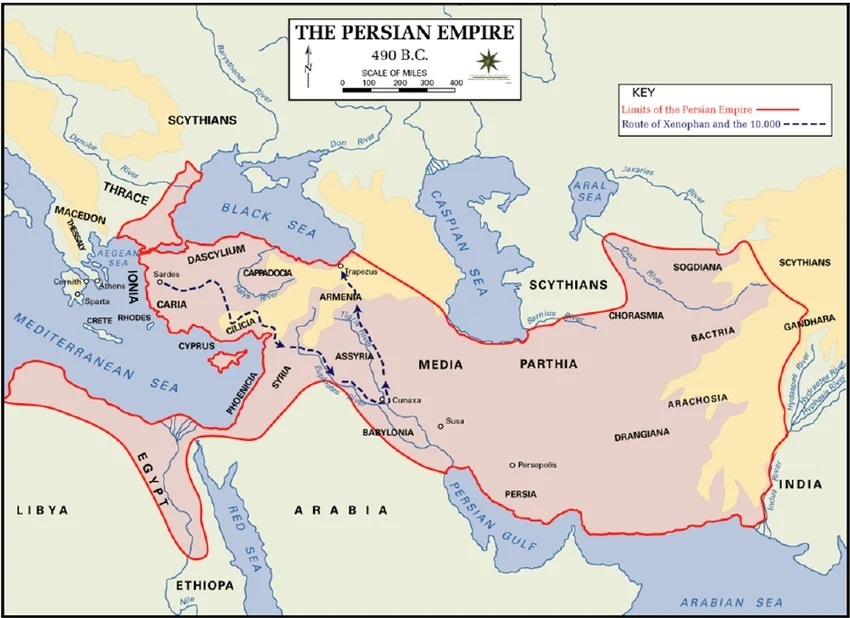
In short: That tension—forward ambition vs. forced retreat—is part of what makes the work endure as both history and adventure narrative. Anabasis 1. Author Bio (1–2 lines)Xenophon (c. 430–354 BCE) was an Athenian soldier, student of Socrates, and exile from Athens. He wrote historical and philosophical works shaped by direct military experience, especially his participation in the Persian expedition described in Anabasis. 2. Overview / Central Question(a) Genre & LengthProse historical memoir; relatively concise ancient narrative (7 books). (b) ≤10-word condensationGreek army survives hostile empire and returns home. (c) Roddenberry Question: What's this story really about?At its surface, Anabasis is a military memoir about Greek mercenaries marching deep into the Persian Empire and then fighting their way back after betrayal and leadership collapse. But its deeper purpose is to explore what happens when organized power collapses in an alien and hostile world—and whether courage, intelligence, and collective discipline can replace formal authority. The central question is: How does a leaderless or abandoned group survive when structure dissolves in chaos? Xenophon becomes both chronicler and participant in answering that question. At a deeper level, it is about the fragility of human plans and the emergence of leadership under pressure. The narrative becomes a study of improvisational order: how meaning, command, and survival are rebuilt in real time. Ultimately, it asks: When institutions fail, what remains of human agency, courage, and reason? 2A. Plot Summary (3–4 paragraphs)The Greek mercenary army, hired by Cyrus the Younger to challenge his brother Artaxerxes for the Persian throne, marches deep into the Persian interior. Though victorious in battle, Cyrus is killed, instantly collapsing the political purpose that justified the expedition. The Greeks suddenly find themselves stranded in the heart of enemy territory, surrounded by hostile forces, without supplies, political protection, or a clear command structure. Their generals are treacherously killed by Persian negotiators, leaving the army leaderless and psychologically destabilized. In this vacuum, Xenophon emerges as a decisive figure, helping reorganize the troops, restore discipline, and forge a survival strategy. The army chooses retreat—not surrender—as its only viable path. The remainder of the narrative follows their long, brutal march northward through mountains, hostile tribes, and starvation conditions until they finally reach the Black Sea and safety. The famous cry “Thalatta! Thalatta!” (“The sea! The sea!”) marks their emotional return from existential threat to survival. 3. Optional Special InstructionsFocus: collapse of authority → emergence of improvised leadership → survival ethics under existential pressure. 4. How this book engages the Great ConversationAnabasis sits at the intersection of existential survival and political philosophy. It asks:
Pressure forcing the text: the lived experience of mercenary warfare in a vast empire where Greek assumptions of order, citizenship, and command no longer apply. It contributes to the Great Conversation by showing that human beings do not merely live within systems—they must reconstruct them when they fail. 5. Condensed AnalysisProblemA disciplined army is suddenly abandoned in enemy territory without leadership, purpose, or legal protection. The problem is not just survival, but how order persists when its foundations collapse. Why it matters: it reveals that political systems are contingent, not natural. Under stress, they dissolve—and humans must rebuild them from behavior, trust, and necessity. Assumptions: that hierarchy, command, and shared purpose are sufficient for survival—until they are not. Core ClaimHuman groups can survive systemic collapse through adaptive leadership, rational discipline, and collective trust, even in the absence of formal authority. Xenophon demonstrates this through practical reorganization: councils, strategic retreats, and moral persuasion rather than coercion. If taken seriously: authority is not fixed—it is continuously generated through action under pressure. OpponentThe implicit opponent is the assumption that empire, command structures, and formal treaties guarantee safety and order. Counterpoint: Persian deception, leadership assassination, and geographic isolation show how quickly formal systems fail. Xenophon’s response is not theoretical but practical: reorganize or perish. BreakthroughThe insight: leadership is not a position but a function that emerges under necessity. Xenophon’s role illustrates that authority can be reconstructed through competence, courage, and persuasion rather than inheritance or appointment. This reframes politics as emergent rather than fixed. CostAccepting this view implies:
Loss: a sense of stable political security. One Central PassageThe moment Xenophon steps forward after the generals are murdered—urging the army not to despair but to reorganize—captures the essence of the work. It crystallizes the transformation from chaos → decision → collective survival. 6. Fear or Instability as MotivatorUnderlying fear: total abandonment within hostile orderless space—the terror of being alive but politically and structurally “unclaimed.” Also: fear of collapse of meaning when hierarchy dissolves. 7. Interpretive Method: Trans-Rational FrameworkApplied lens:
The text discloses that survival is not purely rational—it depends on felt legitimacy of leadership and collective psychological alignment under stress. Meaning is not only argued; it is enacted in movement. 8. Dramatic & Historical ContextSet during the late 5th century BCE Persian Empire expedition. Greek mercenaries are embedded in imperial power struggles. Cultural collision between Greek city-state autonomy and Persian imperial centralization forms the backdrop. 9. Section Overview (macro structure only)
10. Targeted Engagement (Selective Depth Only)six sections 11. Optional Vital Glossary
12. Deeper Significance / Strategic Themes
13. Decision PointNo passages here require deeper textual excavation. The work’s power lies more in structural narrative than in isolated philosophical density. 14. “First Day of History” LensYes—proto-example of:
It marks an early articulation of practical political realism grounded in experience rather than abstraction. 16. Reference Bank of Quotations (selected)
17. Core Concept / Mental Anchor“Collapse → improvised order → leadership as action under necessity.” 18. Famous Words / Cultural Terms
10. Targeted Engagement (Selective Depth Only, with Historical Anchoring)Section 1 – Expedition under Cyrus“A Private Army Inside an Imperial Civil War (401 BCE)”Paraphrased Summary (5–8 sentences)In 401 BCE, Cyrus the Younger, satrap of Lydia and son of Persian king Darius II, recruits roughly 10,000 Greek mercenaries to secretly support his bid to seize the Persian throne from his brother Artaxerxes II. The Greeks are told they are assisting in a minor campaign against rebellious satraps in Asia Minor. In reality, they are being inserted into a dynastic civil war at the center of the Achaemenid Empire. The army marches from Ionia through Asia Minor and into Mesopotamia, moving steadily eastward under conditions of increasing ambiguity. Most Greek soldiers remain unaware of the true objective until deep inside imperial territory. The expedition is economically rational for them (high pay, prestige), but politically opaque. Main Claim / PurposeThe expedition reveals how mercenary logic (contract, payment, tactical clarity) collapses when embedded inside imperial succession politics (opaque, unstable, existential). One Tension or QuestionHow long can soldiers maintain a belief in “bounded war” when they are already inside the center of a dynastic struggle of the Persian Empire? Rhetorical / Conceptual NoteThe Greeks think they are operating in a limited theater of war, but they are already inside the core instability of an empire in succession crisis (Darius II dies 404 BCE; Artaxerxes II reign begins 404 BCE). Section 2 – Collapse of Campaign after Cyrus’ Death“Cunaxa (September 401 BCE): Tactical Victory, Strategic Erasure”Paraphrased SummaryThe decisive battle occurs at Cunaxa (401 BCE) near Babylon. Cyrus initially appears successful due to the effectiveness of the Greek hoplite phalanx, which pushes back Persian forces on his flank. However, Cyrus himself charges directly at Artaxerxes II and is killed in the melee. His death instantly dissolves the political structure of the campaign. The Greeks have won their engagement but lost their employer, strategic justification, and protection within the empire. They remain deep inside hostile territory without diplomatic cover or supply guarantees. Main Claim / PurposeA military victory can instantly become meaningless when the political center of gravity disappears. One Tension or QuestionWhat does “winning” mean in a war whose reason for existence dies in the same moment as battlefield success? Rhetorical / Conceptual NoteCunaxa produces a rare historical paradox: tactical success + strategic annihilation at the same instant. Section 3 – Betrayal and Loss of Leadership“The Murder of the Chain of Command (401 BCE, post-Cunaxa aftermath)”Paraphrased SummaryFollowing Cyrus’ death, Persian satraps and officials initiate negotiations with the Greek commanders, promising guidance, truce, and safe conduct out of the empire. The Greeks accept under traditional assumptions of diplomatic immunity. However, at a meeting under safe-conduct terms, the senior Greek generals—including Clearchus—are seized and executed. This destroys the army’s formal leadership structure in a single stroke. The betrayal reveals that Persian diplomacy operates under radically different assumptions of trust and leverage than Greek hoplite norms. Main Claim / PurposeDiplomatic norms are not universal rules but strategic instruments contingent on power asymmetry. One Tension or QuestionWhat happens when the shared expectation of “safe negotiation” is no longer mutually recognized? Rhetorical / Conceptual NoteThis is a collapse of inter-cultural procedural trust systems, not just battlefield betrayal. Section 4 – Xenophon’s Emergence as Organizer“Leadership Reconstruction (401 BCE, post-execution crisis)”Paraphrased SummaryAfter the execution of the generals, panic spreads through the Greek mercenary force encamped near the Tigris region. At this moment, Xenophon—a young Athenian participant in the expedition and student of Socrates—emerges as a key organizer. He argues that despair is irrational and that survival remains structurally possible if discipline is restored. He helps convene assemblies, re-establish command hierarchies, and reframes the situation as solvable rather than catastrophic. Authority now emerges from rhetorical clarity, tactical reasoning, and perceived competence rather than formal rank. Main Claim / PurposeLeadership is emergent under crisis conditions and rooted in functional necessity rather than institutional appointment. One Tension or QuestionWhy does a group under existential threat reconstitute authority around individuals who demonstrate clarity rather than formal legitimacy? Rhetorical / Conceptual NoteXenophon’s authority is a real-time reconstruction of decision architecture inside a collapsed hierarchy. Section 5 – Strategic Retreat Northward“Decision After Structural Collapse (401 BCE onward)”Paraphrased SummaryThe Greek army decides to retreat northward toward the Black Sea (Euxine Sea), the nearest route to friendly Greek settlements along the coast of the Black Sea. This decision is made after eliminating all other viable options: staying invites Persian annihilation; moving east or south deepens entrapment. The retreat becomes a coordinated moving polity, constantly adjusting formations and strategy. The march is not pre-planned in detail but evolves through continuous decision-making under threat. Main Claim / PurposeIn conditions of total uncertainty, strategy becomes iterative survival optimization rather than fixed planning. One Tension or QuestionHow can rational decision-making persist when all possible paths are incomplete, dangerous, or unknown? Rhetorical / Conceptual NoteThe army functions as a mobile intelligence system improvising survival in real time. Section 6 – Survival Across Hostile Terrain“Geography as an Active Combatant (401 BCE winter–summer march)”Paraphrased SummaryThe retreat spans months across hostile terrain including the Armenian highlands and mountainous regions of northern Mesopotamia and Anatolia. The army endures freezing conditions, snow, limited supplies, and attacks from local populations such as the Carduchians (ancestors of modern Kurdish groups). Terrain acts as a constant adversary shaping movement and survival conditions. The Greeks must adapt formations, ration supplies, and maintain cohesion under exhaustion. Leadership becomes a continuous process of managing entropy across space and time. Main Claim / PurposeEnvironment is not passive background—it functions as a structural force shaping political and military behavior. One Tension or QuestionCan a cohesive identity survive when the primary opposition is not an army, but sustained environmental pressure? Rhetorical / Conceptual NoteNature operates here as a distributed force of attrition replacing the role of a singular enemy. Synthesis Insight (Across All Sections, with Historical Arc)Timeline anchor:
Structural arc:
Core Insight:Anabasis is a case study in what happens when *imperial structure, military command, and geographic certainty all collapse simultaneously—and must be rebuilt from human behavior alone.
|
||
|
|