|
Word Gems
self-knowledge, authentic living, full humanity, continual awakening
|
Great Books
Summary and Review
|
W.B. Yeats
Under Ben Bulben
return to 'Great Books' main-page
see a copy of the analysis format
Commentary by ChatGPT
Under Ben Bulben
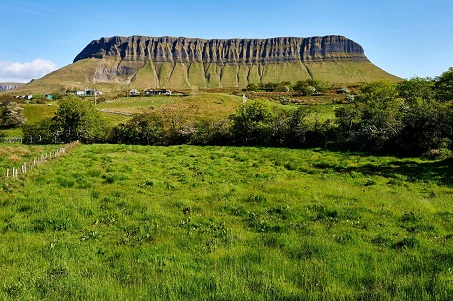
The title of Under Ben Bulben refers literally and symbolically to the mountain Ben Bulben in County Sligo, Ireland — a place deeply associated with William Butler Yeats throughout his life.
Literal Meaning
“Under Ben Bulben” means:
- beneath the mountain Ben Bulben,
- in the region overshadowed by it,
- and, implicitly, buried in its spiritual and geographic presence.
Yeats is in fact buried near Ben Bulben at Drumcliff churchyard in County Sligo.
The poem closes with his famous epitaph:
“Cast a cold eye
On life, on death.
Horseman, pass by!”
So the title already places the poem in the landscape of death, memory, ancestry, and artistic legacy.
What Is Ben Bulben?
Benbulbin is a distinctive flat-topped mountain formed by ancient geological forces. It dominates the Sligo landscape and appears throughout Yeats’s imagination.
For Yeats, Sligo was not merely scenery:
- it was mythic Ireland,
- the land of heroes, fairies, warriors, and spirits,
- the place where the visible and invisible worlds touch.
Ben Bulben thus becomes almost a sacred mountain in Yeats’s symbolic geography.
Symbolic Meaning of the Title
The title signals that the poem is:
- a final testament,
- spoken from the threshold of death,
- under the sign of Irish tradition and eternity.
The poem was written late in Yeats’s life (1938, published 1939), and it functions almost like:
- a poetic will,
- an artistic manifesto,
- and a farewell address to Ireland and future poets.
So “Under Ben Bulben” suggests several layers simultaneously:
1. Under the Mountain = Under Mortality
The mountain outlasts human life. Yeats places himself beneath something ancient and enduring.
2. Under Irish Tradition
Ben Bulben represents ancestral Ireland:
- myth,
- folklore,
- heroic memory,
- artistic inheritance.
Yeats speaks as a poet standing within that tradition.
3. Under Judgment
The phrase has an almost biblical or ceremonial tone:
- as though the poet stands before eternity,
- nature,
- and history.
4. Under the Realm of Vision
In Yeats’s mystical imagination, mountains are often places where worlds meet:
- mortal and immortal,
- historical and mythic,
- earthly and spiritual.
Ben Bulben becomes a symbolic axis between worlds.
Why This Title Fits the Poem So Well
The poem is not merely “about” Ben Bulben. The mountain gives the poem its atmosphere:
- stern,
- ancient,
- impersonal,
- enduring.
Yeats is trying to speak from beyond ordinary life — almost as a bardic voice issuing commands to future generations of artists and Irish people.
The title tells us immediately:
this is a poem spoken beneath the shadow of permanence.
Etymology of “Ben Bulben”
The name comes from the Irish:
- “Binn Ghulbain” or “Benn Gulbain.”
“Ben/Binn” means:
- peak,
- mountain,
- horn-shaped height.
“Gulbain” may derive from a word related to:
- beak,
- jaw,
- or pointed form.
So the name likely originally referred to the mountain’s distinctive shape.
Under Ben Bulben
1. Author Bio
William Butler Yeats (1865–1939)
Irish poet, dramatist, mystic, and Nobel Prize winner, central to the Irish Literary Revival. Yeats grew up between Dublin, London, and County Sligo, whose landscapes and folklore became foundational to his imagination. Major influences relevant to Under Ben Bulben include:
- Irish mythology and folklore
- Mysticism, occult philosophy, and cyclical theories of history
- Romanticism, especially William Blake (1757–1827)
- The political and cultural struggle for Irish identity
Late Yeats increasingly turned toward:
- mortality,
- artistic legacy,
- aristocratic heroism,
- and the role of the poet in civilization.
Under Ben Bulben is one of his final major poems.
2. Overview / Central Question
(a) Poetry or prose? Length?
A late prophetic poem in verse, moderate length (roughly 90 lines depending on edition).
(b) Entire work in ≤10 words
A dying poet commands future generations beneath eternity’s mountain.
(c) Roddenberry question: “What’s this story really about?”
What does an artist owe civilization before death arrives?
Yeats writes as an aging poet confronting mortality while trying to preserve something permanent against cultural decay. The poem asks whether art, heroism, aristocratic discipline, and spiritual vision can survive modernity’s flattening forces. Standing symbolically beneath the ancient mountain Ben Bulben, Yeats speaks almost like a bard issuing final commands to future Ireland. The poem becomes both farewell and challenge: live nobly, create greatly, and resist spiritual mediocrity before death silences you.
2A. Plot Summary of Entire Work
The poem opens in a visionary and mythic register. Yeats invokes supernatural imagery, ancient wisdom, and cyclical understandings of history, placing human life within a larger cosmic and ancestral order. The tone is elevated, ceremonial, almost prophetic.
The poem then turns toward civilization and art. Yeats reflects on Irish identity, European artistic traditions, and the proper role of poets, painters, and aristocratic culture. He attacks what he sees as vulgarity, mediocrity, and shallow modern thinking. Great art, he argues, emerges from disciplined tradition joined to living vision.
In the later sections, Yeats addresses Irish poets directly. He commands them to preserve heroic memory, national identity, and spiritual seriousness. The poet is not merely an entertainer but a guardian of civilization’s soul.
Finally, the poem narrows toward death. Yeats gives instructions for his burial near Ben Bulben in County Sligo and concludes with one of the most famous epitaphs in modern poetry:
“Cast a cold eye
On life, on death.
Horseman, pass by!”
The ending is austere, proud, detached, and strangely serene — a final act of self-mastery before oblivion.
4. How This Book Engages the Great Conversation
Yeats wrote during a period of enormous instability:
- the collapse of old European orders,
- mechanized modernity,
- Irish political upheaval,
- world war,
- and spiritual disorientation.
The pressure driving the poem is civilizational anxiety:
Can beauty, heroism, spiritual depth, and cultural memory survive modern mass society?
The poem engages the Great Conversation by asking:
- What gives human life dignity in the face of death?
- Is civilization merely economic and technological, or spiritual and artistic?
- What kind of person preserves meaning across generations?
- Can art resist historical decay?
Yeats’s answer is aristocratic in the deepest sense:
not merely social class, but excellence of soul.
The poem insists that:
- disciplined artistry,
- memory,
- myth,
- and heroic self-command
are necessary defenses against cultural disintegration.
5. Condensed Analysis
What problem is this thinker trying to solve, and what kind of reality must exist for their solution to make sense?
Problem
Yeats confronts the problem of cultural decline and personal mortality.
Modern civilization, in his view, risks becoming spiritually shallow:
- detached from myth,
- detached from heroic aspiration,
- detached from artistic greatness.
At the same time, the individual faces inevitable death. The problem therefore becomes:
How does one live meaningfully and leave behind enduring value in a transient world?
Underlying assumptions:
- civilization can spiritually decay,
- beauty and greatness are fragile,
- and mortality forces urgency upon all human endeavor.
Core Claim
Yeats argues that art, heroic discipline, and fidelity to cultural memory allow humanity to resist spiritual collapse.
The poet serves civilization by preserving:
- archetypes,
- memory,
- nobility,
- and transcendence.
If taken seriously, the poem implies that:
- culture is not automatically preserved,
- greatness requires intentional cultivation,
- and societies that abandon heroic imagination become spiritually impoverished.
Opponent
Yeats opposes:
- shallow modern materialism,
- cultural vulgarity,
- sentimental nationalism,
- and mechanized mass civilization.
Strong counterarguments include:
- Yeats’s aristocratic vision can appear elitist,
- nostalgic,
- or dismissive of democratic modernity.
Others might argue that modern society expands freedom rather than destroying culture.
Yeats responds indirectly by emphasizing permanence:
great civilizations are remembered not for comfort or efficiency, but for artistic and spiritual achievement.
Breakthrough
The poem transforms a personal farewell into a civilizational manifesto.
Rather than merely lamenting death, Yeats turns mortality into artistic authority. The dying poet becomes a prophetic voice speaking beyond his own lifetime.
The surprising insight:
death itself sharpens artistic vision.
Because life is finite, one must choose:
- greatness or mediocrity,
- memory or oblivion,
- vision or passivity.
Cost
Yeats’s vision demands:
- discipline,
- hierarchy of values,
- artistic rigor,
- and resistance to cultural conformity.
The risks include:
- romanticizing the past,
- undervaluing ordinary life,
- and narrowing human worth to heroic or artistic achievement.
Some readers may also feel that Yeats’s ideal civilization leaves insufficient room for equality or modern pluralism.
One Central Passage
“Poet and sculptor, do the work,
Nor let the modish painter shirk
What his great forefathers did.”
This passage crystallizes the poem’s central demand:
civilization survives only if artists continue the chain of disciplined excellence.
It captures:
- Yeats’s prophetic tone,
- his reverence for tradition,
- and his fear that modern culture abandons greatness for fashion and novelty.
8. Dramatic & Historical Context
Publication date: 1939
Composed largely in 1938, near the end of Yeats’s life.
Historical setting:
- aftermath of World War I,
- rise of mass politics,
- weakening of traditional European aristocratic culture,
- Irish independence and cultural nationalism.
Intellectual climate:
- modernism,
- crisis of faith,
- growing anxiety about civilizational collapse before World War II.
The poem feels almost like a final testament written on the edge of catastrophe.
Geographic center:
Benbulbin and the Sligo landscape, which Yeats mythologized throughout his career.
9. Sections Overview Only
- Mythic and supernatural invocation
- Cyclical vision of history and human existence
- Reflections on art and civilization
- Commands to Irish poets and artists
- Burial instructions and epitaph
10. Targeted Engagement
Final Epitaph — “Cast a cold eye”
Central Question
How should one face death without sentimentality or despair?
“Cast a cold eye
On life, on death.
Horseman, pass by!”
1. Paraphrased Summary
Yeats concludes by rejecting melodrama, self-pity, and emotional excess. The speaker asks the passerby to observe both life and death with clarity and detachment. Human existence is transient; one should neither cling sentimentally to life nor fear death excessively. The “horseman” continues onward, suggesting movement, continuity, and historical flow beyond any individual life. The tone is stoic, austere, aristocratic, and disciplined. Rather than begging remembrance, Yeats commands composure. The epitaph becomes an act of self-mastery.
2. Main Claim / Purpose
The passage argues that dignity comes from lucid confrontation with mortality rather than emotional denial.
3. One Tension or Question
Is this wisdom genuinely transcendent — or emotionally defensive?
Does “coldness” represent courage, or a refusal of vulnerability?
4. Rhetorical / Conceptual Note
The abrupt monosyllables create an epitaph-like hardness:
The language itself becomes granite-like, matching the permanence of the mountain landscape.
11. Optional Vital Glossary of the Book
Ben Bulben
Mountain in County Sligo symbolizing permanence, Irish myth, ancestry, and transcendence.
Aristocratic
For Yeats, not merely hereditary rank, but disciplined excellence and spiritual nobility.
Heroic Memory
The preservation of civilization through stories, art, and exemplars of greatness.
Cyclical History
Yeats believed history moved in recurring spirals or “gyres,” rather than simple linear progress.
12. Optional Post-Glossary Sections
Deeper Significance / Strategic Themes
The poem dramatizes one of humanity’s oldest anxieties:
whether excellence can survive comfort and mass culture.
Yeats fears civilizations die spiritually before they die politically.
The poem therefore becomes:
- a defense of artistic seriousness,
- a meditation on mortality,
- and a final attempt to transmit civilizational memory forward through language.
16. Reference-Bank of Quotations — Plus Commentary
1.
“Cast a cold eye / On life, on death.”
Paraphrase:
Look clearly and unsentimentally at existence.
Commentary:
One of modern poetry’s great stoic formulations.
2.
“Horseman, pass by!”
Paraphrase:
Continue onward; do not linger.
Commentary:
Suggests history’s movement beyond individual mortality.
3.
“Poet and sculptor, do the work.”
Paraphrase:
Artists must continue civilization’s labor.
Commentary:
Art becomes a sacred duty rather than private self-expression.
4.
“Measure the lot; forgive myself the lot!”
Paraphrase:
Recognize human limitation and fate.
Commentary:
Shows Yeats wrestling with judgment, destiny, and self-acceptance.
5.
“Irish poets, learn your trade.”
Paraphrase:
Master tradition before attempting greatness.
Commentary:
Yeats rejects spontaneity detached from discipline.
6.
“Sing the peasantry, and then
Hard-riding country gentlemen.”
Paraphrase:
Preserve the full social memory of Ireland.
Commentary:
Yeats idealizes older social forms and heroic continuity.
18. Famous Words
The epitaph has become one of the most famous endings in modern poetry:
“Cast a cold eye
On life, on death.
Horseman, pass by!”
It is widely quoted because it compresses:
- mortality,
- stoicism,
- dignity,
- detachment,
- and movement beyond death
into four short lines.
The phrase “Cast a cold eye” has entered broader literary and cultural vocabulary as shorthand for unsentimental clarity in the face of reality.
|