|
home | what's new | other sites | contact | about |
||||
|
Word Gems self-knowledge, authentic living, full humanity, continual awakening
Rainer Maria Rilke Duino Elegies
return to 'Great Books' main-page
see a copy of the analysis format Commentary by ChatGPT
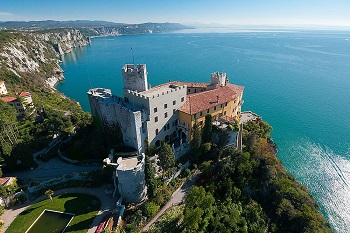
Duino Castle, Italy
Duino Elegies 1. Literal Meaning of the TitleThe title Duino Elegies combines:
So at the simplest level, the title means:
But the title’s real force lies much deeper. 2. Roddenberry QuestionWhat is this work really about?The Duino Elegies are about:
Rilke asks:
The title Elegies signals that the poems are not merely sad: 3. Why “Elegies” MattersTraditionally, an elegy mourns:
Rilke radicalizes the form. These poems mourn:
The opening cry announces this immediately:
This is not ordinary sadness. 4. The Meaning of “Duino”The geographical name matters because Duino becomes symbolic. The castle stands:
Rilke reportedly heard the opening line while walking storm cliffs above the Adriatic. Thus “Duino” becomes:
The title therefore suggests:
5. The Elegiac VisionUnlike ordinary religious poetry, the Duino Elegies do not promise:
Instead, Rilke proposes something harder: Human greatness lies precisely in mortality. The angels in the poems are terrifying because they are complete beings. Yet this incompleteness gives humans a unique power: One of Rilke’s central insights is:
That burden becomes both agony and glory. 6. Composition and Historical WeightRilke began the elegies in 1912 but completed them only in 1922 after a long creative paralysis intensified by:
This matters because the poems stand at the collapse of old Europe. The title therefore also carries the feeling of:
7. Condensed AnalysisCentral Guiding Question
Condensed AnswerThe title Duino Elegies signals poems of lament born at the edge of spiritual revelation. The “elegy” is not merely grief for death, but grief for the entire human condition: our separation from permanence, our inability to fully possess beauty, love, or reality itself. Yet Rilke transforms lament into affirmation. Mortality becomes meaningful precisely because humans can inwardly transform transient experience into consciousness, memory, art, and praise. 8. Why the Title EnduresThe title remains powerful because it sounds simultaneously:
“Duino” gives the poems a physical location. Together they imply:
Duino Elegies 1. Author Bio (1–2 lines)Rainer Maria Rilke (1875–1926) was a German-language modernist poet shaped by Symbolism, Russian spirituality, artistic mysticism, and the collapse of old Europe before and after World War I. His poetry seeks a language capable of confronting mortality, beauty, terror, and transcendence simultaneously. 2. Overview / Central Question(a) Form and LengthA cycle of ten philosophical-spiritual elegiac poems written in highly lyrical poetic prose/verse form. Moderate length, but extraordinarily dense. (b) Entire Book in ≤10 Words
(c) Roddenberry question: “What’s this story really about?”
The Duino Elegies explore what it means to be human in a universe that is simultaneously radiant and terrifying. Rilke presents humanity as suspended between animals, who live instinctively, and angels, who exist in unbearable perfection. The poems argue that mortality itself may be humanity’s highest dignity because fleeting existence forces humans to transform experience inwardly into meaning, memory, art, and praise. Across the elegies, lament slowly transforms into affirmation: existence is painful precisely because it matters. 2A. Plot Summary of Entire WorkThe Duino Elegies do not possess conventional plot, but they do follow an existential movement. The First Elegy opens with one of literature’s great cries into metaphysical silence: “Who, if I cried out, would hear me among the angelic orders?” Humanity appears fragile, abandoned, exposed before overwhelming reality. Angels symbolize a level of existence too intense for human beings to endure. Beauty itself becomes terrifying because it reveals transcendence while reminding humans of mortality. The middle elegies deepen this tension. Rilke reflects on lovers, children, heroes, animals, memory, and artistic creation. Human beings long for permanence yet live amid decay and separation. Animals possess immediate unity with existence, while humans possess self-consciousness, which simultaneously elevates and wounds them. Love fails to permanently overcome isolation. Heroism cannot abolish death. Consciousness itself becomes both humanity’s curse and greatness. As the elegies progress, the poems shift from despair toward transformation. Suffering and transience begin to appear not as cosmic mistakes but as the very conditions that make inward depth possible. Humans become meaningful because they can bear loss consciously. The visible world must be “praised” precisely because it disappears. Mortality creates urgency, intensity, and reverence. The final elegies move toward difficult affirmation. Rather than escaping earthly existence for heavenly certainty, Rilke embraces the tragic beauty of finite life itself. Humanity’s task is not conquest of death but transfiguration of experience into inward spiritual reality. The poems conclude not with doctrinal resolution but with heightened existential awareness: to be human is to stand vulnerably between terror and praise. 3. Optional: Special Instructions for this Book from ChatThis work should not be treated merely as “symbolist poetry.” Its enduring power comes from existential pressure: the terror of consciousness itself. The angels are not sentimental religious figures but embodiments of overwhelming being. 4. How This Book Engages the Great ConversationThe Duino Elegies confront nearly every central philosophical question directly:
The pressure forcing Rilke to address these questions was civilizational collapse and metaphysical instability. Europe’s inherited religious structures were weakening; modernity increasingly reduced existence to mechanism and utility. Rilke responds by attempting something almost impossible:
The elegies therefore stand at the frontier between religion, philosophy, psychology, and poetry. 5. Condensed AnalysisCentral Guiding Question
ProblemRilke confronts the unbearable instability of human existence:
The problem matters because modern humanity increasingly experiences transcendence only as absence or longing. Humans desire permanence while inhabiting a dying world. Underlying assumption: Core ClaimRilke’s central claim is:
Because humans perish, they uniquely transform transient experience into inward consciousness, memory, art, love, and praise. The poems support this not through logical argument but through visionary imagery, emotional resonance, and symbolic contrasts:
If taken seriously, the claim implies:
OpponentRilke challenges:
He also implicitly opposes escapist spirituality that rejects earthly existence in favor of abstract transcendence. Strong counterarguments:
Rilke answers not through proof but through poetic enactment: the poems attempt to make readers feel transformed perception. BreakthroughRilke’s breakthrough is the reinterpretation of finitude itself. Instead of asking: he asks:
This changes the existential frame entirely. Human limitation becomes:
This insight remains mesmerizing because it transforms despair into tragic affirmation without relying on simplistic consolation. CostRilke’s position demands:
Trade-offs:
What may be lost:
One Central Passage
Why pivotal: This line captures the entire existential architecture of the Elegies. Beauty matters because it reveals something larger than humanity, yet that revelation destabilizes the self. The passage embodies Rilke’s fusion of ecstasy and dread: transcendence is magnificent precisely because it threatens human smallness. 6. Fear or Instability as Underlying MotivatorThe underlying fear is:
More specifically:
The elegies attempt to transmute terror into reverence. 7. Interpretive Method: Trans-Rational FrameworkRilke cannot be understood through discursive reasoning alone. The poems operate trans-rationally:
The reader must not merely decode symbols but undergo altered perception. Much of the work’s meaning emerges through intuitive recognition:
Before: After: 8. Dramatic & Historical ContextPublication DateWritten primarily 1912–1922; published in 1923. Historical SettingThe elegies emerged amid:
Rilke began the poems at Duino Castle overlooking the Adriatic cliffs — a fitting symbolic threshold between worlds. Interlocutors and influences include:
9. Sections Overview Only
10. Targeted Engagement (Selective Depth Only)Section I — The Opening CryCentral Question
Passage
1. Paraphrased SummaryThe poem begins not with certainty but with exposure. The speaker calls outward into a universe that may not answer. Angels appear not as comforting guardians but as overwhelming beings whose intensity would annihilate ordinary humans. Human life is revealed as fragile, temporary, and vulnerable before realities beyond comprehension. Yet the act of crying out itself matters: consciousness refuses silence. The poem establishes the entire structure of the elegies — humanity trapped between longing for transcendence and terror of it. 2. Main Claim / PurposeThe passage establishes:
The human condition is therefore defined by partial access to deeper reality. 3. One Tension or QuestionIf transcendence overwhelms humanity, can humans genuinely know it at all? Does the longing for transcendence reveal truth, or merely psychological need? 4. Rhetorical / Conceptual NoteThe opening question is both prayer and existential scream. The ambiguity is deliberate. 11. Optional Vital Glossary of the BookAngelNot a sentimental religious being, but overwhelming pure existence. PraiseThe act of affirming transient reality despite mortality. TerrorThe destabilizing intensity of beauty and transcendence. TransformationThe inward conversion of suffering into consciousness and meaning. OpenA state animals inhabit naturally: immediate unity with existence. 12. Optional Post-Glossary SectionDeeper Significance / Strategic ThemesThe Duino Elegies helped shape:
The work remains compelling because it articulates a modern spiritual condition:
13. Decision PointAre there 1–3 passages that carry the whole book? Yes. Especially:
These passages justify selective deep engagement because they contain the entire existential architecture of the work. 14. “First Day of History” LensRilke did not invent existential anxiety, but he achieved something historically distinctive:
The Elegies represent one of the first major attempts to create post-religious sacred poetry without collapsing into nihilism. 16. Reference-Bank of Quotations(with paraphrase and commentary) 1. “Who, if I cried out, would hear me among the angelic orders?”ParaphraseHuman beings call into ultimate reality without certainty of response. CommentaryThis may be the defining modern spiritual question: longing persists even when certainty collapses. 2. “For beauty is nothing but the beginning of terror…”ParaphraseBeauty overwhelms because it hints at realities larger than ourselves. CommentaryRilke permanently altered modern discussions of beauty with this formulation. 3. “Every angel is terrifying.”ParaphrasePure transcendence is too intense for ordinary humanity. CommentaryThis reverses sentimental religious imagery completely. 4. “Here is the time for the sayable, here is its homeland.”ParaphraseHuman existence uniquely transforms experience into language and meaning. CommentaryLanguage itself becomes sacred vocation. 5. “Praise this world to the angel…”ParaphraseThe visible world deserves affirmation despite impermanence. CommentaryThis is Rilke’s tragic spirituality in concentrated form. 17. Core Concept / Mental Anchor
Or more simply:
18. Famous WordsMost famous lines:
These phrases entered modern literary and philosophical consciousness as shorthand for existential awe and metaphysical vulnerability. Ed: Other translations have it, "every angel is terrible", which is even more jarring. Chat: Yes, and many readers feel “terrible” is closer to the shock of the original German.
Rilke writes:
The key word is schrecklich:
“Terrifying” is the smoother modern English choice because today “terrible” often merely means “bad.” But older English retains the deeper sense:
So:
has a harsher metaphysical force. It sounds wrong at first because modern sentimental religion trains readers to imagine angels as comforting, gentle, therapeutic beings. Rilke destroys that immediately. His angels are closer to:
They are not evil. That is why the line is so destabilizing. The logic is:
This connects directly to the next famous line:
In Rilke, beauty and terror are inseparable because genuine beauty hints at infinity while humans remain finite. The line also matters historically because it marks a profound shift in modern spirituality. Medieval religious art often rendered angels as reassuring messengers of divine order. Rilke’s angels emerge after:
So the angel no longer reassures: One could almost summarize the Duino Elegies this way:
That question gives the work its lasting voltage.
|
||||
|
|