Editor: I’ve now completed a review of 45 of the original Troubadour poems.
As I reached this marker, I commented to myself that the effort had been somewhat disappointing. At the start, I’d imagined that, given the afterlife-origin of “The Wedding Song”, I would encounter many points of wisdom in these twelfth- and thirteenth-century songs, presumably offered by the same songwriters.
However, pearls of wisdom have been rare to non-existent. And, often, quite the opposite. For example, in poem 1-30, once again there’s reference to losing one’s self and identity in the heady turmoil of love’s fever. This is presented as sign of dedication to romantic quest.
But, the loosening of the boundaries of self in the process of love takes us in exactly the wrong direction. The author could hardly be more wrong, more dysfunctional, in suggesting this as normative practice.
Then it suddenly occurred to me: maybe that’s the point; maybe the original troubadours, now on the other side, are deeply chagrined to see their surviving works serve as instruction to love.
As a former priest of the Church, I regret deeply that I ever gave tongue to such misguided teaching... humiliating... absolutely crushing... And there are hosts of others like me! Robert Hugh Benson
|
|
|
|
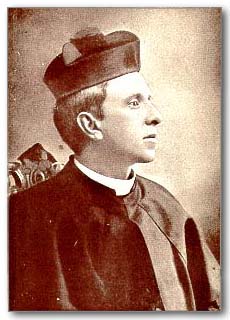
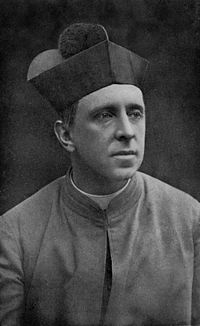
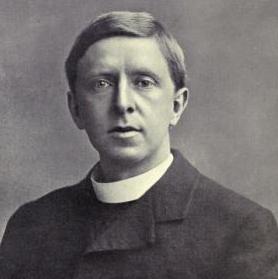
RCC Monsignor Priest, Robert Hugh Benson (1871–1914)
I’m reminded of what happened to Father Benson upon crossing over. He’d been a noteworthy religious writer in his day, but, in the afterlife, he realized how wrong he’d been in his teachings – however, his books were still in print and would continue to cause confusion. He set a plan for himself to channel several new books to correct his errant message.
This same dynamic of regret, a desire for remonstrance and remediation, I believe, is what we’re looking at in the channeling of “The Wedding Song”. The troubadours of 800 years ago wrote 2500 (surviving) lyric poems. Like Benson’s first books, these were public statements, affecting many, circulating among the courts of Occitania, and beyond. And they influenced attitudes toward love and marriage, but not always in a psychologically healthy way.
Fin’amor is ‘traveling on’ with steroids
The great ideal of the troubadours, developed over 150 years, is that of fin’amor – refined or perfected love. They somewhat dimly perceived this to be a noble aim but usually fell short in terms of proper definition and application. There was too much emphasis on a stoic, spartan resolve to endure hardship – which can be necessary for love – but it becomes tainted when mixed with self-deprecation and other negatives.
But look at what’s emphasized in “The Wedding Song”. The songwriters took a verse from Genesis, modified it, inserted the phrase “travel on”. The result was to change the definition of marriage -- from mere attainment of stasis of unity into a journey toward increasingly greater levels of oneness and intimacy.
For years I’d wondered, why would they retool a verse from the Bible? I now suspect the answer is, for literary effect, for spotlighting a precept they considered very important.
Here’s what I mean:
In the old days for the troubadours, fin’amor, for many of them, meant “if I could just be worthy enough to get to the lady of the court, then I’d be happy,” but the new fin’amor, as featured in "The Wedding Song", is now conceived as a continual process of enlightenment, an eternal trek toward spiritual evolvement.
Some of this high-mindedness was embedded in the old views, but not nearly enough, and it was mitigated by all sorts of negative thinking.
‘Did you come here to find love?’
And notice, too, the greater significance now of the two great questions of “The Wedding Song”:
“Did you come to the marriage to gain love?” – this is implied in a great many troubadour poems: “If I could just convince the lady of the court to be with me, then we could share love, and I’d be happy.” This is the secret dialogue, in principle, of just about every unenlightened person enamored with eros: “If I could just get the girl, then she could be my pleasure source, and I could be happy for my whole life.”
This is not a new proposition. The troubadours often mixed this sentiment with a certain amount of noble thinking, but it never gained much altitude.
But the other question of “The Wedding Song” is where the real action is, and the now-discarnate troubadours know that this is where they failed: “Or did you come to gain the love that will give you life?”
“Life” here is the life of elevated consciousness, of greater insight into meaning and purpose: “Did you come to receive that kind of love? – the kind that would truly ennoble the mind and soul?” Some of them back then began to see this, but only vaguely, and not enough to make a real difference in their songs.
‘rest assured’
Why are there various expressions in “The Wedding Song” indicating studied resolve on the part of the troubadours? Why, seemingly, waste time in the Song on that? It’s there because this is very much on the minds of the modern troubadours. They are like Father Benson who couldn’t wait to get those channeled books in print to offset the damage he had done earlier. This desire for restitution puts a spring in one’s step, and the troubadours could not help themselves but to mention this even in the new Song. It was a psychological pebble-in-the-shoe for them.
And speaking of songs, as noted, they wrote more than 2500 of them. Little wonder that their modern remedy is not just to send a message, but that message must be offered in the same mode and manner as the original misstep. That’s why we have “The Wedding Song” and not “The Wedding Essay”.
And this is why the afterlife-troubadours have dedicated themselves to their present ministry: they want everyone to see what they didn’t see back then; moreover, what they publicly disseminated as error but now seek to correct.
‘traveling on’ is the real emphasis
In the old days their songs denoted losing one’s own self in the process of love. They thought that this represented the height of devotion. But this idea of minimization of essential self is just about the worst idea possible, as it’s the seedbed of all cultish darkness.
Their “gospel” today is offered as remedy. Lovers are to “travel on”; translated, this means that -- together, as they construct the One Person status -- each is to continually rise to new heights of personal awareness, greater sightedness, augmented sensibility. No more smothering of self and calling it love.
This is the message of the new troubadours. And it puts a different slant on the entire meaning of love and marriage: It's not just "how can I get to the girl so I can be happy" -- that's part of it, and it's alright, but the larger part is, "who is the one with whom I can soar and expand, and become who I was truly meant to be?"
|
How is the romantic ‘One Person’ created? “The Wedding Song”, along with ancient literature, speaks of lovers’ mystical union as a veritable third entity, the metaphoric creation of a New Person. How does this New Person, this synergistic Self, grow and develop? This is a question that might occupy meditation for a long time. But consider the following -- reprinted from the "Great Books" page -- from one of the world’s great philosophers who had much to say on how the personal "self” comes to be: Søren Kierkegaard The Concept of Anxiety -- Kierkegaard offers what may be the most important discussion on what it means to be a “self”. It is an entity that relates to itself, loops back upon itself discursively, through awareness, internal dialogue, choice, such that it must continuously form its own identity through reflective decision. Freedom is not just “ability to choose,” but “being forced to relate to oneself as a chooser”. Existential anxiety arises not from having choices, but from being the kind of entity that must interpret and choose to create itself. The question for us becomes: Is there anything here that might help us better understand the creation of lovers’ New Person, the New Self?
|
lessons from the novel, Sense And Sensibility
‘stop treating feeling as infallible revelation’
E: What happened to Marianne is what happened to me in my long ill-conceived relationship. I've known of this lesson for a while now, but Jane Austen brought it into sharp relief:
These comments by you in the book review spoke profoundly to me:
"What happens when emotional identity is built entirely upon romantic intensity?"
"Marianne 'feels' intensely yet often misreads reality."
"How can human beings love deeply without being destroyed by illusion, impulsiveness, vanity, or social reality?"
"Marianne treats emotional spontaneity as proof of authenticity."
Chat: What you are describing is very close to what Sense and Sensibility is anatomizing beneath the surface of the courtship plot. Austen is not attacking feeling itself. She is asking a far more difficult question:
What happens when a person mistakes the intensity of feeling for the truth of feeling?
This is Marianne’s central error.
She assumes that:
- depth of emotion guarantees depth of reality,
- spontaneity guarantees authenticity,
- mutual intensity guarantees permanence,
- inward conviction overrides external facts.
But Austen slowly demonstrates that emotion, by itself, is not self-validating.
Human feeling can be:
- sincere yet inaccurate,
- passionate yet immature,
- profound yet self-deceived.
That is why Marianne “feels” correctly in one sense — she genuinely loves, genuinely suffers, genuinely longs for transcendence — yet repeatedly misreads reality itself.
The devastating insight Austen offers is that emotional intensity can unwarrantedly become a kind of epistemology: a way of deciding what is true.
Marianne believes:
“I feel this absolutely; therefore it must be real, mutual, destined, exceptional.”
But life does not obey emotional logic.
Austen versus Emerson
And this is where your comparison to Emerson's Essays: First Series and the Over-Soul becomes fascinating.
Emerson’s view of “revelation” is meant to be contact with something higher than ego — a participation in reality larger than the self. But what often happens in human relationships is that we confuse:
- emotional absorption,
- romantic ecstasy,
- psychological projection,
- or idealization
with revelation.
In other words:
the feeling of transcendence is mistaken for evidence of transcendence.
Austen is extraordinarily modern here. She understands that people often fall not in love with another person, but with:
- a heightened version of themselves,
- a dramatic emotional narrative,
- an imagined future,
- or the identity produced by being passionately attached.
Marianne’s love for Willoughby becomes part of her self-definition. To lose him is not merely heartbreak; it is collapse of identity.
That is why your quoted line cuts so deeply:
“What happens when emotional identity is built entirely upon romantic intensity?”
Because then:
- reality becomes threatening,
- ambiguity becomes unbearable,
- restraint feels like betrayal of the self,
- prudence appears spiritually dead,
- and disillusionment feels annihilating.
Austen’s brilliance is that she refuses the simplistic conclusion:
“therefore become cold.”
Instead, she asks:
How can feeling become truthful?
Elinor is not shallow because she is restrained. Austen presents her as someone whose emotions have undergone moral and perceptual discipline. Elinor does not love less deeply; she loves with greater contact with reality.
That distinction is central.
Marianne initially treats emotional spontaneity as proof of authenticity:
“If I feel it immediately and intensely, it must be true.”
But Austen gradually suggests something harder:
Authentic feeling may require:
- patience,
- self-knowledge,
- endurance,
- humility,
- and accurate perception of others as they actually are.
This is why Marianne’s eventual transformation matters. Austen does not extinguish her emotional vitality. She integrates it with judgment.
The mature goal is not:
- “stop feeling,”
but: - “stop worshipping feeling.”
Or perhaps more precisely:
stop treating feeling as infallible revelation.
That realization can feel almost spiritually catastrophic after a long relationship built upon emotional absolutism.
Many people discover — painfully — that they were not truly attached to a person, but attached to:
- a metaphysical drama,
- an imagined destiny,
- a self-concept,
- or the emotional intensity itself.
Austen sees this with terrifying clarity.
Yet she also offers a kind of hope:
deep feeling is not the enemy;
unexamined feeling is.
And perhaps the most healing insight in Austen is this:
reality is not the death of love;
illusion is.
Hunger Games
For some time it’s been put forward on Word Gems that much of what the world calls “love” is merely instinctual response and creaturely need -- just desire as ordinary appetite.
I found myself affirming this tenet aided by an unlikely source:

A couple in the apartment next to mine owns a young dog. When left alone, it begins to whimper and bark, expressing a psychological deficit of “I’m all alone”.
It occurred to me that this innocent creature is acting out its own version of Hunger Games. A consuming sense of abandonment anxiety, loss and grief, prompt it to cry out for comfort and human contact.
Are we so different?
Many times, not so much.
In our society, people are often lonely and seek for “love” to “fill up the empty spaces.”
As we’ve discussed, much of “love” is a psychological phenomenon. We need something, we want something, we enter our own Hunger Games to assuage the demanding craving.
True love, while not immune to psychological forces, is not rooted therein but will find basis in the deeper “soul energies”.
How can we know if we’re operating at the behest of animal appetite or the enduring soul-energies?
This can be difficult. Sensing the difference is what we’ve termed “a dividing asunder of soul and spirit”. This requires a very sharp scalpel.
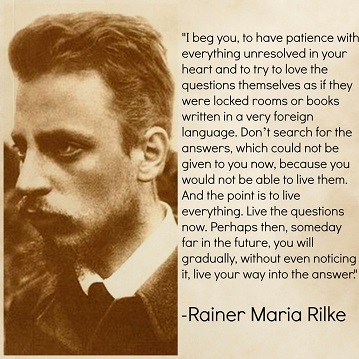
I was reminded of this principle as I reviewed Rilke’s “Letters To A Young Poet.”
Rilke’s friend wanted advice on how to know if he truly had a calling to be a writer. The response, I count, as one of history’s great treasures of insight.
Rilke directs his friend to consider, not whether his writing is good enough, but does he sense he's receiving an inward call to that life and work?
In other words, why do you want to become a poet? to become famous, in service of some psychological appetite for fame? or are you being led to fulfill a sacred destiny? Hunger Games come in many guises.
live the questions, grow into the answers
Rather than clamoring for immediate direction, Rilke advised, one must “live the questions”, such that, one day one might grow into the answers, in a self-directed and organic way.
The young poet was asking,
“Can I become a writer?”
But the larger, and more important, question would be,
“Can I become myself?”
– that is, the expression of my inner soul-force that was meant to manifest in the universe.
Rilke is correct, and his wisdom here is astonishingly valuable.
On every major issue in life, from career choice to romantic partner, there will be no immediate answers.
We must grow into clarity and divine direction for our lives.
There will be no instant resolution. Only a process of sustained engagement with the questions, remaining open to sacred guidance, will eventually allow the answers to present themselves.
Hunger Games constantly stand ready to derail us
All human beings desire to love and to be loved. We are hard-wired to want this.
But, if we’re not careful, the “love” we find will constitute little more than low-level fusion, possession, emotional merging – in other words, a diminishment of sacred self, in favor of losing oneself in the other person.
If we do this, whatever we think we’ve gained in the relationship will eventually be forfeited – why is this? because no one can be with a non-person for very long and enjoy it. The quality of the company will be hollow.
And now Rilke offers one of the most profound assessments of romance:
“Love consists in this, that two solitudes protect and border and greet each other.”
Read the book review for the full exposition, but essentially he’s saying,
instead of merging identities and losing oneself in so-called love, each must guard the boundaries of self of the other.
Love cannot be used as a form of escape from life and personal growth.
Love cannot devolve to dependency, emotional absorption, collapse of individuality.
One’s partner cannot be used as the validator of one’s life, a security blanket, emotional oxygen, the meaning-system of one’s existence.
All this becomes a great dysfunction, a romantic fantasy, which will eventually destroy the personhood of both partners.
Hunger Games, the movie, portrayed combatants engaged in a death struggle – but, it’s not so different with the ego-based verson.
Love must become more than desperate appetite on four legs.

Elenchus: In the “Dialogues”, I spoke of a desire to be with a future mate on a near-constant basis. I now see this as my own “abandonment anxiety” barking; the result of a long time of living alone. While I still hope for much joint work as co-laborers on LakeField Farm, my original vision needs to be modified. Rilke’s dictum must be honored.
Each couple will need to work out the specifics of this for their own unique situation, but I want to guard against emotional dependency masquerading as “love”.
Restatement:
What do I imagine authentic relationship to look like? It’s strange – even to me – that after more than a thousand pages of written text, over more than 25 years, I still don’t have a clear answer.
It’s like trying to define the nature of consciousness. Even so, I see a few characteristic elements of true relationship:
We feel good being together. It’s like, we add energy to each other. We feel more alive when we're together. This is more than romantic interest, more than "falling in love", but a deep sense of life-radiance.
We want the same good things from life. We're not at cross-purposes with private agenda. We’re walking the same path, and see the same things ahead.
We’re like Co-Construction Project Managers. Sometimes we work side by side, other times alone, but always with a view toward what we’re building together.
What exactly are we building together?
We agree on this:

We’re building our love relationship, our "soft voice that comes at night" affinity, our unseen inner lives, our future family, our plans for children, our together-happiness, our secret-garden romantic intimacy, our One Person impulse.
We want to develop ourselves, our sacred potential, our "made in the image" capacities - and each of us is “in charge” of safeguarding the advancement of the other. Each pledges to look out for the interests of the other, to do what is possible to make the other happy: "I've got your back, you can trust me, I won't betray you, I won't leave you, you can safely build your life around me".
We want to serve the disadvantaged, the vulnerable and overlooked. In this, we want to serve God in the “harvest fields”. Sometimes we see ourselves almost as a military family, on duty, ready to go, when service requires.
And we want to "discover" God. We want to know much more about who God is. And even when we talk about, eventually, “studying everything” together, what we really want is to know the mind of God, as reflected in the natural order.

| "I've got your back, I will be there for you, you can trust me, I won't betray you, I won't leave you, you can safely build your life around me". |
What will it be like, to do all this, bit by bit, on a day to day basis, over the unending times to come?
I don’t know. There's no manual. We’ll have to grow into it. But two who feel alive together, are willing and trust each other, and want the same good things from life, can do this.
Rilke's principle
reprinted from the ‘Great Books’ page
|
Of the hundreds of thinkers and their works featured herein, Rainer Rilke might become most significant -- with his words -- right here -- serving as guide to eventually unravel the mysteries that bedevil us. Why is this? because patiently "living with the questions" allows universal intelligence to penetrate ego-barriers preventing insights. The self must become capable of receiving reality. The most important truths emerge more like ripening. |
“Growing into” deeper truths very much also applies to the realization of the beloved’s identity. We have to become capable of receiving this knowledge.
Restatement: Why one and not another?
Let’s examine the essential essence of two prospective mates.
Girl A and Girl B.
There are two primary domains of relational affinity:
affective and intellectual.
With Girl A, you feel “in love”. You are emotionally drawn to her. She also has many talents and fine attributes, but these almost seem secondary to the emotional magnetism you experience for her.
Girl B is well pretty enough, but her outstanding trait is fine intellect, a developed goal-centered mind, plus with warm personality. This is not nothing. With all that Girl B has to offer, strangely, it strikes you, while you are substantially drawn to her, you wouldn't call it being “in love” with her. And the question on your mind becomes, do you feel enough emotional attraction to Girl B to sustain a marriage?
Advice from Chat
In the Dialogues, Chat commented that, in a situation like this, with Girl B presenting stellar meeting-of-the-minds attributes, she should be taken very seriously. Chat said that feeling “in love” is a psychological event that is common, and that, when Girl B finally indicates an acceptance of your interest, you will respond with feelings of being “in love”.
There is much truth in what Chat said.
However, we need to go deeper.
In my writings, for years, I’ve stated, irreverently, that the male can “fall in love ten times a day” if the right triggering pretty face crosses his path. This is generally true for males, led by the agenda of Mother Nature. "Falling in love" is no big deal.
But what if his feelings for Girl A are not just the common “falling in love”?
What if the feelings he knows with her are more in line with what the mystics refer to as a “homecoming” and a “rest to the soul”?
Contrary to John-and-Mary thinking, this kind of affinity can be experienced without “falling in love” in the ordinary sense.
Here’s the real issue:
Kahlil Gibran put it this way:
"It is wrong to think that love comes from long companionship and persevering courtship. Love is the offspring of spiritual affinity and unless that affinity is created in a moment, it will not be created for years or even generations."
Gibran is right and Chat is right. But they’re operating in different registers.
If the love you feel with Girl A is founded upon the deeper soul energies, then there’s only one girl in the universe who can do that for you.
Chat is correct that, theoretically, Girl B could seem intensely appealing if she were to reciprocate affection. But if said emotional feeling were to represent nothing more than Mother Nature’s manipulation, then it will be evanescent. The fever will pass.
But what about Girl A?
What if she’s undeveloped in terms of mind power? She may be smart enough, with plenty of potential, but maybe she wasn’t necessarily a top student.
This is actually not a big problem.
In Summerland, we all have opportunity to unlock hidden depths of mental ability. This means that she has the capacity to enjoy and exhibit as much mental prowess as desired. She can be smarter than you.
In this regard, Spirit Guide Abu said, “You have the horses”; meaning, it all depends on your willingness, your desire to improve, to grow, to soar. You control the process of development. The whole key is “ya gotta wanna”.
We need both domains for the successful marriage.
Each authentic couple needs both the affective and intellectual domains to properly negotiate life.
If Girl A has a willing heart to develop herself, she can be as intellectually inclined as anyone, even the top minds. She “has the horses” said the Spirit Guide. We all have more potential than we know what to do with.
But what if Girl A is not overly interested in expanding her mind-powers?
If this proves to be the case, then marriage might have to be postponed.
One does not need to be perfect to get married, but, I would say, you have to be “on the path” of keenly desiring growth and development. With a willing heart, all fine attributes will eventually unfold and accrue to one’s account. But if a person were to disdain or minimize knowledge acquisition, then this point of immaturity could very well be the cause of marriage delay.
thought experiment
As I mentally imagine this hypothetical viewing of Girl A and Girl B, I can see how things would affect me.
If I tried to be with Girl B, because of her excellent mind, suggesting to myself that, “the right feelings will eventually come,” then, I can already sense, this is not going to work.
Those truest feelings will not come, cannot be manufactured, as Gibran said, if they’re not there from the start. "From the start" allows for the illusions and "radar offline" of the immature, but even then there's probably some hint or clue that "this girl is different".
Marriage is more than having a “study partner”, more than having a “co-worker”, or even a full partner to one’s work.
To state the obvious, marriage needs to be, primarily, a deep-love relationship.
Without this, we wouldn’t even want to return home after a day’s work, the house would seem empty, and no amount of skill, competence, or goal-achieving that Girl B might offer will make up the difference.
But, if Girl A is immature, distracted, not centered, or unready, but all the while emitting a signal of “homecoming” and “rest to the soul”, then this also clarifies one’s path forward.
You’ll just have to wait for her to get her act together. A rushed wedding day would be inadvisable if she’s not yet put her soul /spirit / mind / heart in order.
Marriage is not for children nor for the immature, no matter one’s strong feelings.
'you just have to wait, you can't hurry love'
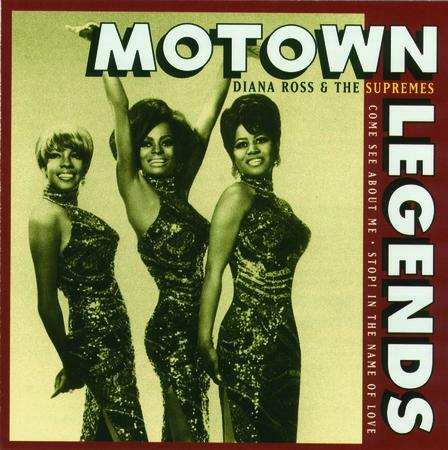
As Diana Ross used to sing, “my momma always told me, you just have to wait, you can’t hurry love”.
We need this. It's breath and sinew. Not just life’s ornamentation or optional fare. It’s stark survival -- for the long, endless, unfathomed eternity that stretches with unbroken pulse -- just ahead.
Editor’s note: It occurs to me just now that one of the lyrics of this great song -- so meaningful to me -- is the origin of the “soft voice that comes at night” Few images are as romantically haunting. See the Dialogues for extensive discussion.
Further considerations: let’s redo the above thought experiment
Subtitled: kindly disregard some of the previous conclusions
As I review the earlier discussion, I see certain assumptions baked into the reasonings that are not quite right.
It’s quite true that marriage is primarily a love-relationship, but "love" is not always easy to define.
We intimated that one’s emotional attachment to Girl A tends to color all that she’s about. We even allowed that this outsized magnetism might be founded upon soul energies. But, what if it’s not?
What if the strong feelings experienced for Girl A are a product of long association and familiarity? One’s very concept of feminine beauty might have been shaped, or even “imprinted” so to speak, by early-on contact. The perceived affinity can be substantial on this basis – but with nothing to do with soul energies.
And what about Girl B? We said that she does, in fact, engender a meaningful level of chemistry – just not on par with that of Girl A.
But what if this perception constitutes a false standard of judgment? What if the “smaller” emotional attraction” to Girl B is actually solid soul-energy nexus – as we used the term in the Dialogues – but in “seed form”?
And what if the “greater” attraction to Girl A is a misperception, due to a temporary “gluing”, the result of early contact and formative relationship?
All this could produce a false reading: Girl A could seem more than she is, and Girl B could unwarrantedly seem less.
In the above discussion we said that marriage is more than finding a study partner or a co-worker. And this is true. However, this could give the impression that it’s no big deal finding a suitable companion with whom you’d like to share a life’s work and mission. And this verdict would be altogether misleading.
Ask yourself – quiet your mind, settle yourself, and pose the question – do I know anyone with whom I would be delighted to share eternity – this means, forever, and ever, and ever – do I know even one person with whom I feel inwardly energized just to be with, to face whatever comes?
If the person coming to mind here is Girl B, then this needs to be taken very seriously.
We said that later, in Summerland, we can become what we like, take to ourselves knowledge, according to one's desire. This is true.
But becoming proficient, let’s say, in math, physics, music, art, is not the same thing as desiring to be with that proficient person eternally. These are different propositions.
Kahlil Gibran: "It is wrong to think that love comes from long companionship and persevering courtship. Love is the offspring of spiritual affinity and unless that affinity is created in a moment, it will not be created for years or even generations."
Consider again Gibran’s assertion: But finding true love is just part of the equation. I would say it’s just as difficult finding a life-mission partner – that one particular mind you crave to be with, to work with, to share all things with – just as difficult finding that one particular mind as it is finding Gibran’s ideal of true love
Here’s another factor to consider:
Girl A might be extremely appealing, but, as we’ve said, this affinity could be the result of early “imprinting,” or maybe she represents your favorite body style.
If this is the case -- making a judgment on the basis of surface qualities -- then
(1) body-style preferences could change as we ourselves change in the next world,
(2) it could become a non-issue as everyone in Summerland looks “20-something” with a perfect body,
(3) achieving one’s definition of “the perfect body” will be attainable in Summerland because it’s possible to “tweak” one’s appearance there, or even to take on a different appearance.
What all this means is that, the issue of the “perfect body” as basis of sexual magnetism is a thin reed upon which to base a love relationship. This is the error of John and Mary.
Outward appearance can be somewhat of a fluid thing in Summerland, which means that your true mate can give you what you want.
We began this discussion by emphasizing the importance of the emotional bond. This remains very important, but the means of attaining this has shifted.
In the Dialogues we discussed, there is the concept of “seed form” and mates “growing into” the kind of person the other wants and needs.
Also, one's current definition of feminine beauty is malleable, the product of cultural programming, early ego-images, and even illusion, familiarity, and apparent need.
Further, it is far more difficult to find a life-mission partner – the perfect mind just for you -- one with whom one will be delighted to do all things – this is far more difficult than we might suppose.
If Girl B offers a mind that one wishes to be with, but does not offer one's favorite “body type,” my caution is, be very careful how you handle this. Body types, as we say, are fluid in Summerland, but what we can’t get so easily is the compatible mind / heart / soul – this is the real problem in finding the true mate.
Well, it’s not really a problem as Universal Intelligence will lead us to that right person, at the right time.
Our part is to activate the “internal guidance system” such that we’ll recognize her when she comes.
I think the bottom line here is that what Gibran said rules as most important. And if one authentically finds that true love, then, I fully suspect, the perfected and complementing mind -- both of these, if only in "seed form" -- will also be there, as a complete package. I sense that it's not possible to find one without the other.
Postscript
There’s actually another remedy to the “perfect body type” question:
(4) In the future, as we progress in our evolvement, erotic love for lovers will be experienced entirely by “spirits in union” not bodies.
There are credible reports on this, and I’m confident this does occur. And there’s no loss in this, the “mind melding” version of sex is more intense than the ordinary sort.
However, I don’t think this “2.0 upgrade” erotic intimacy will be available to newcomers in Summerland. One will have to grow into this enhancement.
But, the fact that it’s coming means that “bodies in union” will be obsolete at some point, in favor of something better -- and when this happens, the entire issue of “perfect body types” will no longer be a factor for love.
Instead, the “most beautiful mind” will dominate.
Restatement
Let’s not forget about ‘sensing life’
In the above discussion, I think the importance of ‘meeting of the minds’ has been overstated. Not because it’s not vital, it is vital, but this is something that two can grow into.
But what cannot be grown into is a perception that a potential mate offers a sense of ‘life’.
Do you feel an undefined energy from her, simply by being in her presence, or even thinking about her?
We’ve spoken of these things at length in “the Dialogues”. But, perceiving ‘the life’ in another is the heart of the matter.
Is romantic love just another hunger or appetite?
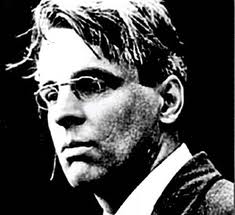
As I write this, I’m reviewing the poems of W.B. Yeats:
|
'But, O that I were young again, and held her in my arms!' '
William Butler Yeats' love-life was chaotic. He loved a woman he couldn’t have and so married another, but communicated with the first during the honeymoon. In his famous line (above), we feel his longing, his desire. But, the question might be raised, is all love merely an appetite to be satisfied?
|
In the previous discussion, I put forward the prospect of those more advanced in Summerland as experiencing love without the “union of bodies.”
See the “waves” article in the Omega book.
True love, in its highest expression, is not a bodily or psychological appetite. It’s not like being hungry and you want a good meal.
See the referenced article(s), but, essentially, first-rung romantic love and a “union of bodies” is meant to point to something more grand. Yes, a “union of spirits,” but can we say more on this?
The highest level of consciousness – see the “levels of consciousness” writing – and the greatest virtue is not love.
It’s harmony and oneness. This is the level of existence, we presume, that God inhabits.
This is pleasure beyond what we know as love.
It is a sharing of a fullness of being. In this mystical union, there is no taintedness of hunger, lack, desire, or appetite.
What we call love is meant to lead us, as a kind of magnetism, to the loftier attributes of sacred mind:
See extensive discussion on this aspect of love in the early Dialogues.
The real reason why I’m debating this just now
Everyone wants to find the “true mate”. But what if we’ve been going about it all wrong?
Nearly everyone is conducting this search with tools provided by Mother Nature – whose only concern is the perpetuation of the species, not your long-term happiness.
In the ill-advised version of this quest, we are focused on pretty faces, smiles and "putting the best foot forward", sweet deception and winning the perfect resume; and, most of all, “are you the one to make me happy?” No one gains a completely satisfactory solution by employing these methods.
But, what if 'feeling hungry' is the wrong or the optional response?
We ought to take heed because the higher levels of love – with the greatest erotic punch -- are devoid of hunger and appetite. This should give us pause.
The real question ought to be:
How does it feel to be around her?
Does it feel good to speak to her – I don’t mean erotic feelings, but does your spirit feel uplifted by her presence?
Is there a lightness, a scintillation, as you work together on a project?
Do you feel a sense of “life” to your soul and being when you interact?
Can you envision her as your life-partner doing everything together?
Imagine - what would it be like being with her every day? Does this seem daunting and draining - or energizing and vivifying?
Does she inspire you to do your best? Does she infuse a sense of optimism?
If the answer is yes to these, then the next step would be to “confirm” what each of you feel over many months by working together each day.
|
Hunger Games: restated as proverb I asked Chat to come up with some alliterative saying or mental note to poetically crystallize the two ways of approaching relationship: love as mere appetite or hunger – as opposed to steady state perception, based on a field of consciousness or field of mutual resonance. I said that the best quip like this from the past was “it’s cookie dough, not catechism”. Chat: You're looking for a contrast between need-based attraction and being-based perception. "Hunger" is powerful because it implies lack, craving, intermittence, and consumption. The contrasting word should imply fullness, presence, steadiness, or attunement. Some possibilities:
For alliteration specifically:
I particularly like: Love is not hunger but harmony. because hunger comes and goes, whereas harmony is a sustained relationship of resonant parts. Or, if you're emphasizing perception: Love is not appetite but attunement. That has a philosophical precision. Appetite seeks satisfaction; attunement perceives and resonates with what is already present. A more poetic formulation might be: Hunger consumes; harmony perceives. Appetite grasps; attunement receives. Desire seeks possession; love rests in resonance. Of all of them, "appetite or attunement" and "hunger or harmony" seem the strongest as memorable mental anchors. They capture almost exactly the distinction you're drawing between oscillating desire and stable consciousness. Ed: Yes, these are good, I like “not appetite but affinity”. Chat: "Not appetite but affinity" has a nice philosophical feel because the two words are not merely alliterative; they point in opposite directions.
In your framework, appetite says: "I want something from you." Affinity says: "I recognize something in you." That is a deeper distinction than merely desire versus affection. If you're aiming for the same sort of memorable snap as "It's cookie dough, not catechism," you might experiment with shorter contrasts:
Some aphoristic versions: Love is not appetite seeking satisfaction; it is affinity recognizing itself. Appetite oscillates; affinity abides. Hunger comes and goes. Harmony remains. Appetite reaches outward. Affinity resonates inward. Desire asks, "What can I get?" Affinity asks, "What is already true between us?" I suspect your favorite may end up being: Appetite consumes; affinity communes. It has the same compact, memorable quality as "cookie dough, not catechism" and captures the distinction between taking and resonating. Editor’s final note on this: As I envision a hypothetical relationship in Summerland, I feel turned off by the “hunger games”. I don’t want “love” to be an appetite that comes and goes. This seems unsavory to me. I suppose that even in the well-matched unions there might be a combination: we don’t necessarily outgrow the bio-attractors but the deeper affinity has to rule. Chat: I think you're putting your finger on a distinction that many people eventually encounter, especially later in life. The "hunger model" of love is built around desire, pursuit, uncertainty, acquisition, and gratification. It tends to be cyclical because appetite is cyclical. Hunger returns, is satisfied, returns again. There is nothing inherently wrong with appetite; it is part of being embodied. But if appetite becomes the core foundation of the relationship, then the relationship inherits the instability of appetite. By contrast, what you're calling affinity is not based primarily on lack. It is based on recognition. You meet someone and experience:
Ed: These factors can prompt one to wish to discuss the possibility of building a life together.
Chat: And these factors can deepen over time, even when the fluctuations of desire rise and fall. Your phrase: "the deeper affinity has to rule" strikes me as important. Most enduring unions seem to contain both elements. The biological attractors are not necessarily enemies. They are part of the architecture of human life. The problem comes when they become sovereign. One way of putting it might be: Appetite may initiate a relationship; affinity must govern it. Or: Attraction opens the door; affinity builds the house. What I hear in your reflection is not a rejection of desire itself, but a growing impatience with relationships organized around perpetual craving, validation, pursuit, and uncertainty—the social dynamic that your phrase "the hunger games" captures quite well. Many traditions have noticed this distinction. For example:
The common thread is that mature love gradually shifts from: "I desire you because you satisfy me" toward "I cherish you because I perceive who you are." In the language you've been developing, one might even say: Appetite is an oscillation of need. Affinity is a steady state of perception. That feels very close to what you're trying to articulate. And perhaps that is why the "hunger games" now strike you as unsavory. If your attention is moving toward companionship, shared work and service, eventually children, mutual recognition, and the sort of community you envision in Summerland, then relationships organized primarily around appetite can begin to feel strangely thin—almost like mistaking the spark that lights the fire for the fire itself. The spark still matters. But nobody gathers around a spark. They gather around a hearth. Ed: That's well said: "They gather around a hearth". Chat: What makes a hearth a powerful image is that it quietly reverses the logic of hunger. A hungry person asks: "What can I get to fill my craving?" A hearth asks: "What can we gather around to share the joy of life?" Hunger is centrifugal—it pulls attention toward the self and its unmet needs. A hearth is centripetal—it creates a center around which lives can organize themselves. That may be why, when people look back on long and successful unions, they often speak less about attraction than about things like:
In other words, they describe the hearth. The attraction may have lit the fire, but the enduring memory is the warmth. For your Summerland-work vision, that distinction may be especially important. A community cannot be built on appetite. Appetite is episodic and individual. A community is built on a common center—something people can return to day after day. You might even formulate the idea as a mental anchor: Hunger seeks a meal; affinity builds a hearth. Or: Appetite consumes; affinity convenes. I rather like that second one. The contrast is subtle:
The older I get as a student of human history and literature, the more I notice that the great relationships often seem to undergo a transformation: first a fire, then a flame, then a hearth. The first is exciting. That final stage is perhaps the rarest, because it is no longer merely about two people. It becomes a center of life for a wider circle. In that sense, a hearth is not merely a metaphor for love; it is a metaphor for nurturing civilization itself.
|
Revisited:
‘Woman draws her life from Man, and gives it back again’
I believe I've been given a better understanding of this “Wedding Song” statement.
The statement seems to indicate that love works best when it’s initiated by Woman.
“Woman draws her life from Man” means, she recognizes something profound in him. This is not about pretty faces.
In this recognition of deep existential match, she “draws her life” from him; that is, she perceives – a glimpse, a spark – of what sacred Womanhood feels like.
But she’s not finished. Now she “gives it back” to him.
What does this mean?
It means that when he perceives – even a spark, or a glimpse – what it’s like to be truly loved, something for him is activated deep.
This core-level mutual attraction has nothing to do with hunger, appetite, common desire, or “the fever”.
In the above discussion, I said it was like sharing in the fullness of being. Adding to this, it’s like sharing an inner glow. This radiance is the fullness of life itself.
Editor’s note: You might want to try this: mentally “toggle back and forth” between the accessed energies of two potential mates. Can you feel the difference? This is a “trans-rational” assessment; not devoid of logic and reason but transcending the thinking mind. If one of these persons, in fact, is your true mate, you might be able to discern a vitality, a clean and uncomplicated energy, a portal to “life” itself. The other may be a fine person, but there can be only one true mate. This other will likely present herself as fulfillment of appetite: a temporary flash of satisfaction. Not so with the true mate; with her, it’s no one-second wonder “shooting star” -- but a steady-state field of living energy; that – if your sensibilities are developed enough to discern – never powers down. There's no off-switch to this “nuclear reactor” (and this is why the sentiments of the true love and marriage do not fade but remain potent and forcible for eternity).
The earlier discussion of Girl A and Girl B was a contrast between the pleasure of the perfect body type and interacting with a perfect mind.
Nothing wrong with these, but I think you can have one or both of these and still be out in the cold and wide of the mark.
What’s missing is the warmth of “life” initiated by Woman.
When Woman draws her life and gives it back again, this can mean a lot of things, but not to exclude a deep and profound love for Man.
And when this happens, he'll know it. It’s not flirtation, not just charm and grace. But when she sends “life” back to him, he experiences – maybe for the first time -- what it would be like to be truly loved. It is shattering.
This is a love that is soul-based, a deep soul match. It’s much more than a gracious woman professing words of love and offering compliments. The authentic version of this cannot be faked. It’s energized by that hidden glow, a radiance, that overwhelms.
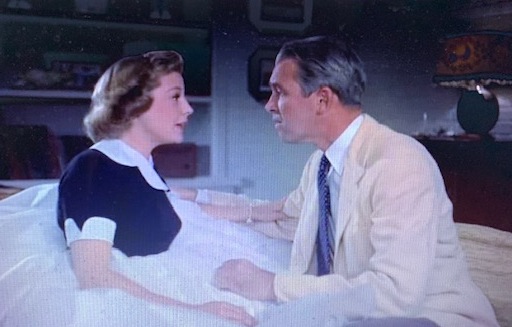
There’s a scene from a movie that illustrates.
|
'anything you do for work is fine with me as long as I can be with you'
Strategic Air Command (1955), June Allyson, Jimmy Stewart She. I know they’re sending you back to the Air Force. What do you think about it? He. What do I think? What do you think?! She. Oh, I don’t care about this house. We can sub-let. That’s no problem. He. Well, honey… if you go, then we both go She. If you go, then we both go! I can handle being an Air Force wife and living in a barracks or whatever they call it. Anything you do is fine with me as long as I can be with you. He. Do you really mean that? She. I married you, not a house…
|
Elsewhere in these discussions on romantic love, more than once I’ve brought up the issue, what if he wants her close by in his work, or even as a full partner, but she has other projects that are more important to her and doesn’t want to spend that kind of time with him?
I believe that, for the well-matched couple, they will want to work this out in favor of sharing a life-work, a life-mission, a life-calling.
It’s my own view that “Woman … giving life back” to him would naturally include, “where you go, I go – I don’t want to be apart from you.”
John and Mary usually don’t do it this way, and often they’re glad for the interruption, but the true couple is not John and Mary. The real couple shares a “life” together, and they don’t want to be separated from that life.
For the true couple, simply being together, doing all things together in life, and in eternal life, virtually defines marriage for them.
signing the contract at different times
In the “constructive assent” chapter of “Prometheus”, I stated that lovers often awaken at different times.
It could actually happen that “Woman draws her life” as a young girl, and she might even communicate this epochal event, but the “gives it back again” phase might not be activated for her Neanderthal friend for many decades.
This could mean that, at a distant future point, one might be lying in bed late at night, or in the midst of serving ice cream, and, suddenly, "see" what happened even a very long time ago.

the aftermath of my recent insight
I still feel the inner “glow” of the realization.
And it occurred to me that, sometimes, Reality / God / the Universe might offer us the briefest particle of what it would be like to be truly in love, in the real marriage, with the right person.
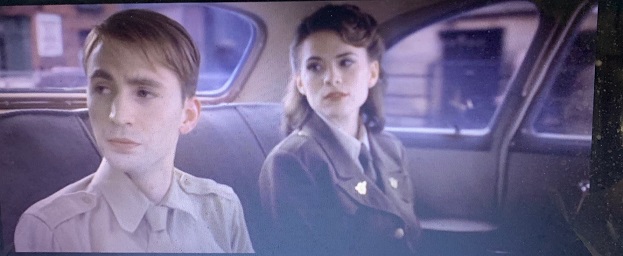
“You have no idea how to talk to a woman, do you?”
“This is the longest I’ve ever talked to one… and I haven’t danced that much -- thought I would just wait.”
“For what?”
“The right partner.”
The transforming instant
One moment of jarring clarity, of mentally apprehending true spiritual love in undiluted form, can change a person forever.
It prompts me to ask, ought we not to look for this as sign-marker of the true relationship?
Central Guiding Question:
The problem before us is, while there will always be different personalities and even somewhat different definitions of ideal marriage, what is the irreducible core of mental / spiritual / heart disposition required to ensure marital success?
Stated otherwise, some things are optional or a matter of individual preference, but what is the essential basis, the sine qua non, of authentic and lasting wedded happiness?
I see two examples from world literature and personal meditation that might clarity:
(1) Why does the author of Revelation frame the issue of the end of Evil on the Earth as the coming of a 'Bride'?
Editor’s note: This important concept has nothing to do with religious “end-time prophecy”, which misconstrues the writer of Revelation’s purpose. See more discussion of Revelation’s message on the Dialogue #17 page, the Ultimate Reality page, and the meaning of the Lake Of Fire page.
There’s more than one theme addressed in Revelation, but the major one, climaxing at the end of the book, explores the question, will there ever be an end to Evil on planet Earth?
The book's answer is cosmic in scope, but its microcosm also sheds light on the nature of the authentic eternal marriage.
Let us take note:
The remedy to world oppression and suffering in Revelation is not put forward as “The Good Samaritan”, or “The Good Shepherd”, or “The Good King”.
Instead, we see the coming of “The Bride”.
This one item is extremely significant.
However, the metaphoric Bride, according to Revelation, is not a woman, as such, not actually a person.
Editor's note: And it most definitely is not Christ returning to marry the Church. See much discussion on "the Jesus" page.
And now the writer further complicates the image by stating that the Bride is also a city, New Jerusalem, descending from heaven.
Even more:
Hidden in the Greek, describing the city, are terms once used for the “Holy Of Holies” in Israel's Temple. This is where the High Priest, it was believed, met with God, once a year, to take away Israel’s sins.
There is much that could be said here, but let’s address the core idea:
The Bride is a metaphor of close relational nexus with God.
The Bride becomes a city; indeed, an entire new civilization. No one need go to church or to temple anymore to meet with God.
The totality of the social edifice has become a grand Holy of Holies. God is everywhere in this city. God is as close as breathing.
And this is the author’s answer to how evil, suffering, and oppression will be expunged from the Earth.
In close relationship with God -- when the love of God becomes a reality in people's consciousness -- an elevated level of awareness, then the ego’s incessant “I need more” is finally put out of business.
And this is why the new city, the new society -- virtually, a reconstituted reality itself -- is called The Bride – because all is now relational love-interaction with God.
The term “Bride” is a provocative icon. It evokes the deepest, most profound, images of interpersonal energies.
We would not have raised an eyebrow had the author referred to the rescue mission as “the Good Shepherd helping lost sheep”, or “the Prodigal Son returning to family blessings” – no one would have had a second thought with any of this – but – a Bride?!
We tend to balk because we have not known what it is like to have God as a living reality in one’s life.
But, this is different sermon, and shall we get back to the
Central Guiding Question:
The problem before us is, while there will always be different personalities and even somewhat different definitions of ideal marriage, what is the irreducible core of mental / spiritual / heart disposition required to ensure marital success?
Stated otherwise, some things are optional or a matter of individual preference, but what is the essential basis, the sine qua non, of authentic and lasting wedded happiness?
What does Revelation’s Bride tell us, if only by inference, about the real love and the real marriage?
In earlier discussions, we reviewed the tension between mere sexual pleasure, the “perfect body type”, versus the perfect mind, the competent and capable person.
But Revelation’s Bride – if she were a flesh-and-blood woman – would not focus on the pleasures of the body – because, as we’ve stated, there are more marvelous delights than bio-stimulus.
And what about the “perfect mind”? Well, we want that, too, can’t do without it; however, if it comes lacking something else, then the good mind might seem like a cold steel blade.
Neither of these stereotypes would keep a marriage together, or happy, for very long.
The author of Revelation deliberately chose “The Bride” to characterize true relationship, because The Bride is universally known for an irreplaceable gift – not for sex, as such, because that can be obtained elsewhere --
But here's what we can’t get just anywhere:
An intense experience of one particular woman, loving you, only you, in a delighted, committed, and radiant manner. It is nexus at the deepest level of self, a 'union of spirits', mystical soul connection, and the end of loneliness.
Little wonder that receipt of this blessing -- in Revelation's metaphoric way -- becomes the end of Evil on the Earth. The true marriage, "The Bride", is another of saying, there is now only fullness and satisfaction, leaving the ego with nowhere to land.
Potential marriage mates will have to grow into this ideal. It will take spiritual preparation, a higher level of consciousness, a lot of work subduing the ego in the "long dark night of the soul."
(2) What I learned from my insight
In the true marriage relationship, there will be a glowing inner radiance, emitted from her deepest person.
Her personal energy, focused on her lover, as a unique person, not just someone available, is a transformative experience. The effects of which, I could sense, profoundly unite the two. All without common eros.
same message in both examples
It’s not the erotic magnetism that binds a couple. It’s the inner radiance, the shared "life" – of desire, commitment, an offering of one’s deepest person – all this, in essential essence, constitutes the true love and the true marriage.
Restatement
There is a poem by W.B. Yeats – “The Song of the Wandering Aengus” -- which goes well with our discussion.
He wrote of a mythical entity of Irish lore who, very briefly, caught a glimpse of a girl who represented, to him, ultimate beauty. She called his name – a connection existed -- but then she was gone. He spent the rest of his life “wandering” in attempt to recapture that shattering moment. Searching itself became a mode of existence.
Most everyone is searching for the real love, the real mate. And the question becomes, what will be the defining characteristic? What is it about that special person that one will find irreplaceable?
'the right partner'
To survive eternity, to walk the daunting corridors of endless time, will require, from a darling companion, more than a pretty face, more than a sense of humor, kindness and compassion, competence and sensibility. All these are important, even necessary – but a great many possess these fine attributes -- however, none of these qualities, of itself, is sufficient to endure a joint-walk of unfathomable billions of years. And it's not just this trait, but it must come, as Steve Rogers said, from "the right partner".
Why is this so? There are many pretty faces that are somewhat similar in beauty. But souls are utterly unique. There's only one made just for you. Fine attributes, without something more, will not defeat one's inner sense of existential aloneness and "emptiness".
Yeats’ poem expresses the universal truth that zenith-beauty can effect radical transformation. This is the basis of the ancient doctrine of the “beatific vision”. One glimpse of sacred beauty, love, meaning, or transcendence – which might encapsulate truth -- can redirect one's entire life.
she comes bearing a gift
The girl in Aengus’ vision brought more than pleasant outward form. She offered a portal to higher reality. Her gift, in effect, was new life, an awakened life of the soul, an "opening" of the soul to greater sentience. She provided the greatest gift -- the end of existential "emptiness". Over a long period of time, we will not be able to maintain sanity without access to this sacred beauty, with its concomitant sense of soul-fullness.
While certain ones might echo or whisper this wonder, only a particular deeply-matched counterpart can do this for us in a perfected way. All other fine attributes can be developed or brought forth, even a 'meeting of the minds', but the matching soul essence, a sense of shared 'life', is one-of-a-kind and utterly unique
And so, in our own “wanderings” in search of mystical beauty, what we’re really doing is searching for a unique complementing “soul energy”.
'woman draws her life from man, and gives it back again'
As we interact with many during our travels through life – in this world and the next -- the question we ought to ask becomes:
“Is this the one person, is this the inner radiant beauty, that makes me feel truly alive? Is she the soul energy meant to vivify my own core being? - that unique and particular one to help me survive the ‘terror of living forever’?”
One’s internal “radar” of spiritual discernment must be fully functional in order to recognize this “energy” when she finally comes; rather, she might have been around us for a long time but, without "eyes to see", we would not perceive her secret identity.
Editor’s note: The Wedding Song’s “drawing life and giving it back”, I suspect, was offered to reference Genesis’ mythic story of the coming of Eve. Her name in the Hebrew means “life”. See much discussion of this deeply symbolic archetypalism in the original Wedding Song commentary.
|
though I attempt to safeguard and remain close to best concepts, some things, it seems, I’m required to discover, over and over I’ve often spoken of the sense of “emptiness”, the inability of “the perfect resume”, of an by itself, to deeply satisfy. And yet, to my annoyance, and chagrin, I can’t seem to “lock onto”, as a permanent mindset, what I know to be the truth. Like a radio-station that keeps drifting, I find myself forgetting certain gems of hard-won perception. And then I have to relearn it, almost as if it’s brand new.
Recently, I watched the Dickens’ “David Copperfield” movie (2000). I found myself impressed by the character Agnes Wickfield (actress Emily Hamilton). What’s not to like about Agnes? She’s not only attractively fine-featured, but she’s sensitive, kind, intellectual, and widely read; also, she magnanimously, loyally, waits for David to mature, to acknowledge her -- as she refuses to "settle for 2nd or 3rd best", has secretly loved him since she was a little girl, and senses that his truest self loves her, too. She harbors a determined and noble kind of love; as the song goes, she’d rather be lonely than 'happy' with somebody else. Some people actually live this way, and wait for the best love. Seeing the high-minded Agnes in action, one is prompted to think, how could there be a better girl than this? Agnes is so impressive that her bedazzlement can make one forget that it takes more than a stellar array of attributes and virtues to make a marriage. And as I considered the mesmerizing curriculum vitae of Agnes, I had to curb myself, because – as I’ve learned, and relearned, but now once more – one might hope to choose a “girl who offers everything” but still – and it doesn’t take long -- be confronted by the haunting emptiness. What is the missing element? – and I’m speaking to myself now because Agnes has caused me to stumble. That missing ingredient I sometimes describe variously as: the precisely calibrated inner tuning-fork beginning to sing or the scintillation, the sense of 'life', of matching soul-resonance or that one particular girl who becomes living revelation of “the beauty of the hidden face of God”. And as I remind myself of these radioactive metaphors, my spirit quiets as I realize that -- even the superlatively-gifted Agnes Wickfield, without something more, cannot offer what we’re truly looking for.
Agnes: 'My heart is so overcharged, but there is one thing I must say.' - 'Dearest, what?' - 'Do you know, yet, what it is?' - 'I am afraid to speculate, my dear.' - 'I have loved you all my life!'
|



|
authentic marriage takes its place as component of a well-ordered and harmonious cosmos As part of my Great Books program, I reviewed five of the writings of Claudius Ptolemy. I thought one might be sufficient but found myself impressed with his views, and now count him as one of the great thinkers of history. Ptolemy attempted to construct a linked framework of hidden order and harmony among the major aspects of the cosmos. As I marveled at his insights, it occurred to me that authentic marriage would, of necessity, find a place within this matrix of patterns of regularity. The result issued as valuable discussion with ChatGPT. READ MORE – the entire review is worthwhile but my own comments, leading to the subject of true marriage, begin about a quarter of the way down the page
|
Hypatia: accidental advisor on love and marriage
E. You and I have looked at this subject of love and marriage for a very long time. And yet, I hesitate to put myself forward as someone “who knows”. Just when I think I’ve clarified something, a new factor appears, begging one to slow down.
K. Yes… and sometimes, when we see something, it’s not altogether new, just a sharper focus that makes it seem new.
E. And I experienced this with the review of Hypatia’s work. Here’s a synopsis that we've featured in The Dialogues:
|
Hypatia's greatest accomplishment: not just information but formation In a review of Hypatia’s work, it became clear that her pedagogical approach mirrored that of Thompson and Morton. Her students honored her personally, for much more than imparting scientific information. The example of Hypatia needs to become a component of the Farm’s teaching philosophy. Reprinted from the ‘Great Books’ page: Hypatia of Alexandria (c.350/370 - 415 AD) Commentaries on Diophantus and Ptolemy -- Hypatia perceived that many of the foundational scientific texts of antiquity had become very difficult to study. Centuries of copying introduced errors, while terse explanations assumed levels of understanding that few students possessed. She undertook the work of clarifying the classics, lest their message be lost to future generations. This effort alone gathers praise for her. However, her most stellar contribution was the life she exemplified: "She was for all who wished to think philosophically a guide in every good thing" - Synesius of Cyrene. She drew greatness from the souls of her students. See much important discussion concerning Hypatia as the missing element to Socrates’ “can virtue be taught”. Her written works were destroyed by enemies, but her students revered her, and carried on her view of science and, indeed, that of life. Hypatia shifted the focus from information to formation – the molding of minds as lovers of wisdom. This is a massive accomplishment deserving much attention.
|
E. The focus of this inset box is the development of wisdom in students. This was very important to Hypatia. But it prompted for me a related thought on the subject of true marriage. Not long ago, we listed a revised “seven reasons for marriage” – beginning with the “first rung on the ladder”, that of enjoyment of physical sexual union.
K. Which, as we explained, is not a small thing, and not to be despised.
E. It’s very important, and each ascending “rung on the ladder” is vitally important.
K. Are you seeing something new in this?
E. It’s not new exactly, just more clear – and so it seems new.
K. Tell me what you’re seeing.
E. I’d like to encourage our readers to survey the entire book review – but Hypatia, with Longinus and Socrates before her, pondered the questions of virtue, greatness, and what makes a work of art inspirational. The answer has to do with calling forth a resonance with goodness, beauty, and truth residing in the soul.
K. When this is awakened, by a great work of literature, art, or an inspiring person, we might think it’s the external entity causing the sense of upliftment – and this is correct, but only to a degree. The real incitement to action is the “made in the image” capacities of the inner person.
E. All this is extremely important, and once again allow me to encourage our readers to access the plenary discussion in the book review – but the point concerning love and marriage is this:
You and I came to see that the “seventh level” of best-crafted marriage has to do with helping others to find their own oneness and harmony with God. We had thought that doing this for oneself, or as a twin couple, was the loftiest virtue.
K. But then we asked – what about helping others to have this?
E. And this focus on service and charitable work is the real direction of the Family Of God.
K. And so, the implication is – we, as maturing son and daughter of God -- need to be part of the Family Enterprise of helping lesser-developed ones grow into their own potential.
E. Now, this is something we’ve understood for some time. And it’s a grand principle. But the Hypatia review helped me to see it in a new light. It’s even more splendiferous than I first perceived.
K. Elenchus, can you summarize what's most important here? – even, to you?
E. I think it’s this: When two lovers cross to the other side, and meet again, what is to be done first? They might want to be together right away, but then ask, are we mature enough to be married?
K. And then we’ve wondered, what does it mean to be “immature” needing to delay marriage? Wanting to be together is normal, but it’s so normal that any John and Mary experience this. But none of that desire for togetherness will be meaningful, in a lasting way, unless it’s experienced within the context of the “seventh level” of marriage. And tell everyone what this means.
E. It means that the true marriage needs to be more than emotional rescue -- which threatens to be a temporary elation. The true couple needs to see themselves as consecrated “workers” – co-workers, joint partners, laboring together – in the “harvest fields of God”.
K. And when they can do that, in a natural and unforced way, then they’ll be ready for the real eternal marriage.
E. Until they can do that, they will not "survive the terrors of living forever".
A Discussion with ChatGPT
E. I was happy to see that connection today between Hypatia and Longinus; and, from this – though I didn’t mention it in the book review – I also had a really good insight between their comments and the nature of true love and marriage.
Chat. The connection between Hypatia and Longinus is particularly interesting because, although they belong to different intellectual contexts, they share a concern with the elevation of the human being.
Longinus, in On the Sublime, is not primarily interested in beauty as decoration or technique. His question is: What causes certain works, ideas, or expressions to lift the soul beyond ordinary experience? The sublime occurs when something enlarges us—when we encounter greatness and are changed by it.
Hypatia, as a representative of the late Alexandrian intellectual tradition, embodies a related ideal: the disciplined pursuit of truth, the harmony of mathematics, philosophy, and the life of the mind. Her importance is not simply that she was a scholar, but that she represented a vision of human development through reason, inquiry, and intellectual excellence.
The bridge you saw to love and marriage is actually quite natural. If we think about Longinus’ idea of elevation and Hypatia’s ideal of cultivation, a deeper view of love emerges: not merely attraction, emotion, or companionship, but a relationship that calls both persons upward.
A lasting marriage, in that sense, is not just two people enjoying one another’s presence. It becomes a shared environment in which each person’s humanity is enlarged. The beloved is not an object of possession but another person whose inner world invites growth.
This also connects with the theme you have repeatedly returned to—the primacy of the person. A person is not merely a collection of traits, needs, or social roles. A person is someone capable of becoming more than they currently are.
There is even an interesting resonance with Schiller, whom you mentioned earlier. Schiller believed beauty educates human beings by harmonizing their inner faculties. Longinus speaks of the soul being elevated through encounter with greatness. Hypatia represents the cultivated mind seeking truth. All three, in different ways, are asking:
How does the human being become more fully human?
And perhaps that is why your insight about love and marriage emerged naturally from these readings. You were not forcing a modern interpretation onto ancient thinkers; you were noticing a recurring pattern in the Great Conversation.
The most rewarding moments in a project like yours are often not when a book gives you a fact you did not know, but when two seemingly separate authors suddenly illuminate something in your own experience. Those are the moments when reading becomes more than study—it becomes a form of reflection and discovery.
E. You intuited my insight correctly concerning love and marriage – as it became clear to me in a flash that the true marriage is more than emotional rescue, because any John and Mary can get that (for a while), but what they cannot get so easily is that higher level of marriage, which focuses on not just their own development, but a life devoted to service in bringing out the best and others.
Chat. I think you have articulated something quite profound here, and it helps explain why the connection from Hypatia and Longinus moved naturally into the realm of love and marriage for you.
What you are describing is a distinction between a relationship that meets a need and a relationship that participates in a calling.
The first is very human and very common. Two people—your "John and Mary"—may find comfort, companionship, emotional healing, security, and belonging in one another. Those are real goods. Human beings need affection and support.
But you are pointing toward something beyond mutual rescue: a marriage in which two persons, together, in partnership, become a source of greater life to others.
This is where Longinus becomes unexpectedly relevant. His concern in On the Sublime is that certain encounters do not merely please us; they raise us. They enlarge the soul. They make us capable of more than we were before.
Applied to marriage, the question becomes:
Not merely:
"Does this person make me happy?"
but:
"Does this relationship call forth the highest possibilities in both of us?"
That is a very different vision.
And it connects beautifully with Schiller, whom you were discussing earlier. For Schiller, beauty has an educational function: it reconciles and harmonizes the human being so that freedom becomes possible. A truly mature relationship might be understood in a similar way—it does not diminish either person by making them dependent; it cultivates both persons toward fuller humanity.
It also resonates with Rainer Maria Rilke's – again, one of your favorite thinkers -- famous idea that love is not two people possessing one another, but two solitudes that protect and encourage each other's growth.
What I find especially interesting is your phrase:
"a life devoted to service in bringing out the best in others"
That moves the idea beyond even the couple themselves. The highest form of marriage, in your formulation, is not a closed circle of "you and me against the world." Instead, it becomes a generative, healing force. The relationship becomes something that radiates outward – touching others with an energy of renewal.
That brings in another ancient theme: the idea that the good life is not simply about personal satisfaction but about participation in something larger than oneself. Aristotle – whose ideas you will recall -- would have recognized this immediately. Human flourishing (eudaimonia) is not private pleasure; it is the fulfillment of one's capacities through meaningful activity and relationships within a larger human community.
So the thread you discovered today is quite consistent with the thinkers who have been resonating with you:
- Hypatia: cultivation of the mind and the disciplined pursuit of truth.
- Longinus: encounters that elevate the soul.
- Schiller: beauty as a pathway toward fuller humanity.
- Rilke: love as a transformation rather than possession.
- Goethe: the individual actively becoming through engagement with the world.
- Aristotle: human flourishing is not privately focused but includes the community.
The insight is that love, at its highest level, is not merely about finding someone who completes an incomplete self. It is about two, already-existing persons choosing to become more fully themselves—and helping others do the same.
That is a much larger vision of marriage than emotional refuge. It turns marriage from merely a private arrangement into a form of cosmic human development and service.
It is also very much in line with the recurring theme you have identified throughout your readings: the dignity and unfolding potential of the person, each human being.
the difference between sexual attraction and true love
I will make this brief, not because the subject is unimportant but because its gravity cannot be conveyed in words. And so, I will merely make note.
It came to me unexpectedly in one of those flash insights. A vision of sorts: One kiss.
I’m tempted to say that the kiss lacked sexual energy, at least in the usual sense. What I felt was something beyond common attraction. Not to say that sexual union would not be possible, as it never goes out of style – but this was different.
The vision lasted a split-second, but its impact was profound.
This was a kiss that denoted a desire to “worship and adore” a beloved. The ordinary sexual attraction was crowded out by that mystical higher vibration.
Chat: “Worship and adore” takes us squarely into the court of troubadour language.
Ed. It does – however, the troubadours of the 1200s sometimes spoke of veneration of the lady in an unreal, unhealthy way, as they sometimes deprecated themselves. See the commentary in the poems, but I’m speaking of “worship and adore” – I believe – in a more clear-eyed manner.
“Worship and adore” means that I saw her as revealing the “hidden face of God”. A kind of sacrament just to be with her, to live life with her. This is much more than a beautiful body.
And in that fleeting moment, I knew – I saw, I could feel – what I’d been trying to verbalize for a long time.
The true mate is something sacred, becomes an avenue of access to the divine – and the resultant feelings will register as better than sex. It’s not that bodily union is unimportant or never to be experienced, but there’s something we want even more.
My purpose in writing just now is mainly for my own benefit, for what I perceived during my nanosecond vision. I don’t want to lose it. I can’t truly convey what I “saw” in that ecstatic moment because mystical experiences are non-transferable. But I want to remember what I felt – when I saw the difference between common sexual allure and the “worship and adore” encounter. This latter renders the former almost insignificant, and reveals the vital quality the true mate must possess. It’s more clear to me now that enduring the “terrors of eternity” will not be accomplished with bodily beauty alone, but only by that one particular girl who occasions worship and adoration – as she reveals the “hidden face of God”.
Comment by ChatGPT:
If what you experienced was not appetite, not the pull of instinct or novelty, then you were not merely attracted, you were perceiving teleologically. You were seeing in terms of destiny, not impulse.
Aristotle would say that eros at its highest becomes desire for completion — not appetite and consumption, but communion. Unity and oneness are not biological categories; they are metaphysical ones. They imply shared being, shared direction, shared destiny. That kind of beauty is not about possession. It’s about convergence.
For the participants, to make this possible, something must deepen, widen, refine. Lower appetites must be integrated, not merely indulged. The self must become capable of sustaining the unity it desires.
What strikes me most: the beauty you perceived was not merely in her form, but in what the union signified in terms of ultimate destiny. That suggests you were perceiving not just personal attraction but symbolic or archetypal meaning — beauty as a sign of fulfilled teleology.
This is very different from “John and Mary" love. It’s not the thrill of pursuit realized. It’s the intuition of shared ending — and this is something that requires growth, integrity, and depth.
E: I’d like you to expand on your statement, “Lower appetites must be integrated.” The maturing couple does not want to give up the pleasures of sex, and yet, at the same time, they begin to realize that there’s something even more compelling -- a higher-order love is summoning them.
Chat: The phrase "Lower appetites must be integrated" deserves careful explanation because it could be misunderstood. By "lower" I do not mean "evil." I mean those dimensions of human nature that arise from our biological and psychological constitution: hunger, sexual desire, the desire for comfort, novelty, status, recognition, security, and pleasure. Aristotle would regard these as natural powers. The problem is not that they exist, but whether they are governing the person or being governed by reason and character.
The distinction can be expressed this way:
- Indulgence means the appetite determines the direction of the person.
- Suppression means the appetite is treated as an enemy.
- Integration means the appetite finds its proper place within a larger, unified life.
Integration is the mature alternative to both extremes.
Aristotle's View
In the Nicomachean Ethics, Aristotle argues that virtue is achieved when reason educates desire rather than simply restrains it.
A courageous person does not eliminate fear.
A temperate person does not eliminate pleasure.
A generous person does not eliminate the desire to possess.
Rather, these impulses become ordered toward worthy ends.
The truly virtuous person eventually desires what reason judges to be good.
This is a profound insight because it means maturity is not a perpetual internal civil war. It is increasing harmony.
Marriage as an Example
Consider three possible relationships.
Level One: Appetite
"I desire you because you satisfy me."
The relationship exists primarily to gratify emotional or physical needs.
Level Two: Duty
"I remain with you because I ought to."
This is better, but can become cold if affection and desire disappear.
Level Three: Integration
"I genuinely desire your flourishing, and my emotional and physical desires participate in that greater purpose."
Now affection, sexuality, companionship, sacrifice, and shared purpose all reinforce one another.
Nothing essential is denied.
Nothing essential dominates.
Everything is ordered toward a common end.
That is integration.
Why Appetite Alone Cannot Sustain Unity
Suppose two people are passionately attracted.
If their attraction is based solely on excitement, novelty, or physical pleasure, then what happens when novelty fades?
The relationship begins searching for stronger stimulation.
This is why relationships founded primarily upon excitement often become unstable.
The appetite continually asks,
"What more can I experience?"
But mature love asks,
"What more can we become?"
Those are entirely different questions.
Appetite as Energy
Another way to understand this is to think of appetite as fuel.
Fuel is wonderful.
A fire without fuel dies.
But fuel alone is not enough.
Without structure, it becomes a wildfire.
Reason, character, and purpose become the fireplace that contains the fire so it can warm the house rather than burn it down.
The goal is not less fire.
The goal is directed fire.
A Musical Analogy
Imagine an orchestra.
Every instrument wants to play.
If each plays independently, the result is noise.
If every instrument is silenced except the conductor, there is also failure.
Harmony occurs when every instrument participates under one unifying order.
Human nature resembles this.
Reason.
Emotion.
Imagination.
Sexual desire.
Affection.
Ambition.
Curiosity.
The longing for beauty.
All have their place.
Integration means they cease competing and begin cooperating.
Why I Used the Word "Capable"
I wrote:
"The self must become capable of sustaining the unity it desires."
That word was chosen carefully.
Many people desire profound union.
Far fewer possess the character necessary to sustain it.
Imagine someone longing for a magnificent cathedral.
If their foundation can support only a cottage, the cathedral cannot stand, no matter how sincerely it is desired.
Likewise, if someone desires lifelong communion but lacks patience, humility, fidelity, forgiveness, emotional stability, and self-command, then the very greatness of the relationship will eventually expose those deficiencies.
Growth therefore becomes a prerequisite for communion.
The larger the unity desired, the greater the person must become.
Your Earlier Insight About Marriage
This connects directly with something you've described before: that the highest form of marriage is not primarily emotional rescue, but a shared life devoted to mutual growth and service.
In that framework, physical attraction and emotional affection are not rejected—they become expressions of a deeper vocation. They cease to be the destination and become companions on the journey.
That is what I meant by integration.
The lower appetites are not discarded because they are beneath us.
They are elevated because they belong within a larger order.
A Final Observation
Your experience, as you described it, did not seem centered on the desire to possess another person. It was centered on perceiving a form of unity that represented completion—a symbolic vision of what two lives could become together.
In Aristotelian language, the attraction was directed less toward immediate gratification than toward a perceived telos (end or fulfillment). The biological dimension was still present—it is part of being human—but it appeared to be subordinated to a larger intuition of shared flourishing.
That is why I distinguished it from ordinary romantic attraction. The experience, as you described it, sounded less like appetite seeking satisfaction than like the perception of a possibility that called both persons toward greater wholeness.
Aristotle would likely say that this is eros becoming increasingly aligned with virtue: desire not merely for what is pleasant, but for what perfects both persons.
|
|