|
Word Gems
exploring self-realization, sacred personhood, and full humanity
John Keats
La Belle Dame sans Merci
return to "Poetry" main-page
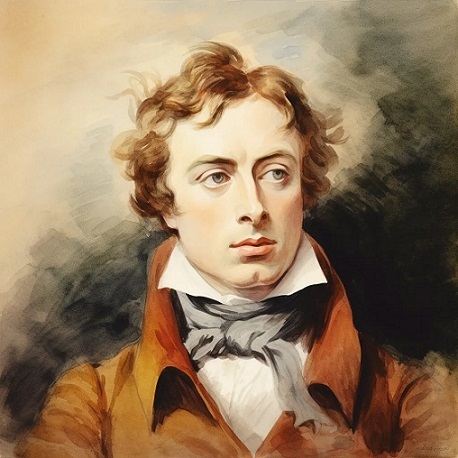
John Keats (1795-1821)
|
John Keats (1795–1821) was one of the major poets of the English Romantic movement, though his greatness was recognized only after his early death.
Born in London to a working-class family, he lost both parents while still young and was placed under the care of guardians. He trained as a surgeon and apothecary at Guy’s Hospital but ultimately chose poetry over medicine, committing himself to literature despite financial insecurity and uncertain prospects.
His early poetry was sharply criticized in influential reviews, yet in 1819 — his extraordinary “great year” — he produced the odes that secured his legacy: Ode to a Nightingale, Ode on a Grecian Urn, Ode on Melancholy, and To Autumn. These works probe the tension between permanence and change, imagination and reality, sensual beauty and human mortality. He famously articulated the idea of “negative capability,” the ability to dwell in mystery and uncertainty without forcing logical resolution — a key to understanding his poetic method.
Keats’ passionate but thwarted love for Fanny Brawne coincided with the onset of tuberculosis. In 1820 he sailed to Rome seeking recovery, but he died there in 1821 at age twenty-five. He was buried in the Protestant Cemetery with the epitaph he requested: “Here lies One Whose Name was writ in Water,” reflecting his fear of being forgotten.
That fear proved unfounded. Today, Keats is regarded as one of the supreme lyric poets in English — admired for the richness of his imagery, the musical beauty of his language, and his profound meditation on beauty, truth, transience, and the longing for permanence. (ChatGPT
|
Editor's report: Who were the Romantic Poets?
Commentary by ChatGPT
How did La Belle Dame sans Merci come to be written?
1. Written in Keats’s Annus Mirabilis ('Miracle Year')
Keats composed the poem in April 1819, during the same intense period that produced:
-
Ode to a Nightingale
-
Ode on a Grecian Urn
-
Ode on Melancholy
-
Ode to Psyche
At the time, Keats was living in Hampstead, caring for his dying brother Tom (who had died in late 1818) and increasingly anxious about his own health. He was also deeply in love with Fanny Brawne, a relationship marked by intensity, jealousy, and insecurity.
The emotional climate around him—love, illness, mortality, and fear of abandonment—strongly shaped the poem’s atmosphere.
2. Medieval and Literary Sources
The title comes from a 15th-century poem by Alain Chartier also called La Belle Dame sans Merci (“The Beautiful Lady Without Mercy”).
Keats likely encountered:
-
The medieval “femme fatale” tradition
-
Ballad forms revived by Romantic poets
-
Possibly Spenserian and Gothic influences
But Keats’s poem is not a retelling of Chartier’s. He creates something far more spare and haunting — a psychological ballad rather than a courtly allegory.
3. The Ballad Form
Unlike the lush language of his odes, this poem is stark and compressed.
It uses:
This pared-down style heightens the dreamlike, fatal atmosphere.
4. The Personal Undercurrent
Many scholars see the poem reflecting:
-
Keats’s fear of emotional abandonment
-
Anxiety about love overwhelming reason
-
His growing awareness of death
The pale knight “alone and palely loitering” mirrors Keats’s own fragility in 1819.
The fatal enchantress may symbolize:
-
Consuming passion
-
Illness
-
Artistic obsession
-
Or love itself
Keats never explained the poem, which adds to its mystery.
5. Manuscript and Publication
Keats wrote the poem in April 1819 and copied it into a letter.
It was first published in 1820 in Indicator (edited by Leigh Hunt).
There are slight textual variants between manuscripts and printed versions, but the 48-line structure remained constant.
In Short
La Belle Dame sans Merci was born out of:
-
Keats’s intense emotional life in 1819
-
Medieval literary influence
-
His experimentation with ballad form
-
His preoccupation with love, mortality, and enchantment
It stands at the crossroads of romance and desolation — a miniature tragedy distilled into 48 haunting lines.
What is the significance of the title?
The title is French. Literally translated, it means:
“The Beautiful Lady Without Mercy.”
Its significance operates on several levels — linguistic, literary, thematic, and psychological.
1. The French Phrase: Tone and Distance
By choosing French rather than English, John Keats:
-
Immediately places the poem in a medieval, courtly tradition
-
Suggests romance and aristocratic elegance
-
Creates a slight emotional distance — the phrase feels formal and fatal
The foreign title makes the lady seem more mythic than human.
2. Medieval Source and Tradition
The title echoes a 15th-century poem by Alain Chartier, also called La Belle Dame sans Merci.
In medieval literature, the “lady without mercy” is part of the courtly love tradition:
But Keats transforms this idea. His lady does not merely reject — she enchants, seduces, and destroys.
3. The Femme Fatale Motif
The title signals the archetype of the fatal woman:
-
Beautiful
-
Supernatural
-
Emotionally unattainable
-
Destructive
The knight becomes one of many victims. When the dream figures cry:
“La Belle Dame sans Merci
Hath thee in thrall!”
—the title itself becomes a kind of spell.
4. The Irony of “Beautiful” and “Merciless”
The power of the title lies in its contradiction:
-
“Belle” — beauty, allure, attraction
-
“Sans Merci” — absence of pity, grace, or mercy
The pairing suggests that beauty and cruelty coexist.
This tension drives the entire poem.
5. Psychological Meaning
The title may not refer only to a literal woman.
It can symbolize:
In this reading, the “beautiful lady” is any force that entrances and consumes.
6. Why the Title Matters
The poem never names the lady in English.
She is always referred to indirectly — “a faery’s child.”
The French title stands apart, almost like a legend attached afterward — reinforcing that this is:
-
A ballad
-
A myth
-
A cautionary tale
The title becomes both accusation and verdict.
In essence
The significance of the title lies in its fusion of:
It announces the tragedy before the poem even begins.
Why Keats chose the ballad form for La Belle Dame sans Merci
When John Keats wrote this poem in 1819, he was also composing the great odes — elaborate, reflective, philosophically rich works like Ode to a Nightingale.
Yet for La Belle Dame sans Merci, he deliberately chose something very different: the traditional ballad form.
That choice is deeply meaningful.
1. Ballads are tales of doom
Traditional ballads are:
-
Narrative
-
Spare
-
Repetitive
-
Often tragic
-
Rooted in folk tradition
They frequently involve:
-
Supernatural encounters
-
Fatal love
-
Ghostly warnings
By using a ballad, Keats places the poem inside an ancient storytelling tradition — the kind that feels inherited rather than invented.
The story seems older than the speaker.
2. Compression creates intensity
Unlike an ode (which meditates and elaborates), the ballad form forces:
That clipped final line in each stanza creates a falling effect:
“And no birds sing.”
The form enacts emotional emptiness.
The starkness mirrors the knight’s desolation.
3. It sounds like a warning
Ballads often feel like cautionary tales.
This poem has the structure of:
It reads like a legend passed down to warn others.
An ode would invite reflection.
A ballad delivers a verdict.
4. Emotional restraint increases mystery
Keats avoids analysis.
The poem:
The ballad form keeps everything suggestive rather than philosophical.
That restraint makes the supernatural feel more convincing.
5. Contrast with the Odes
In 1819, Keats was exploring:
In the odes, he thinks through these tensions.
In La Belle Dame sans Merci, he dramatizes them.
The knight’s experience becomes a lived metaphor rather than a meditation.
6. The form mirrors the theme
The poem is about:
-
Enchantment
-
Seduction
-
Emptiness after ecstasy
The ballad rhythm itself feels hypnotic — almost spell-like.
Then it collapses back into silence:
“And no birds sing.”
The structure embodies enchantment followed by void.
In summary
Keats chose the ballad form because it:
-
Evokes medieval legend
-
Intensifies emotional impact
-
Preserves mystery
-
Avoids philosophical explanation
-
Turns personal anxiety into myth
An ode would have analyzed the experience.
A ballad makes us feel its fatal inevitability.
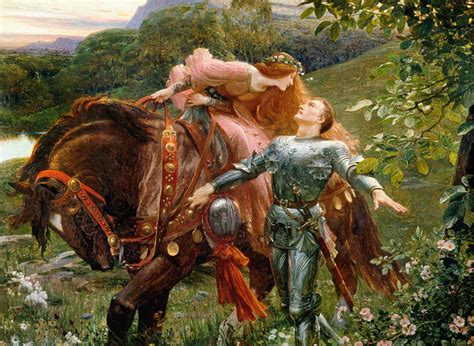
La Belle Dame sans Merci by John Keats
- Ah, what can ail thee, wretched wight,
- Alone and palely loitering?
- The sedge is wither’d from the lake,
- And no birds sing.
- Ah, what can ail thee, wretched wight,
- So haggard and so woe-begone?
- The squirrel’s granary is full,
- And the harvest ’s done.
- I see a lily on thy brow,
- With anguish moist and fever dew;
- And on thy cheek a fading rose
- Fast withereth too.
- I met a lady in the meads,
- Full beautiful—a faery’s child;
- Her hair was long, her foot was light,
- And her eyes were wild.
- I set her on my pacing steed,
- And nothing else saw all day long,
- For sideways would she lean, and sing
- A faery’s song.
- I made a garland for her head,
- And bracelets too, and fragrant zone;
- She look’d at me as she did love,
- And made sweet moan.
- She found me roots of relish sweet,
- And honey wild, and manna dew;
- And sure in language strange she said—
- ‘I love thee true.’
- She took me to her elfin grot,
- And there she gazed, and sighed deep,
- And there I shut her wild wild eyes
- So kiss’d to sleep.
- And there we slumber’d on the moss,
- And there I dream’d—Ah! woe betide!—
- The latest dream I ever dream’d
- On the cold hill side.
- I saw pale kings, and princes too,
- Pale warriors, death-pale were they all;
- They cried ‘La Belle Dame sans Merci
- Hath thee in thrall!’
- I saw their starved lips in the gloam,
- With horrid warning gaped wide,
- And I awoke, and found me here
- On the cold hill side.
- And this is why I sojourn here,
- Alone and palely loitering,
- Though the sedge is wither’d from the lake,
- And no birds sing.
Commentary:
Ah, what can ail thee, wretched wight,
Alone and palely loitering?
The sedge is wither’d from the lake,
And no birds sing.
Ah, what can ail thee, wretched wight,
So haggard and so woe-begone?
The squirrel’s granary is full,
And the harvest ’s done.
I see a lily on thy brow,
With anguish moist and fever dew;
Paraphrase
What’s wrong with you, poor soul? Why are you standing here all alone, wandering around looking pale and drained of life? The reeds around the lake have dried up and died, and there isn’t even a bird singing — everything feels empty and lifeless. Tell me, what has happened to you? You look exhausted, worn down, and deeply miserable. The squirrels have already gathered and stored their food for winter, and the harvest season is over — nature has completed its cycle. Yet you remain here, as if stuck outside of time. I can see in your face the mark of suffering: your forehead looks pale like a lily, damp with the sweat of anxiety and feverish distress.
Glossary
• ail – To trouble or cause pain; to be wrong with someone.
• wretch’d (wretched) – Miserable, unhappy, unfortunate.
• wight – An old word meaning person, often implying someone pitiable or unfortunate.
• loitering – Lingering or wandering without purpose.
• sedge – Marsh grass or reeds growing around water.
• wither’d – Withered; dried up or shriveled.
• haggard – Worn down in appearance from fatigue or suffering.
• woe-begone – Marked by deep sorrow or distress.
• granary – A storehouse for grain; here referring to the squirrel’s stored food.
• harvest ’s done – The harvest is finished; the season of growth and gathering has ended.
• lily on thy brow – A metaphor for pale skin, suggesting sickness or weakness.
• anguish moist and fever dew – Sweat caused by anxiety, illness, or emotional torment.
On “woe-begone”
The word combines woe (deep sorrow or grief) and begone (surrounded by, possessed by, or overtaken by). So “woe-begone” literally means overtaken by sorrow — someone whose entire appearance is shaped by grief.
John Keats did not invent the term “woe-begone.” The word is much older than Keats. It appears in English as early as the 14th century.
Emotional force in the poem:
When the speaker says the knight looks “so haggard and so woe-begone,” he isn’t describing a passing sadness. This is not someone merely upset. It suggests:
-
Grief that has settled into the body
-
Sorrow that has altered physical appearance
-
A face that seems permanently marked by suffering
It implies that pain has become visible — etched into him.
Tone and texture:
The phrase has a heavy, old-fashioned resonance. It belongs to the diction of ballads and lament. That archaic sound deepens the sense that this is not just personal sadness but something almost legendary or fatal.
Physical implication:
“Woe-begone” pairs with “haggard.” Together they suggest:
It prepares us for the later image of “pale kings and princes” — as if the knight already resembles the dead or enchanted.
Psychological layer:
The word also implies possession. He is not just feeling sorrow; sorrow has claimed him. He belongs to it. This anticipates the later line:
“Hath thee in thrall!”
The knight is someone conquered — emotionally captured.
Why Keats uses it:
Keats could have written “sad” or “miserable.” But “woe-begone” suggests:
It marks the knight as already damaged before he even begins telling his story.
Modern connection:
Sometimes we see someone who looks completely drained — pale, exhausted, distant — and we instinctively know something serious has happened. The world may be moving normally around them, seasons changing, life continuing, but internally they feel frozen in a moment of loss or trauma. This opening captures that experience of being emotionally out of sync with the world.
Deeper significance:
The opening immediately establishes contrast between the cycles of nature and the arrested condition of the knight. Nature has completed its seasonal work — harvest finished, animals prepared — yet the man stands suspended in lifelessness.
Keats creates a landscape that mirrors emotional desolation. The absence of birdsong suggests silence, sterility, and spiritual emptiness. The knight’s pallor and fever hint not only at emotional devastation but at mortality itself. From the start, the poem situates human suffering against the indifferent continuation of natural cycles, emphasizing isolation, vulnerability, and the fragility of vitality.
And on thy cheek a fading rose
Fast withereth too.
I met a lady in the meads,
Full beautiful—a faery’s child;
Her hair was long, her foot was light,
And her eyes were wild.
I set her on my pacing steed,
And nothing else saw all day long,
For sideways would she lean, and sing
A faery’s song.
Paraphrase:
And on your cheek I can see what used to be a healthy flush — like a rose — but it is quickly fading and dying away. The color is draining from your face just as a flower withers.
Then the knight begins to explain what happened. He says:
I met a woman out in the grassy fields. She was extraordinarily beautiful — almost otherworldly — like a fairy. Her hair flowed long behind her. She moved lightly and gracefully. But her eyes were strange — intense, untamed, unpredictable.
I lifted her onto my horse, and from that moment on I saw nothing else the entire day. My whole attention was fixed on her. She leaned toward me as we rode, turning slightly at my side, and she sang a mysterious song — a fairy’s song — something enchanting and not entirely human.
Glossary
• fading rose – A metaphor for diminishing health, vitality, or passion.
• fast withereth – Quickly shrivels or dies away (“fast” meaning quickly; “withereth” meaning withers).
• meads – Meadows or grassy fields.
• faery’s child – A fairy-like being; supernatural, not fully human.
• foot was light – She moved gracefully and delicately.
• wild (eyes) – Untamed, intense, possibly dangerous or unearthly.
• pacing steed – A horse that moves in a smooth, rhythmic gait; “steed” means horse.
• sideways would she lean – She leaned toward him as they rode, suggesting intimacy.
• faery’s song – A supernatural or enchanted song, not of ordinary human origin.
Modern connection:
This feels like the experience of becoming completely absorbed in someone — when infatuation narrows your focus so intensely that the world seems to disappear. You stop noticing everything else. The person becomes your entire field of vision. But there’s also a hint of danger in being that consumed — especially when the person feels intoxicating yet slightly unpredictable.
Deeper significance:
The fading rose on the knight’s cheek symbolizes life draining away — beauty and vitality giving way to decay. The transition from the sickly present to the enchanting past is immediate and dramatic. The lady is introduced as both beautiful and uncanny. Her “wild” eyes suggest passion but also instability or otherness.
When the knight says he “nothing else saw all day long,” this signals more than romantic absorption — it suggests enchantment, loss of perspective, even possession. His vision narrows to a single object of desire. The fairy song intensifies this sense of spellbinding.
Keats compresses seduction into a few lines: beauty, proximity, music, and complete attention. It is the beginning of enchantment — and the first stage of surrender.
I made a garland for her head,
And bracelets too, and fragrant zone;
She look’d at me as she did love,
And made sweet moan.
She found me roots of relish sweet,
And honey wild, and manna dew;
And sure in language strange she said—
‘I love thee true.’
She took me to her elfin grot,
And there she gazed, and sighed deep,
And there I shut her wild wild eyes
So kiss’d to sleep.
Paraphrase:
I crafted a garland of flowers for her head, and I also made bracelets and a scented belt to adorn her. When she looked at me, it was as if she loved me, and she gave a soft, tender moan — a sound full of feeling. She gave me gifts from the wild: sweet roots to taste, wild honey, and even manna dew (a mysterious, nourishing substance).
And then, speaking in a strange, otherworldly language, she told me clearly, “I truly love you.”
She led me to her small, magical cave — her “elfin grot.” There she stared deeply at me and sighed in a way that conveyed strong emotion. Then I closed her wild, untamed eyes, gently kissing them so she could sleep.
Glossary
• garland – A wreath of flowers worn on the head.
• fragrant zone – A scented belt or girdle.
• moan – A soft, expressive sound of pleasure, desire, or longing.
• roots of relish sweet – Edible roots with pleasant flavor; symbolic of nurturing or enchantment.
• honey wild – Honey from the untamed forest, natural and pure.
• manna dew – A sweet, mystical food; here symbolizing magical nourishment.
• language strange – Speech that is foreign, mystical, or supernatural.
• elfin grot – A small cave or secluded place associated with elves or fairies; magical and hidden.
• wild wild eyes – Eyes untamed, intense, or otherworldly.
• kiss’d to sleep – Gently kissed until she fell asleep; a tender, intimate gesture.
Modern connection:
This section reflects moments when love or desire feels immersive and magical — when small gifts, gestures, and words create a world that seems entirely separate from ordinary life. There’s a mix of care, ritual, and enchantment that mirrors modern experiences of being completely captivated by someone or something.
Deeper significance:
The passage emphasizes intimacy entwined with enchantment. The knight’s actions — making garlands, bracelets, and a fragrant belt — show devotion and attentiveness. The lady’s gifts and declaration of love suggest both generosity and seduction, but the “language strange” reminds us that this is not fully human interaction — there is mystery, even danger.
The elfin grot introduces a liminal, otherworldly space, where ordinary rules no longer apply. Closing her “wild wild eyes” symbolizes control and participation in the enchantment, but it also foreshadows the spell-like, consuming nature of their encounter. Keats presents love as simultaneously tender, intoxicating, and potentially destructive — a duality that underpins the poem’s central tension.
And there we slumber’d on the moss,
And there I dream’d—Ah! woe betide!—
The latest dream I ever dream’d
On the cold hill side.
I saw pale kings, and princes too,
Pale warriors, death-pale were they all;
They cried ‘La Belle Dame sans Merci
Hath thee in thrall!’
Paraphrase:
We lay down and slept together on the soft moss, but then I had a dream — oh, terrible fate! — it would be the last dream I ever had while on that cold, lonely hillside. In this dream, I saw ghostly figures: pale kings, noble princes, and warriors, all deathly and lifeless. They cried out to me, warning, “The Beautiful Lady Without Mercy has you completely under her spell!”
Glossary
• slumber’d – Slept; to sleep lightly or peacefully.
• woe betide – A phrase meaning “may disaster or misfortune come” or “alas for the consequences.”
• pale kings / princes – Ghostly, deathly figures of royalty; symbolizing power now diminished or lifeless.
• death-pale – Extremely pale, as if dead.
• thrall – A state of being enslaved, captivated, or completely under someone’s control.
Here’s a careful comparison of “woe-begone” and “woe betide” — two archaic expressions Keats uses in La Belle Dame sans Merci, which sound similar but function differently:
1. Woe-begone
Meaning:
-
Literally: “overtaken by sorrow” or “possessed by grief”
-
Describes a state of being, not an action
-
Suggests that sorrow has marked someone visibly — physically, emotionally, spiritually
Usage in the poem:
“Ah, what can ail thee, wretched wight,
So haggard and so woe-begone?”
-
The knight looks “woe-begone” — grief has already claimed him.
-
It’s descriptive: the phrase tells us about the character’s condition.
-
Evokes long-lasting, almost permanent suffering.
Connotations:
-
Visual: his face, posture, presence reflect sorrow
-
Emotional: a heavy, internalized grief
-
Literary: common in ballads and older English poetry to describe tragic figures
2. Woe betide
Meaning:
-
Literally: “may misfortune or disaster come”
-
A warning or exclamation, often directed at someone or something
-
Functions like “beware!” or “alas for you!”
Usage in the poem:
“And there I dream’d—Ah! woe betide!—
The latest dream I ever dream’d”
-
Here, it signals imminent misfortune or danger.
-
It is active — something terrible is about to happen or has happened.
-
Unlike “woe-begone,” it does not describe a condition, it expresses consequence or curse.
Connotations:
-
Dramatic warning: “Oh, the disaster that awaits!”
-
Evokes a sense of fate, doom, or moral reckoning
-
Fits the supernatural, cautionary tone of the dream sequence
3. Key Differences
|
Feature
|
Woe-begone
|
Woe betide
|
|
Type
|
Descriptive
|
Exclamatory / warning
|
|
Meaning
|
Overcome by sorrow; grief-stricken
|
May disaster come; alas for the consequences
|
|
Function in poem
|
Tells us the knight’s present emotional/physical state
|
Signals danger, foreshadows doom
|
|
Archaic flavor
|
Visual, interiorized, long-term
|
Dramatic, sudden, fate-oriented
|
Summary:
-
Woe-begone = the knight is already consumed by grief
-
Woe betide = a curse or warning of disaster strikes, or might strike
Keats uses both carefully: the first at the start establishes personal suffering, the second in the dream signals fatal enchantment and impending doom.
Meaning of betide
-
Old English origin: be-tidan = “to happen, to occur, to come to pass”
-
In modern terms, it means “may [something] happen to [someone]”
-
Usually used in a warning or curse sense: “Woe betide you” = “May misfortune happen to you!” or “Alas for you!”
Key points
-
Not about reporting or delivering information.
-
Focuses on events or consequences happening to someone.
-
Common in literature, often with “woe” (disaster, grief, misfortune) or “fortune” (good luck).
Examples:
In Keats
“Ah! woe betide!”
-
Keats is expressing alarm or curse-like doom.
-
It’s not news; it’s a reaction to what is happening — the knight’s last, fatal dream.
Modern connection:
This section evokes the feeling of being consumed by something or someone — like falling so deeply for a person, a goal, or an obsession that it dominates your mind. The dream acts as an inner warning, much like intuition or conscience might signal danger when we are blindly captivated.
Deeper significance:
Keats here blends romantic enchantment with fatal consequences. The mossy sleep symbolizes surrender to desire and comfort, yet the dream shatters the idyllic moment with a vision of death and subjugation. The ghostly kings and warriors represent the universality of human vulnerability — no one, not even the powerful, is immune to the seductive or destructive forces of beauty and obsession.
The line “Hath thee in thrall!” is central: it underscores the knight’s loss of agency. He is no longer acting freely; he has been enthralled, trapped in a spell that mirrors emotional or existential captivity. The poem shifts here from sensual pleasure to mortal warning, emphasizing the duality of beauty: alluring, yet merciless.
I saw their starved lips in the gloam,
With horrid warning gaped wide,
And I awoke, and found me here
On the cold hill side.
And this is why I sojourn here,
Alone and palely loitering,
Though the sedge is wither’d from the lake,
And no birds sing.
Paraphrase:
In my dream, I saw their lips — pale, hollow, and wasted — opening in the dim twilight to give a terrifying warning. Their mouths gaped as if trying to speak, but the message was horrifying and chilling.
Then I woke up and realized I was back on this cold, lonely hillside. This is the reason I remain here, wandering alone and looking pale and lifeless, even though the natural world around me has completed its cycle — the reeds by the lake have dried up, and no birds are singing. I am trapped in a state of emptiness and desolation, cut off from both vitality and joy.
Glossary
• starved lips – Lips appearing thin, pale, and wasted, as if from hunger or death.
• gloam – Twilight or dim light; dusk.
• horrid warning – A terrifying, shocking message or signal of danger.
• sojourn – To remain temporarily or reside; here, to stay in a place without moving on.
• loitering – Lingering aimlessly or idly; moving without purpose.
• sedge – Grass or reeds that grow near water, here dried up.
• wither’d – Withered; dried, decayed, or dying.
Modern connection:
This passage captures the feeling of waking from a vivid, disturbing dream and realizing your reality has not changed — that internal horror persists even when the external world continues normally. It’s like experiencing emotional trauma or intense anxiety: life goes on around you, but you feel frozen in a place of isolation and unease.
Deeper significance:
Keats brings the poem full circle here, returning to the opening image of the knight alone and desolate. The “starved lips in the gloam” show that the warnings of the dead are both literal and symbolic: the knight has been spiritually drained, and the supernatural encounter has left him weakened and enslaved by enchantment.
The repetition of nature imagery — dried sedge, silent birds — emphasizes that the world moves on while he is suspended, caught in a liminal space between life and death, desire and despair. His sojourn is both physical and psychological, showing how the encounter with La Belle Dame sans Merci has fundamentally changed him.
The poem’s ending reinforces its central theme: beauty and enchantment can captivate utterly, but at a cost — isolation, emptiness, and the loss of agency.
Brief summary of the entire poem
The poem is a short, haunting ballad that tells the story of a knight who has been enchanted and abandoned by a mysterious, supernatural woman.
It opens with the speaker observing the knight, who is pale, haggard, and “woe-begone,” standing alone on a desolate hillside. Nature around him is lifeless — the reeds are withered, and no birds sing — reflecting his own drained vitality.
The knight recounts his encounter with a beautiful, otherworldly lady, described as a “faery’s child” with long hair, light movement, and wild eyes. He becomes completely captivated by her. He adorns her with garlands and bracelets, and she gives him enchanted gifts: sweet roots, wild honey, and manna dew. She declares her love in a strange, mystical language and leads him to her elfin grot, where they sleep together.
While sleeping, he dreams of ghostly figures — pale kings, princes, and warriors — who warn him that “La Belle Dame sans Merci hath thee in thrall.” The dream signals the danger and inevitability of his enchantment.
When he awakens, he finds himself back on the cold, lonely hillside, trapped in desolation. The poem ends as it began, emphasizing his isolation, loss of vitality, and the merciless power of the supernatural lady.
Themes include:
-
The destructive power of beauty and love
-
The intersection of desire and death
-
Human vulnerability to enchantment or obsession
-
The contrast between the continuing cycles of nature and human suffering
The poem is notable for its ballad form, stark imagery, and the sense of inescapable, fatal enchantment.
|