|
home | what's new | other sites | contact | about |
|||||||||||||||||||||||||||||||
|
Word Gems exploring self-realization, sacred personhood, and full humanity
Person, Authentic Self
Editor's Essay: Higher Creativity: Liberating The Unconscious For Breakthrough Insights Eckhart Tolle: Discovering the True Self Cultism, the Denial of the Sacred Individual Ralph Waldo Emerson: Self-Reliance Report: The Psychology Of Life Purpose: Do We Need One?
reprinted from Dialogue #30
Swami Abhayananda: “We, who are but insubstantial images in that Mind imagine in our turn that we are, and all about us is, substantial, real, a solid edifice of reality that we can cling to and hang our hats on. But even this body which we label “I” is but a fleeting shadow, a flickering image on a passing screen in the Mind of the One whose bodies all these truly are. We exist in a dream-world, a projection of a dancing spray of lightbeams upon an infinite expanse of Thought.”
Life In Two Spheres, or Scenes in the Summerland, by Hudson Tuttle, channeled testimony from the other side: "Wretch! Wretch! Wretch,” he exclaimed in anguish."Oh, that I had never been born!” The Sage, taking him by the hand, raised him up, saying: "Self-accusing child, why blame yourself thus? Blame no one for their follies, but the circumstances in which you were placed. They were bad; popular opinion, before which you bent , was bad. All tended to make you what you were. You have a germ of native goodness in your being, or you would not thus accuse yourself. Arise! weep no more! The future is bright.” ... "You have corrected me aright; I acknowledge your superior spiritual powers of perception reverentially." "Reverence not me; I am no more than the others. We acknowledge submission to no one. Each is his own individual sovereign, to think and act as best pleases himself, if he is regardful of the rights of others and is measured by his worth alone. If you are thankful express it, not by words or gestures, but by actions. Reverence not me, but truth. You are still prejudiced on this and kindred subjects, and your prejudice must be overcome." Editor's note: The speaker, known as the Ancient Sage, a resident of Summerland for 3000 years, will accept no adulation: "reverence not me but the truth." This is the godly sentiment. However, there is an entire class of would-be teachers on the other side who glory in their power and position. These imposters to wisdom need to be avoided lest we fall into their insanity. See extensive discussion in the writing "500 tape-recorded messages from the other side." I became herself... Archdeacon Wilberforce, Letters from the Other Side: "On this side, when I met my beloved ... I became herself - she was transformed into me. All that she knew and felt became the content of my consciousness. All that I had attempted and achieved, all that I had failed to accomplish, yet battled and struggled to complete, was known to her as no words, no thoughts even, as earth uses the terms, could have conveyed. We were one, yet individually our own very separate selves, knowing as we were known, to the full extent of each other's capacity. Capacity is the only limitation in the spiritual realms." Compare to the following, from Excursions to the Spirit World by Frederick C. Sculthorp: “So I concentrated my thoughts on her and simply said: ‘Come!’ After a short pause my wife suddenly appeared in the lane walking towards me. I felt very happy at the success of my telepathic call… as she came closer, I noticed that her features were exactly as they had been on earth. Then, as our auras met, there was a transformation. [Her features] were perfection. She was my same companion, but different; yet I knew her better than I had ever done before. I would have recognized her unfailingly, even with my eyes closed, because her whole life and personality were contained within her aura and I could sense the years of her companionship with me. I was also aware that she knew me better than she ever did before. There seemed to be a wonderful harmony between us, for we both uttered the same words of greeting and blessing at the same instant. After that we did not trouble to speak with our lips -- speech was too slow… we were able to exchange thoughts with unbelievable rapidity.” Peter F. Drucker: "The individual is the central, rarest, most precious capital resource of our society." Barack Obama: “If you’ve got a business, you didn’t build that!”
William James: “There is but one cause of human failure. And that is man's lack of faith in his true Self.” Three Cups of Tea, by Mortenson and Relin: (2003) 17 year-old Jahan, the first educated woman of the Braldu Valley, a graduate of Pakistan’s Korphe school, the first elementary school built by Mortenson in 1995, now studying in another city: “Before I met you Dr. Greg, I had no idea what education was. But now I think it is like water. It is important for everything in life.” Mortenson asks her of her plans. She will tell him if he agrees not to laugh. He teases her with a threat that he might. “When I was a little sort of girl and I would see a gentleman or a lady with good, clean clothes I would run away and hide my face. But after I graduated from the Korphe School, I felt a big change in my life. I felt I was clear and clean and could go before anybody and discuss anything. And now that I am already in Skardu [to study], I feel that anything is possible. I don’t want to be just a health worker [anymore]. I want to be such a woman that I can start a hospital and be an executive, and look over all the health problems of all the women in the Braldu. I want to become a very famous woman of this area. I want to be a … ‘Superlady’[she said with a grin].” Mortenson didn’t laugh and mused that ten years of work was not too much effort to relish such a moment.
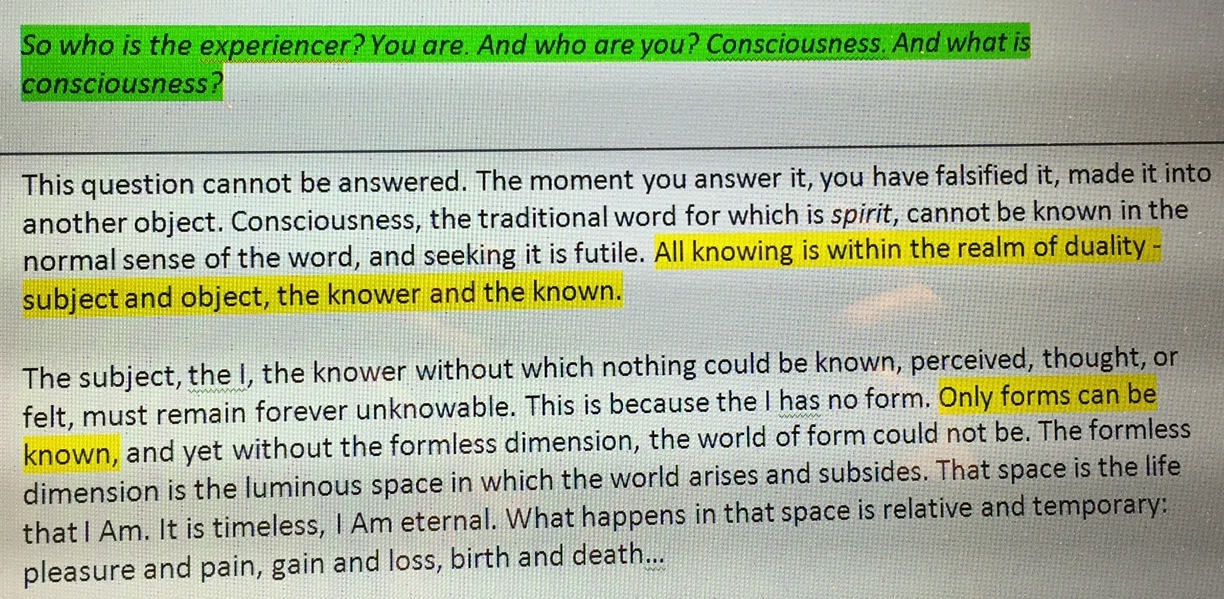
Eckhart Tolle:
to move uninjured among falling worlds, the anguish which might dissolve the stars In his well-written essay on the Bronte sisters, Sydney Dobell speaks of Jane Eyre’s journey to Lowood School. Conditions are forbidding; dark, windy, rainy. Dobell comments: "There is something intensely, almost fearfully, interesting in the diary of a child’s feelings. This 'I,' that seems to have no inheritance in the earth, is an eternity with a heritage in all heavens. This 'me,' which is thrown here and there as a thing of nought, the frail, palpitating subject of a schoolboy's tyranny, almost too fragile even to make sport for him, fear not for it. It can endure. This, that trembles at the opening of a parlour-door, quails at the crushing of a china plate, droops amid the daily cuffs and bruises of a household, and faints with fear in a haunted room, will pass alive through portals which the sun dare not enter, survive all kinds of temporal and spiritual wreck, move uninjured among falling worlds, meet undismayed the ghosts of the whole earth, pass undestroyed through the joys of angels, perhaps; also, through anguish which would dissolve the stars." Editor’s note: I am so shocked, breathless, at the beauty of Mr. Dobell’s writing here. I am tempted toward highest superlative: this might be the most captivating prose I’ve ever encountered. But, not just style, let us consider content. A young girl, alone, walking in cold and darkness, forlorn, with no safe harbor in life, secrets an astonishing destiny, one to yet surmount all obstacle, “to move uninjured among falling worlds, the anguish which might dissolve the stars.” Is this not incredible beauty?
Rumi: “There is a candle in your heart, ready to be kindled. There is a void in your soul, ready to be filled. You feel it, don’t you?” Friedrich Nietzsche: “At bottom every man knows well enough that he is a unique being, only once on this earth; and by no extraordinary chance will such a marvelously picturesque piece of diversity in unity as he is, ever be put together a second time.”
Carl Rogers: "It seems to me that ... each person is asking, Who am I, really? How can I get in touch with this real self, underlying all my surface behavior? How can I become myself? ... I should like to point out one final characteristic of these individuals [who] strive to discover and become themselves. It is that the individual seems to become more content to be a process rather than a product... to drop such fixed goals, and to accept a more satisfying realization that he is not a fixed entity, but a process of becoming... that he discovers in these experiences the stranger who has been living behind these masks, the stranger who is himself... a person who is more open to all of the elements of his organic experience; a person who is developing a trust in his own organism as an instrument of sensitive living; a person who accepts the locus of evaluation as residing within himself; a person who is learning to live in his life as a participant in a fluid, ongoing process, in which he is continually discovering new aspects of himself in the flow of his experience. These are some of the elements which seem to me to be involved in becoming a person." Frederick Douglass: "I prefer to be true to myself, even at the hazard of incurring the ridicule of others, rather than to be false, and to incur my own abhorrence." Walter Anderson: "Our lives improve only when we take chances and the first and most difficult risk we can take is to be honest with ourselves." Frederick Douglass: "The soul that is within me no man can degrade."
we are spirits in prison, able only to make signals to each other Fitzjames Stephen, in his letter to John Stuart Mill: “All human language, all human observation, implies that the mind, the ‘I,’ is a thing in itself, a fixed point in the midst of a world of change... It is the same yesterday, to-day, and to-morrow… It seems to me that we are spirits in prison, able only to make signals to each other, but with a world of things to think and speak which our signals cannot describe at all.”
Unknown: "Into this mysterious universe we are born, with no apparent set of instructions, no maps or equations, no signs or guideposts, nothing but our equally unfathomable instincts, intuitions, and reasoning abilities to tell us where we came from, why we are here, and what we are supposed to do. What we do possess - perhaps it is the key to our survival as a species - is an almost unquenchable need to know." De Gaulle: "Faced with crisis, the man of character falls back upon himself." Rainer Maria Rilke: “Keep growing quietly and seriously throughout your whole development; you cannot disturb it more rudely than by looking outward and expecting from outside replies to questions that only your inmost feeling in your most hushed hour can perhaps answer.” Dr. Raymond Moody, Life After Life, the video: Conducting near-death experience research, Dr. Moody interviews an elderly lady who describes a particular part of her journey into the Light; she focuses on a poignant sense of personal autonomy and independence that was hers as she left the body, an over-riding realization that she had become her true self: "I felt just free of everything. I'm no one's wife, mother, or daughter. I am myself, alone." Francesca Johnson (Meryl Streep), The Bridges of Madison County: "Everything I knew to be true about myself up until then was gone. I was acting like another woman, yet I was more myself than ever before." Albert Einstein, public statement, England, September 15, 1933: "Any power must be an enemy of mankind which enslaves the individual by terror and force, whether it arises under the Fascist or the Communist flag. All that is valuable in human society depends upon the opportunity for development accorded to the individual." Betty Friedan, The Feminine Mystique, 1963: "It is easier to live through someone else than to become complete yourself." Peter F. Drucker, What Is America?, 1954: "The individual is the central, rarest, most precious capital resource of our society." Buddha: "Believe nothing just because a so-called wise person said it. Believe nothing just because a belief is generally held. Believe nothing just because it is said in ancient books. Believe nothing just because it is said to be of divine origin. Believe nothing just because someone else believes it. Believe only what you yourself test and judge to be true [paraphrased] ... Work out your own salvation. Do not depend on others." Carl Rogers: "If we value independence, if we are disturbed by the growing conformity of knowledge, of values, of attitudes, which our present system induces, then we may wish to set up conditions of learning which make for uniqueness, for self-direction, and for self-initiated learning." Eleanor Roosevelt: "Friendship with oneself is all important because without it one cannot be friends with anybody else in the world." Felix Adler, The Ethical Philosophy of Life: "The conception of worth, that each person is an end per se, is not a mere abstraction. Our interest in it is not merely academic. Every outcry against the oppression of some people by other people, or against what is morally hideous is the affirmation of the principle that a human being as such is not to be violated. A human being is not to be handled as a tool but is to respected and revered." Goethe: "To be loved for what one is, is the greatest exception. The great majority love in others only what they lend him, their own selves, their version of him." Wild Woman Sisterhood: "Maturity: It doesn’t always come with age in fact it’s deeper than age. It’s about the way you see and understand things. The way you consider others. The way you communicate. The way you react. The things you value. The things you entertain. The way you represent yourself and others as an adult. Everyone grows old, but not everyone is growing up." Henry David Thoreau: "If a man does not keep pace with his companions, perhaps it is because he hears a different drummer. Let him step to the music which he hears, however measured or far away." Joseph Campbell: "Your sacred space is where you can find yourself again and again." Lorraine Hansberry: "The thing that makes you exceptional, if you are at all, is inevitably that which makes you lonely." M. Scott Peck: "The whole course of human history may depend on a change of heart in one solitary and even humble individual - for it is in the solitary mind and soul of the individual that the battle between good and evil is waged and ultimately won or lost." Martin Buber: "A person cannot approach the divine by reaching beyond the human; to become human, is what this individual person, has been created for." Pearl S. Buck: "A good marriage is one which allows for change and growth in the individuals and in the way they express their love." Rabbi Zusya: "In the world to come, I shall not be asked, 'Why were you not Moses?' I shall be asked, 'Why were you not Zusya?'" Ralph Waldo Emerson: "Insist on yourself; never imitate. Your own gift you can present every moment with the cumulative force of a whole life's cultivation; but of the adopted talent of another you have only an extemporaneous, half possession... Nothing is at last sacred but the integrity of your own mind... There is a time in every man's education when he arrives at the conviction that envy is ignorance; that imitation is suicide; that he must take himself for better for worse as his portion... It is the harder because you will always find those who think they know what is your duty better than you know it. It is easy in the world to live after the world's opinion; it is easy in solitude to live after our own; but the great man is he who in the midst of the crowd keeps with perfect sweetness the independence of solitude." Rainer Maria Rilke: “A billion stars go spinning through the night, glittering above your head, But in you is the presence that will be when all the stars are dead.” Sara Teasdale: "No one worth possessing can be quite possessed." William Shakespeare: "Self-love, my liege, is not so vile a sin, as self-neglecting." David Limbaugh: "One tragic irony of liberalism is that it robs human beings of their dignity by legislating and regulating away their individuality and liberties all in the name of humanity." Rainer Maria Rilke: “[A]t bottom, and just in the deepest and most important things, we are unutterably alone, and for one person to be able to advise or even help another, a lot must happen, a lot must go well, a whole constellation of things must come right in order once to succeed.” Sun Tzu, The Art of War: "Those who excel in war first cultivate their own humanity and justice and maintain their laws and institutions. By these means they make their governments invincible... Know your enemy and know yourself; in a hundred battles, you will never be defeated. When you are ignorant of the enemy but know yourself, your chances of winning or losing are equal. If ignorant both of your enemy and of yourself, you are sure to be defeated in every battle..." Gen. Douglas MacArthur, Reminiscences: on his philosophy regarding the military occupation of Japan: "... history clearly showed that no modern military occupation of a conquered nation had been a success... If any occupation lasts too long ... one party becomes slaves and the other masters... almost every military occupation breeds new wars of the future... [I set about] restoring a sense of dignity and purpose in their people." [Editor's note: A&E's Korean War documentary, Fire & Ice, suggests that the Japanese subjagation of Korea had stunted the sense of individualism that should have belonged to the South Korean soldiers, resulting in their sometimes-ineffectiveness as warriors as they fought alongside GI's. Note Sun Tzu's comment above.] General Matthew Ridgeway, Korean War General: In January 1951, Seoul was evacuated for a second time, and Ridgeway's UNC forces were demoralized. In reply to his men's oft-repeated question, "What are we fighting for?" Ridgeway replied: "Real estate is here incidental.... The real issues are whether the power of Western civilization.... shall defy and defeat Communism; whether the rule of men who shoot their prisoners, enslave their citizens, and deride the dignity of man, shall displace the rule of those to whom the individual and his individual rights are sacred... The sacrifices we have made, and those we shall yet support, are not offered vicariously for others, but in our own direct defense. In the final analysis, the issue now joined right here in Korea is whether communism or individual freedom shall prevail." C.S. Lewis: "The rescue of drowning men is ... a duty worth dying for, but not worth living for. It seems to me that all political duties (among which I include military duties) are of this kind. A man may have to die for our country: but no man must, in any exclusive sense, live for his country. He who surrenders himself without reservation to the temporal claims of a nation, or a party, or a class is rendering to Caesar that which, of all things, most emphatically belongs to God: himself." Dr. Mortimer Adler: "In the opinion of the ancients, education is the process of developing or perfecting human beings. It tries to cultivate the humanity of man by developing his specifically human excellences - both intellectual and moral... The connection of liberal education with scientific creativity is not mere speculation. It is a matter of historical fact that the great German scientists of the nineteenth century had a solid background in the liberal arts. They all went through a liberal education which embraced Greek, Latin, logic, philosophy, and history, in addition to mathematics, physics, and other sciences. Actually, this has been the educational preparation of European scientists down to the present time. Einstein, Bohr, Fermi, and other great modern scientists were developed not by technical schooling, but by liberal education... The aim of liberal education, however, is not to produce scientists. It seeks to develop free human beings who know how to use their minds and are able to think for themselves." Marcus Aurelius: "Thou must be like a promontory of the sea, against which, though the waves beat continually, yet it both itself stands, and about it are those swelling waves stilled and quieted." Ernest Fitzgerald: "It is not by accident that the happiest people are those who make a conscious effort to live useful lives. Their happiness, of course, is not a shallow exhilaration where life is one continuos intoxicating party. Rather, their happiness is a deep sense of inner peace that comes when they believe their lives have meaning and that they are making a difference for good in the world." Jim Croce, New York's Not My Home: "I had begun to doubt all the things that were me..." Dr. Philip G. Zimbardo, The Stanford Prison Experiment: an “inmate responded: "I began to feel that I was losing my identity, that the person that I called Clay, the person who put me in this place, the person who volunteered to go into this prison - because it was a prison to me; it still is a prison to me. I don't regard it as an experiment or a simulation because it was a prison run by psychologists instead of run by the state. I began to feel that that identity, the person that I was that had decided to go to prison was distant from me - was remote until finally I wasn't that, I was 416. I was really my number." Inscription on Nikos Kazantzakis' tomb in Heraklion, Greece: "I hope for nothing. I fear nothing. I am free." Aristotle: "Whosoever is delighted in solitude is either a wild beast or a god." Sir Edward Gibbon: "Conversation enriches the understanding, but solitude is the school of genius." Eleanor Roosevelt: "No one can make you feel inferior without your consent." Emerson: "An individual has a healthy personality to the exact degree to which [he or she has] the propensity to look for the good in every situation." Professor Daniel N. Robinson, Georgetown University: How did the ancient Greeks manage, almost single-handedly, it seems, to create what we call philosophy? Why is it that the beginnings of so many subjects find their roots in the Hellenic world? Various theories are advanced: there was an abundance of sunshine; a plentiful fish diet was most healthful; slave labor made possible ample leisure time -- none of these explanations are at all satisfying: Pharaoh had no shortage of sunshine, but Egypt is rather lean on philosophical thought; other lands had managed to create reliable food sources, and slave labor was common in the ancient world. But the Greeks, it seems correct to assert, were different from all others in one area: The ancient Greek world never had a state religion, but the polis was never completely secular either; rather there is an "extraordinary integration of the secular and the devote." The ancient Greeks, it might be said, had a "religious attitude - but not a religion, as such." Prof. Robinson lays "great stress on the relationship, in any society, between the epistemological authority conferred on religious figures and the philosophical vitality of that age ... if you are fairly satisfied that the most burning questions are best answered by going to an authority [an oracle, a saint, a wise man] ... [then] I submit that the philosophical dimensions of that culture will be fairly thin and fragile, if present at all. There's something about philosophy that is at once humanizing and utterly human -- when the oracles have failed us, when saints have grown silent, and when God has chosen not to reveal himself, then we must stand back in the dark shadows of confusion and fear and ask, What sort of being am I? What sort of life is right for me? ... The philosopher doesn't enter the arena of philosophy devoid of belief, purpose, plan, aspiration and values -- all of that is in place; but there are those moments when we say no matter how much this means to me, no matter how centered my being is on this pattern of beliefs, no matter how close, emotionally, romantically, I am to those who hold these convictions, I'm going to be skeptical about those statements, I'm going to plumb the depths of those arguments to see finally what their true value is." To do otherwise, you are, as Plato said, a puppet on a string, a slave; but the truth will set you free. Professor Daniel N. Robinson, Georgetown University: When a culture takes the position that the problem of knowledge is essentially a religious problem; when it invests its credulity in a denominated group of official interpreters whose judgments on matters of this kind are taken to be dispositive - then, "the only thing left for scholarship is to interpret the words of the wise. So the entire debate becomes, not about the nature of truth, but, what Smith meant when he said 'X,' granting that Smith is the repository of all truth." This attitude can invade all branches of knowledge... [its bastard children, the likes of e.g. cult religion and demagogic politics. The unstated dictum from all of these true-believer spiders' nests is that the individual matters for nothing; that the only opinion worth listening to is that of the local cult chieftain and that truth will die along with him]. Professor Daniel N. Robinson, Georgetown University: "Socrates asks the question, How should we be governed? And you cannot answer a question like that in the abstract. You can't answer [this question] unless you've already established what kind of life is the right kind of life for us to live; and you can't answer that question until you've settled the question, What kinds of beings are we? and How is that we can come to know anything? So until you've successfully defeated a skeptical position on all knowledge, you can't have much of a position on ethics; and until you've handled the ethical dimensions of life, you can't have much of a handle on what the political organization of what the polis should be. It's to Socrates' lasting genius that he understands the interconnectedness of these questions -- that the problem of knowledge, the problem of conduct, the problem of governance, are various faces of the same kind of problem, which is, how we come to know ourselves and realize our humanity in the course of a lifetime." John Miller, 1771, Of the Origin and Distinction of Ranks: Miller, a student of Adam Smith, moral philosopher and author of Wealth of Nations, explains the moral foundations of free trade and a capitalistic market economy; how economic servitude and fawning dependence create a stultifying view toward personal freedoms and the dignity of man in general. "In this situation, persons of low rank have no opportunity of acquiring [wealth] or of raising themselves to superior stations and remain for ages in a state of dependence. They naturally contract such dispositions and habits as are suited to their circumstances. They acquire a sacred veneration for the person of their master and are taught to pay an unbounded submission to his authority. They are proud of that servile obedience by which they seem to exalt his dignity and consider it as their duty to sacrifice their lives and their possessions in order to promote his interest or even to gratify his capricious humour ... The farther a nation advances in [free, open markets, open opportunities for all] ... the lower-people in general thereby become more independent of their circumstances. They begin to exert those sentiments of liberty which are natural to the mind of man and which necessity alone is able to subdue. In proportion as they have less need of the favour and patronage of the great, they're at less pains to procure it. That vanity which was formerly discovered in magnifying the power of a chief is now equally displayed in a sullen indifference or in a contemptuous and insolent behaviour to persons of a superior rank and station." Jamie Lee Curtis: "The more I like me, the less I want to pretend to be other people." Kenneth Clark, Civilisation: Clark points out that, during the Dark Ages, artists tended to depict humankind in very obscure terms; such tendency reflected a general hopelessness and low self-esteem that people of that age had of themselves. But, 200 years after the death of Charlemagne, the art of the times reflects a growing self-awareness and new self-respect for Man; he no longer depicts himself in art as a pitiful, obscure figure. "Man is no longer Imago Hominis, the [mere stylized] image of man, but a [vital] human being, with humanity's impulses and fears; also humanity's moral sense and belief in the authority of a higher power." This new respect and self-awareness served as prelude to an explosion of creative achievement after AD 1000. Abhijit Naskar, Love, God & Neurons: Memoir of a scientist who found himself by getting lost: “Never focus your attention on what the world has to say about you. Rather turn your focus inside and listen to what your inner voice has to say to you. You can find the answers to the most complicated questions of life from your deepest self. Pay attention and listen. Your inner self has to say something to you. Listen to that eternal entity within, and you shall discover the way through which you’ll reach your goal.” C.S. Lewis: "Critics who treat adult as a term of approval, instead of as a merely descriptive term, cannot be adults themselves. To be concerned about being grown up, to admire the grown up because it is grown up, to blush at the suspicion of being childish; these things are the marks of childhood and adolescence.... When I was ten, I read fairy tales in secret and would have been ashamed if I had been found doing so. Now that I am fifty, I read them openly. When I became a man, I put away childish things, including the fear of childishness and the desire to be very grown up." James Fenimore Cooper, The American Democrat, 1838: "Individuality is the aim of political liberty... The tendencies of democracies are, in all things, to mediocrity, since the tastes, knowledge, and principles of the majority form the tribunal of appeal... It is the besetting vice of democracies to substitute public opinion for law. This is the usual form in which the masses of men exhibit their tyranny." Dante, Monarchy, 1309: "Mankind is at its best when it is most free. This will be clear if we grasp the principle of liberty. We must recall that the basic principle is freedom of choice, which saying many have on their lips but few in their mind." Supreme Court Justice William O. Douglas, 1954: "The struggle is always between the individual and his sacred right to express himself ... and ... the power structure that seeks conformity, suppression, and obedience." Learned Hand, US Federal Judge, 1944: "Liberty lies in the hearts of men and women; when it dies there, no constitution, no law, no court can save it." Apostle Paul: "Make a careful exploration of who you are and the work you have been given, and then sink yourself into that. Don't be impressed with yourself. Don't compare yourself with others. Each of you must take responsibility for doing the creative best you can with your own life." Galatians 6.4-5, The Message Don Feder: "In The Lord of The Rings Tolkien dealt with such paramount matters as corruption of the soul, temptation, the will to power, mercy, forgiveness, redemption and salvation. He did so brilliantly, with prose that sears the soul like an incandescent blade... Tolkien believed that the only way to combat this slide to technological barbarism is for people to rediscover their essence - to know that each of us has a divine spark within, to understand that history isn’t shaped by relentless forces but is the product of individuals with a vision (angelic or demonic), and that we are not 'mere cogs in the vast machine of modern industrial society' but sub-creators, whose works can reflect the glory of the ultimate Creator. As the wizard Gandalf proclaims when he confronts the monstrous Balrog in Moria: I am a servant of the Secret Fire!"
John Stuart Mill, On Liberty, 1859: "Whatever crushes individuality is despotism... The only part of the conduct of any one, for which he is amenable to society, is that which concerns others. In the part which merely concerns himself, his independence is, of right, absolute. Over himself, over his own body and mind, the individual is sovereign." George Washington: "Labor to keep alive in your heart that little spark of celestial fire called conscience."
Chariots of Fire, the movie: Duke of Sutherland: A sticky moment, George. Mark Twain: "Each of you, for himself, by himself and on his own responsibility, must speak. And it is a solemn and weighty responsibility, and not lightly to be flung aside at the bullying of pulpit, press, government, or the empty catchphrases of politicians. Each must for himself alone decide what is right and what is wrong, and which course is patriotic and which isn't. You cannot shirk this and be a man. To decide against your convictions is to be an unqualified and inexcusable traitor, both to yourself and to your country, let man label you as they may. If you alone of all the nation shall decide one way, and that way be the right way according to your convictions of the right, you have done your duty by yourself and by your country- hold up your head! You have nothing to be ashamed of." Leo Tolstoy, On Life and Essays on Religion: "Freethinkers are those who are willing to use their minds without prejudice and without fearing to understand things that clash with their own customs, privileges, or beliefs. This state of mind is not common, but it is essential for right thinking; where it is absent, discussion is apt to become worse than useless." William Channing: "I call that mind free which jealously guards its intellectual rights and powers, which calls no man master, which does not content itself with a passive or hereditary faith, which opens itself to light whencesoever it may come, which receives new truth as an angel from Heaven." Ayn Rand, For The New Intellectual: "Intellectual freedom cannot exist without political freedom; political freedom cannot exist without economic freedom; a free mind and a free market are corollaries." Ayn Rand, What Is Capitalism?: "When ‘the common good’ of a society is regarded as something apart from and superior to the individual good of its members, it means that the good of some men takes precedence over the good of others, with those others consigned to the status of sacrificial animals." Ernst Toller, German playwright, 1935: "As a rule, people are afraid of truth. Each truth ... destroys the crutches on which we need to lean." Ayn Rand: "Men have been taught that it is a virtue to agree with others. But the creator is the man who disagrees. Men have been taught that it is a virtue to swim with the current. But the creator is the man who goes against the current. Men have been taught that it is a virtue to stand together. But the creator is the man who stands alone." Will & Ariel Durant, The Lessons of History: "History repeats itself in the large because human nature changes with geological leisureliness, and man is equipped to respond in stereotyped ways to frequently occurring situations and stimuli like hunger, danger and sex. But in a developed and complex civilization individuals are more differentiated and unique than in a primitive society, and many situations contain novel circumstances requiring modifications of instinctive response; custom recedes, reasoning spreads, the results are less predictable." Martha Graham, choreographer: "There is a vitality, a life force, a quickening that is translated through you into action, and because there is only one of you in all time, this expression is unique. If you block it, it will never exist through any other medium and be lost. The world will not have it. It is not your business to determine how good it is; nor how valuable it is; nor how it compares with other expressions. It is your business to keep it yours, clearly and directly, to keep the channel open. You do not have to believe in yourself or your work. You have to keep open and aware directly to the urges that motivate you. Keep the channel open. No artist is pleased. There is no satisfaction whatever at any time. There is only a queer, divine dissatisfaction; a blessed unrest that keeps us marching and makes us more alive than the others." Harry S Truman, Address to the UN Conference, San Francisco, 1945: "We must build a new world, a far better world - one in which the eternal dignity of man is respected." Jo Coudert, Advice From A Failure: "It is not an easy world to live in. It is not an easy world to be decent in. It is not an easy world to understand oneself in, nor to like oneself in. But it must be lived in, and in the living there is one person you absolutely have to be with." John Milton: "The mind is its own place, and in itself can make a Heaven of Hell, a Hell of Heaven." Frank Herbert: "If you think of yourselves as helpless and ineffectual, it is certain that you will create a despotic government to be your master. The wise despot, therefore, maintains among his subjects a popular sense that they are helpless and ineffectual."
Eric Hoffer, The True Believer: “Faith in a holy cause is to a considerable extent a substitute for the lost faith in ourselves.” Eric Hoffer, The True Believer: “The less justified a man is in claiming excellence for his own self, the more ready is he to claim all excellence for his nation, his religion, his race or his holy cause.” Eric Hoffer, The True Believer: “There is a fundamental difference between the appeal of a mass movement and the appeal of a practical organization. The practical organization offers opportunities for self-advancement, [but]… a mass movement … appeals not to those intent on bolstering and advancing a cherished self, but to those who crave to be rid of an unwanted self.” Eric Hoffer, The True Believer: “A mass movement attracts and holds a following not because it can satisfy the desire for self-advancement, but because it can satisfy the passion for self-renunciation.” Eric Hoffer, The True Believer: “People who see their lives as irremediably spoiled cannot find a worth-while purpose in self-advancement… They look on self-interest as on something tainted and evil; something unclean and unlucky. Anything undertaken under the auspices of the self seems to them foredoomed… Their innermost craving is for a new life – a rebirth – or, failing this, a chance to acquire new elements of pride, confidence, hope, a sense of purpose and worth by an identification with a holy cause." Thomas Sowell: "Virtually no idea is too ridiculous to be accepted, even by very intelligent and highly educated people, if it provides a way for them to feel special and important. Some confuse that feeling with idealism." Albert Camus: "In the depth of winter, I finally learned that within me there lay an invincible summer." Jean Anouilh: "True miracles are created by men when they use the courage and intelligence that God gave them." Maxim Gorky: “Everybody, my friend, everybody lives for something better to come. That's why we want to be considerate of every man--Who knows what's in him, why he was born and what he can do?” John Adams (20 years old), 1755: "Upon common theaters, indeed, the applause of the audience is of more importance to the actors than their own approbation. But upon the stage of life, while conscience claps, let the world hiss! On the contrary if conscience disapproves, the loudest applauses of the world are of little value." C. Bradley Thompson: "During his retirement years, [John Adams] was fond of saying that the War for Independence was a consequence of the American Revolution. The real revolution, he declared, had taken place in the minds and hearts of the colonists in the fifteen years prior to 1776. According to Adams, the American Revolution was first and foremost an intellectual revolution." Helen Keller: "I am only one; but still I am one. I cannot do everything, but still I can do something; I will not refuse to do the something I can do. Life is either a daring adventure or nothing. Security is mostly a superstition. It does not exist in nature." Marceline Valmore: "To gain in strength and elevation of mind, day by day ... there is something in all this which may yet sanctify life." George Bernard Shaw: "No man who is occupied in doing a very difficult thing, and doing it very well, ever loses his self-respect." Frederic W. H. Myers, Vanishing Night, transmitted to Juliet S. Goodenow, 1923: "It is not so much what you will find when you come to this side of life as what you will bring with you... Sleep is the best definition of death I know anything about -- just going to sleep unafraid to awake in a new and beautiful room, and to be satisfied... [On Earth] you are the apprentice to your own soul. Here you are the promoted individual... Bring all of your soul treasures -- you will need them, your culture, your love of art, of music -- all this you will use... Every want shall be satisfied. Material possessions you will not need... We are undisguised, for on our foreheads is the insignia of whatever we have gained in culture, love for humanity, charity, selflessness, energy and force, ambitions for the sake of others -- all this is here waiting for us when we are given ... our Price, our Wage, whatever we have earned during our years of apprenticeship." Walt Whitman: "Re-examine all you have been told ... dismiss whatever insults your own soul." Thoreau, Civil Disobedience: "There will never be a free and enlightened State until the State comes to recognize the individual as a higher and independent power, from which all its own power and authority are derived, and treats him accordingly...Why has every man a conscience, then? I think that we should be men first, and subjects afterward. It is not desirable to cultivate a respect for the law, so much as for the right. The only obligation which I have a right to assume is to do at any time what I think right... A common and natural result of an undue respect for law is, that you may see a file of soldiers, colonel, captain, corporal, privates, powder-monkeys, and all, marching in admirable order over hill and dale to the wars, against their wills, ay, against their common sense and consciences... Now, what are they? Men at all? or small movable forts and magazines, at the service of some unscrupulous man in power? Visit the Navy Yard, and behold a marine, such a man as an American government can make, or such as it can make a man with its black arts — a mere shadow and reminiscence of humanity, a man laid out alive and standing, and already, as one may say, buried under arms with funeral accompaniments… The mass of men serve the state thus, not as men mainly, but as machines, with their bodies... In most cases there is no free exercise whatever of the judgment or of the moral sense; but they put themselves on a level with wood and earth and stones; and wooden men can perhaps be manufactured that will serve the purpose as well. Such command no more respect than men of straw or a lump of dirt. They have the same sort of worth only as horses and dogs. Yet such as these even are commonly esteemed good citizens…" Paul Johnson: "Again and again, an enlightened and strong-willed individual has pushed against the prevailing trends and the prevailing wisdom to perform an act of courage that has changed history." Joseph Schumpeter, Harvard professor and economist (1883-1950): In his book Business Cycles (1939), Schumpeter asserted that the long-term ebb-and-flow price movements of the business cycle are linked to technological innovation. These innovations, the product of entrepreneurial efforts, not only upset and influence certain industries but entire economies. Schumpeter foresaw that technological innovation presents itself in “clusters” or groups of occurrences – this happens because of copy-cat versions of the original product or service, others attempting to cash in on a good thing. All of this sets up a Kondratieff long-wave cycle (a pattern of economic regularity) as the innovation process plays itself out and is diffused within the marketplace. Alvin Hansen (1887-1975), Schumpeter’s Harvard colleague, summarizes his friend’s theory: “Innovation wells up in a great tidal wave and then recedes. The business cycle, as Schumpeter saw it, is nothing more or less than the ebb and flow of innovation, together with the repercussions flowing there from. An economy which experiences innovations necessarily displays wave-like movements. Innovation involves capital investment which appears en masse at intervals. Innovational activity tends to come in ‘clusters,’ in ‘bunches,’ because of the herd-like action of followers in the wake of successful innovation. Whenever a few successful innovators appear, a host of others follow. The appearance of a few innovating entrepreneurs facilitates the appearance of others; and these the appearance of more in ever-increasing numbers. This is the basis of the wave-like movement of economic life.” Editor’s note: We see here further evidence of the prime importance of individual activity – not socialistic governmental directive – as the prime mover of growth and change within a national economy: think of the entrepreneurially-induced tech boom of the 1980s, the waves and ripple-effects of which still reverberate today. Barack Obama: “If you’ve got a business, you didn’t build that!” Lawrence Moss, economist, student of Ludwig von Mises: “I read his books and questioned those aspects of thought with which I disagreed. Oddly enough, the more I argued against some of his tenets, the more he seemed to appreciate my presence. I slowly began to understand what Mises philosophy is essentially about. It is more than a theory of economics, and more than a program of political activity. It is a philosophy built around the individual, considering his opinions and decisions to be important. Mises’ laissez-faire is more than a plea for economic sanity – it is a plea for human toleration.” Alexis de Tocqueville: De Tocquelle understood that democracy is an essentially individualist institution -- and that it stands in unremitting conflict with socialism: "Democracy extends the sphere of individual freedom; socialism restricts it. Democracy attaches all possible value to each man; socialism makes each man a mere agent, a mere number. Democracy and socialism have nothing in common but one word: equality. But, notice the difference. While democracy seeks equality in liberty, socialism seeks equality in restraint and servitude." Star Trek III, The Search For Spock: Kirk to the reborn Spock: "The needs of the one outweigh the needs of the many.” Samuel Adams: “It does not require a majority to prevail, but rather an irate, tireless minority keen to set brush fires in people's minds” Jerry Seinfeld, 4-15-11, commenting on the British royal wedding: "Well, it's a circus act, it's an absurd act. You know, it's a dress-up. It's a classic English thing of let's play dress-up. Let's pretend that these are special people. OK, we'll all pretend that - that's what theatre is. The British have the greatest theatre in the world. They love to dress up, and they love to play pretend. And that's what the royal family is. It's a huge game of pretend. These aren't special people. It's fake outfits, fake phoney hats and gowns," [all designed to make you believe that they are better, more worthy, than you.] Robert F. Kennedy (1966): "Few men are willing to brave the disapproval of their fellows, the censure of their colleagues, the wrath of their society. Moral courage is a rarer commodity than bravery in battle or great intelligence. Yet it is the one essential, vital quality for those who seek to change a world which yields most painfully to change." Steve Jobs: "Here's to the crazy ones, the misfits, the rebels, the troublemakers, the round pegs in the square holes... the ones who see things differently -- they're not fond of rules... You can quote them, disagree with them, glorify or vilify them, but the only thing you can't do is ignore them because they change things... they push the human race forward, and while some may see them as the crazy ones, we see genius, because the ones who are crazy enough to think that they can change the world, are the ones who do." Dr. Suess: "You have brains in your head,
|
|||||||||||||||||||||||||||||||
|
|