|
home | what's new | other sites | contact | about |
||||||||||||||||||||||||||||||||||||||||||||||||
|
Word Gems self-knowledge, authentic living, full humanity, continual awakening
Gottfried Wilhelm Leibniz Explication de l'Arithmétique Binaire
return to 'Great Books' main-page
see a copy of the analysis format Commentary by ChatGPT
Explication de l'Arithmétique Binaire Explication de l'Arithmétique Binaire is the title of one of Gottfried Wilhelm Leibniz's most remarkable essays. It was published in 1703 and introduces the philosophical and mathematical significance of the binary (base-2) number system. Literal TranslationExplication de l'Arithmétique Binaire Breaking the title into its parts:
A natural English translation is:
Or more smoothly:
What Is Binary Arithmetic?Binary arithmetic is a system that uses only two symbols:
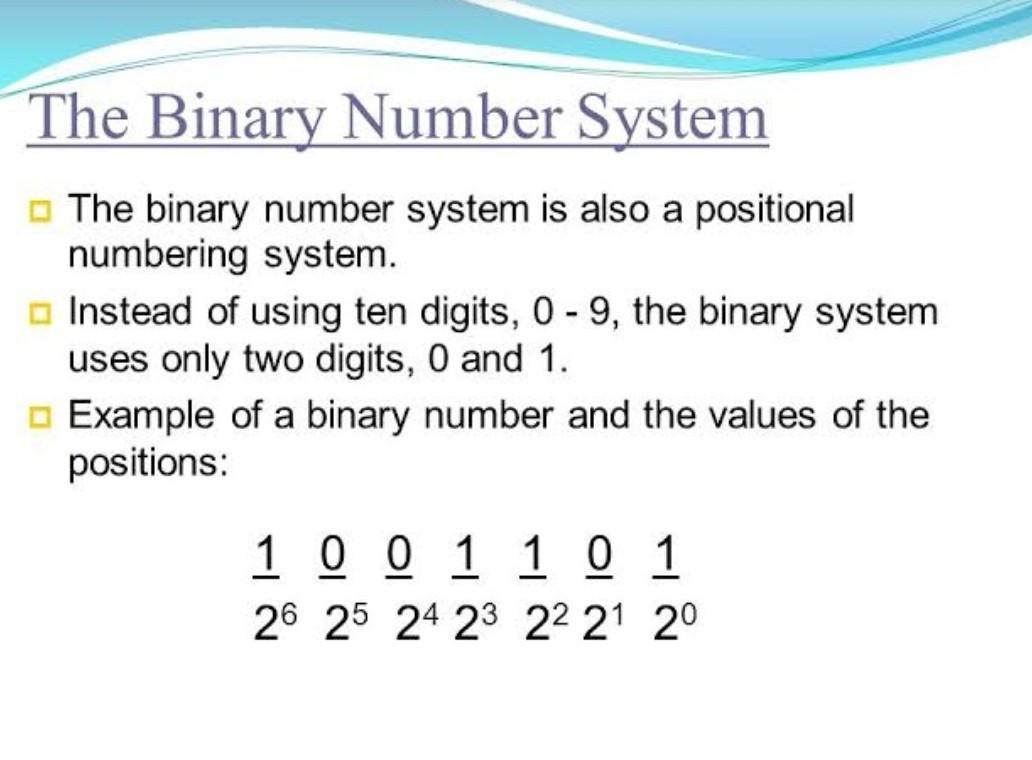
Instead of counting in tens (0–9), as in our familiar decimal system, binary counts in powers of two. For example:
Today, virtually every digital computer operates internally using binary logic. Why the Title Is ImportantAt first glance, the title appears to describe only a mathematical technique. In fact, Leibniz saw something far more profound. He believed binary arithmetic revealed a striking philosophical image of creation:
From the repeated combinations of these two simple symbols, every number can be generated. Leibniz viewed this as a symbolic analogy for the creation of the world from apparent nothingness through divine rational order. While this is an analogy rather than a mathematical proof, it reflects how closely he linked mathematics, metaphysics, and theology. The Deeper MeaningThe title is really announcing an explanation of how immense complexity can arise from astonishing simplicity. This theme appears repeatedly throughout Leibniz's thought:
Binary arithmetic became one of his favorite illustrations of these ideas. Roddenberry QuestionCan the infinite richness of reality arise from the simplest possible principles? That question gives the essay its enduring fascination. What appears to be a modest discussion of a numbering system becomes a meditation on order, creation, and intelligibility. More than three centuries later, Leibniz's binary system forms the mathematical foundation of digital computing, making this short essay one of the most historically consequential works ever written on numbers.
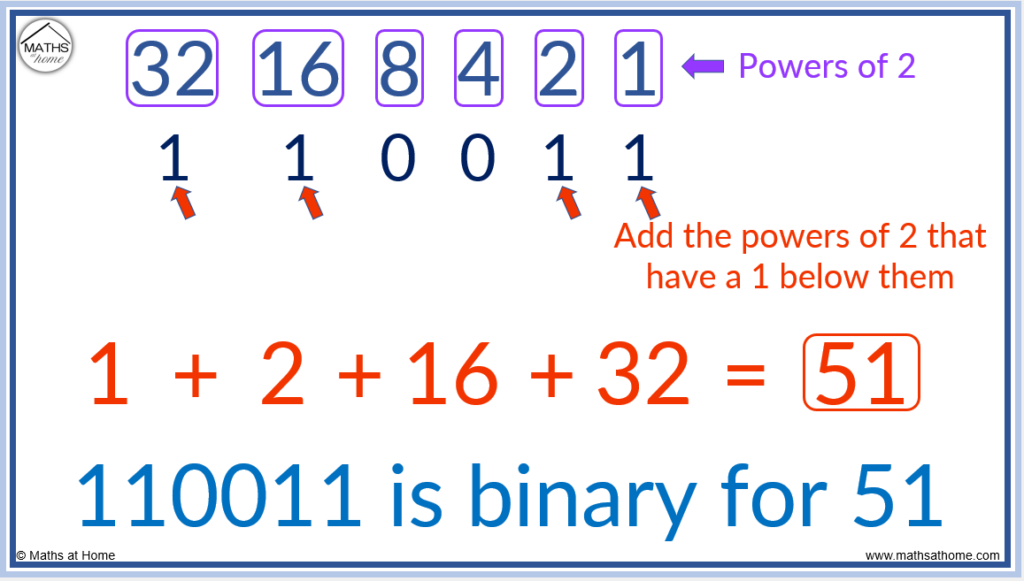
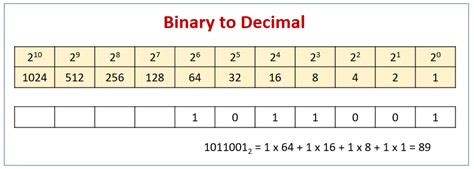
The key is that binary is exactly like decimal, except it uses powers of 2 instead of powers of 10.
Why Only 0 and 1?Imagine a row of light switches. Each switch can only be:
Suppose the switches represent these values:
You have
So the pattern
represents 11. This is exactly how computers store numbers. Every tiny electronic circuit is essentially acting like a microscopic switch that is either off (0) or on (1). Billions of these switches, working together, allow computers to represent numbers, text, images, music, and programs—all using nothing more than combinations of 0 and 1. This is what so impressed Leibniz. He realized that an unlimited variety of numbers—and, symbolically, immense complexity—could arise from the simplest possible pair of symbols. That insight foreshadowed the digital age by more than 250 years.
Explain the subscripts -- 1101012 = 5310
The subscripts tell you which number system (or "base") is being used. They are not exponents; they are labels. So when you see 1101012 = 5310 read it as:
The subscript is simply saying, "Interpret this number using this counting system." Base 10 (Decimal)Our everyday number system is base 10, written with the subscript 10. It uses ten digits:
When we write 5310 we mean
Usually we omit the 10 because everyone assumes ordinary decimal notation. Base 2 (Binary)Binary uses only two digits:
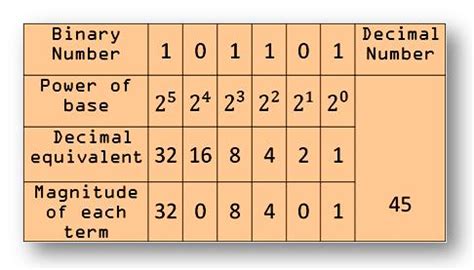
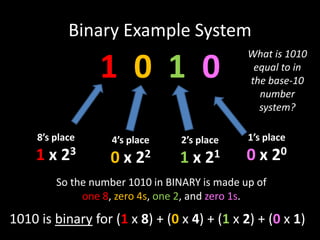
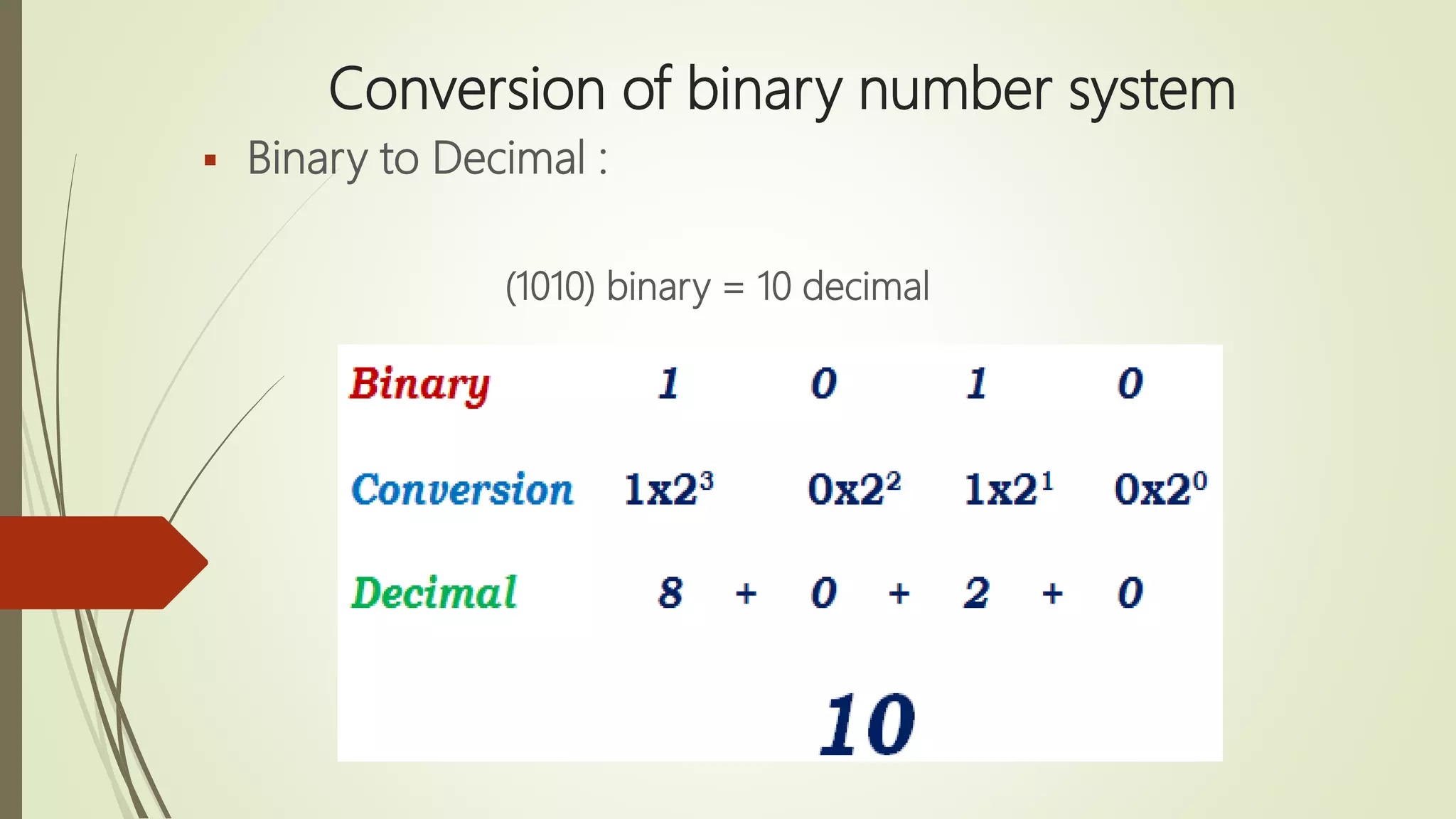
The positions represent powers of 2 instead of powers of 10. So 1101012 means:
Now add the values where there is a 1:
Total: 32 + 16 + 4 + 1 = 53 Therefore 1101012 = 5310 Another ExampleTake 10102 The place values are:
Add the columns with a 1: 8 + 2 = 10 So 10102 = 1010 Notice the interesting reversal:
The digits look the same, but the subscript tells you how to interpret them. Why the Subscript MattersImagine writing simply:
Without a subscript, you don't know what it means. Leibniz appreciated this because it showed that a number system is defined not by the symbols themselves, but by the rules governing their interpretation. With just two symbols—0 and 1—and a different set of place values, one can represent every whole number. That elegant simplicity was one of the reasons he regarded binary arithmetic as both mathematically powerful and philosophically profound. Explication de l'Arithmétique Binaire 1. Author BioGottfried Wilhelm Leibniz (1646–1716) was a German philosopher, mathematician, jurist, diplomat, and polymath of the Holy Roman Empire. Influenced by René Descartes (1596–1650)'s search for mathematical certainty and by Athanasius Kircher (1602–1680) and the combinatorial tradition, Leibniz sought universal symbolic systems capable of expressing both mathematical and philosophical truth. His work on binary arithmetic anticipated the logical architecture of the modern digital world. 2. Overview / Central Question(a) Form and Length
(b) Entire Work in ≤10 Words
(c) Roddenberry Question: "What's this story really about?"Can all complexity arise from the simplest possible principles? Leibniz introduces the binary number system, demonstrating that every whole number can be represented using only the symbols 0 and 1. He then moves beyond mathematics, arguing that this remarkable simplicity symbolizes the rational structure of creation itself. The essay suggests that profound complexity need not arise from complicated beginnings, but from simple principles governed by universal laws. That vision continues to resonate because it underlies both modern computing and enduring philosophical questions about order, simplicity, and creation. 2A. Plot Summary of the Entire WorkLeibniz begins by explaining a number system that uses only two digits instead of the familiar ten. Through straightforward examples he shows that binary arithmetic can represent every integer while following consistent mathematical rules. He then reflects on the surprising elegance of the system. What initially appears to be a mathematical curiosity becomes evidence that simplicity can generate unlimited variety. The discussion broadens into philosophy and theology. Leibniz proposes that the relationship between 0 and 1 symbolizes the emergence of created reality through rational order. The binary system thus becomes more than a computational tool—it becomes an illustration of intelligibility itself. The essay closes by inviting readers to recognize that symbolic languages often reveal truths extending beyond their immediate technical applications. A seemingly modest numbering system hints at the deep unity of mathematics, logic, philosophy, and nature. 3. Special InstructionsAlthough historically famous because modern computers use binary arithmetic, the essay should be read primarily as a philosophical meditation on simplicity, symbolic representation, and rational order. 4. How This Book Engages the Great ConversationThe Great Conversation repeatedly asks whether reality is ultimately simple or irreducibly complex. Leibniz argues that beneath the world's immense diversity may lie astonishingly simple principles. Mathematics becomes evidence that complexity need not imply disorder; rather, it may reflect the unfolding of elegant underlying laws. The essay therefore addresses more than arithmetic. It proposes that human reason succeeds because reality itself possesses an intelligible structure that symbolic thought can progressively uncover. 5. Condensed AnalysisWhat problem is this thinker trying to solve, and what kind of reality must exist for his solution to make sense?ProblemCan a complete numerical system be built from the fewest possible symbols? More broadly, can great complexity emerge from radical simplicity? The problem matters because it tests whether mathematical richness depends upon complicated foundations or whether simple rules suffice. Core ClaimBinary arithmetic demonstrates that two symbols alone are sufficient to represent every whole number. Leibniz further argues that this mathematical economy illustrates a broader principle: rational order allows simple elements to generate immense complexity. If taken seriously, the essay suggests that simplicity is often the deepest mark of truth rather than a sign of inadequacy. OpponentThe essay does not directly attack another mathematician. Instead, it quietly challenges the assumption that richer systems necessarily require richer foundations. It also stands against any view that complexity itself is the ultimate explanation of nature. A modern reader might object that binary is simply an alternative notation and carries no metaphysical implications. Leibniz would reply that while the symbolism does not prove metaphysical truths, it vividly illustrates how profound order can emerge from minimal principles. BreakthroughThe mathematical breakthrough is recognizing binary arithmetic as a complete positional number system. The conceptual breakthrough is seeing that symbolic systems possess explanatory power extending beyond calculation. Binary becomes a model of how simplicity and universality coexist. Three centuries later, every digital computer would validate the extraordinary practical significance of this insight. CostLeibniz's mathematical claims are uncontroversial. His philosophical interpretation, however, asks readers to view mathematics as revealing something genuine about the architecture of reality rather than functioning merely as a useful computational device. Not every reader will accept that broader conclusion. One Central Passage
Why this passage is pivotalThis sentence captures the essay's distinctive character. Binary arithmetic is not presented merely as efficient notation but as a symbolic analogy linking mathematics with metaphysical reflection. It reveals Leibniz's lifelong conviction that mathematical beauty often mirrors deeper rational order. 8. Dramatic & Historical ContextPublication: 1703 Published in the Mémoires de l'Académie Royale des Sciences in Paris. Europe stood at the height of the Scientific Revolution. Decimal arithmetic had become standard, while algebra and calculus were transforming mathematics. Leibniz introduced binary notation not because decimal arithmetic was deficient but because binary revealed a remarkable conceptual economy. More than two centuries later, electrical engineering and computer science would discover that physical circuits naturally implement precisely the two-state logic Leibniz had explored theoretically. 9. Sections OverviewThe essay progresses through four principal movements:
10. Targeted EngagementDecision: Activate. This short essay is foundational because its central insight unlocks both its mathematical importance and its philosophical ambition. Binary Representation of NumbersCentral QuestionHow can every number arise from only two symbols? Paraphrased SummaryLeibniz demonstrates that binary arithmetic follows the same positional principle as decimal notation, differing only in its base. Instead of powers of ten, binary employs powers of two. Every whole number becomes a unique combination of these positional values using only 0 and 1. The method is systematic rather than ingenious, showing that expressive power depends more upon structure than upon the number of available symbols. The simplicity of the system is precisely what gives it its remarkable generality. Main ClaimTwo symbols, governed by positional rules, are sufficient to express every integer. One QuestionDoes the extraordinary efficiency of binary notation reveal something fundamental about reality itself, or only about mathematics? Conceptual NoteThe essay shifts attention from the symbols themselves to the rules governing their arrangement—a theme that later became central to logic, information theory, and computer science. 11. Vital GlossaryBinary — A base-2 positional number system using only 0 and 1. Decimal — A base-10 positional number system. Positional Notation — A system in which a digit's value depends upon its position. Base (Radix) — The number determining each place value in a numeral system. Bit — A binary digit (modern term unknown to Leibniz). Powers of Two — 1, 2, 4, 8, 16, 32... forming the place values of binary notation. 12. Deeper Significance / Strategic ThemesThe essay illustrates one of Leibniz's deepest intellectual convictions: the greatest explanatory power often arises from the simplest principles. Its influence extends far beyond arithmetic. Binary logic became the conceptual foundation of digital electronics, computer architecture, programming, telecommunications, and information theory. More philosophically, the essay demonstrates that symbolic languages do not merely record thought; they can reshape what thought itself becomes capable of expressing. 13. Decision PointOne targeted engagement is sufficient. The mathematical argument is straightforward, and the philosophical significance emerges naturally once the reader grasps the elegance of binary representation. 14. "First Day of History" LensThis essay contains one of history's remarkable conceptual anticipations. Leibniz did not invent the idea of using two symbols—binary representations had appeared in earlier cultures—but he was the first to recognize binary arithmetic as a complete positional system of profound mathematical and philosophical significance. His deeper leap was to perceive its universal potential. More than two centuries before electronic computers, he identified the conceptual language that would become the foundation of the digital age. 16. Reference-Bank of Quotations
Paraphrase: Binary arithmetic symbolically reflects creation from apparent simplicity. Commentary: The sentence expresses Leibniz's conviction that mathematics and metaphysics illuminate one another.
Paraphrase: Binary is the simplest possible complete numeral system. Commentary: Its simplicity is precisely the source of its enduring power. 17. Core Concept / Mental Anchor"From two symbols, infinite possibility." Binary arithmetic teaches that overwhelming complexity can emerge from remarkably simple rules. That insight became a cornerstone not only of modern computing but also of Leibniz's broader vision of a rationally ordered universe. 18. Famous WordsThis essay did not contribute a famous literary phrase comparable to Shakespeare or Bacon. Its enduring legacy is conceptual rather than verbal. The paired symbols 0 and 1, understood as the complete basis of binary notation, have become among the most recognizable and influential symbols in modern civilization, forming the universal language of digital technology.
Ed: Clarify: did L. invent the binary number system? Chat: No. Gottfried Wilhelm Leibniz (1646–1716) did not invent the binary number system, but he transformed its historical significance.
Here's the distinction. What Leibniz did not inventThe idea of representing numbers with only two symbols is much older.
So Leibniz was not the first person to think of "0 and 1." What Leibniz did inventLeibniz was the first to recognize several profound things simultaneously:
The historical ironyLeibniz had no idea that electrical engineers, two centuries later, would discover that switches naturally have two stable states:
That made binary the ideal language for electronic computation. Thus, although Leibniz did not invent binary notation, he became its greatest early champion and the first to appreciate its extraordinary conceptual power. A useful comparisonA helpful analogy is Nicolaus Copernicus. Copernicus did not invent the idea that the Earth moves around the Sun; earlier Greek thinkers such as Aristarchus of Samos had proposed it. What Copernicus did was develop it into a coherent, systematic theory that permanently changed astronomy. Similarly:
In retrospect, that achievement proved enormously consequential. His essay of 1703 stands as the first major exposition that recognized binary arithmetic not merely as an oddity but as a universal symbolic system—one that eventually became the foundation of the digital age.
|
||||||||||||||||||||||||||||||||||||||||||||||||
|
|